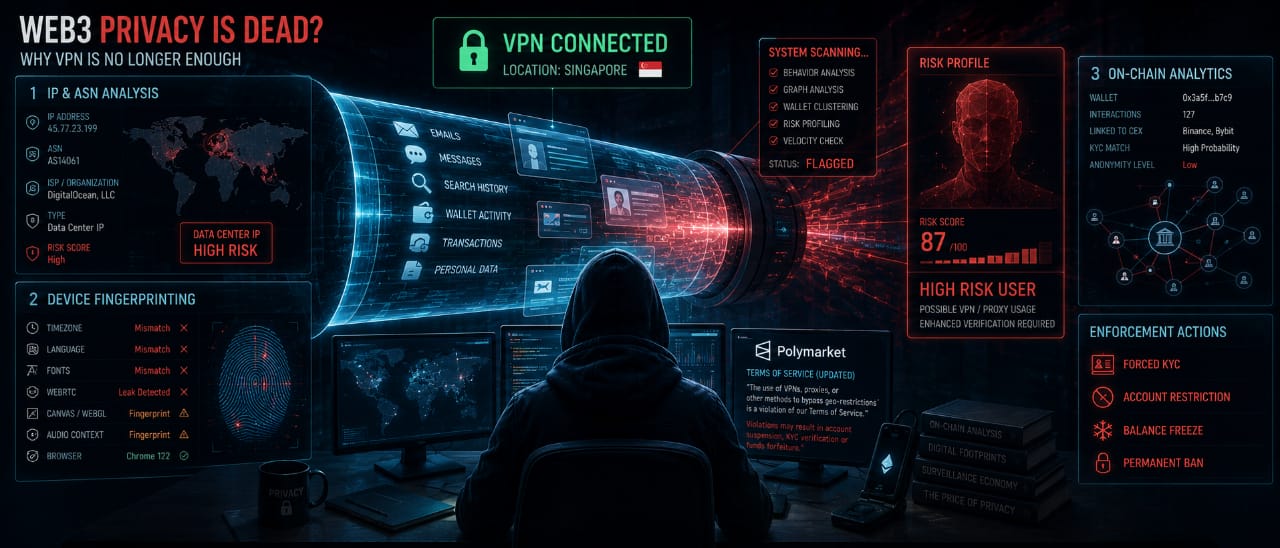
For years, the crypto community lived inside a comfortable illusion: "As long as I have a non-custodial wallet and a VPN switch, regulators can’t touch my perimeter." But recent events have officially dismantled that paradigm. Polymarket—the crown jewel of decentralized prediction markets—facing severe regulatory pressure and facing bans or limits in over 30 countries, has launched a massive infrastructure purge. The platform didn’t just update its Terms of Service; it began a brutal crackdown, deploying advanced automated engines to explicitly block IP addresses tied to commercial VPN services.
The permissionless Web3 ecosystem, which was built as a direct technological manifesto for personal sovereignty, is being actively integrated into the legacy apparatus of financial surveillance.
Let’s dissect the engineering behind this new digital dragnet and examine why a primitive IP swap is a dead strategy against modern anti-fraud systems.
Why the "Country Swap" via VPN Is Obsolete
Average consumers approach anonymity like it’s 2016: click a button, mask your physical location to an unflagged country, and assume the platform takes your connection at face value. But for enterprise-grade scoring engines (like MaxMind, IPinfo, or FraudLab) integrated into Web3 backends, your IP address is just noise.
The network stack deconstructs your digital presence across three independent layers of verification:
1. Autonomous System Number (ASN) Segregation
Every IP address on Earth is bound to a specific Autonomous System Number (ASN). Tracking scripts categorize these blocks into three distinct buckets:
Data Center IPs (Servers hosted by AWS, DigitalOcean, Linode, Hetzner, etc.);
Residential IPs (Real residential ISPs like Comcast, AT&T, Verizon);
Mobile IPs (Cellular carriers).
The overwhelming majority of commercial VPN brands purchase their bandwidth arrays straight from corporate data centers. The millisecond your wallet attempts to initialize a handshake from a Data Center IP, the anti-fraud script flags your session as high-risk. Normal retail users do not place predictive trades or browse social media from a server rack in Frankfurt or Singapore. To the platform’s security gateway, you are instantly flagged as a bot, a sybil node, or an operator evading a geofence.
2. Environment Fingerprinting (The Telemetry Leak)
Even if your VPN tunnel configuration is flawless, your own browser operates as a data informant. JavaScript payloads embedded in the Web3 interface query your hardware within milliseconds, pulling your WebGL configurations, Canvas canvas-hashes, device audio profiles, and system metadata.
This creates an immediate mismatch flag: your secure tunnel routes you out of a node in Iceland, but your browser's WebRTC subroutine bypasses the tunnel entirely, leaking your local ISP-allocated IP address. Simultaneously, your system clock exposes a US Eastern or Pacific time zone, and your browser headers (Accept-Language) reveal localized settings. For an automated compliance algorithm, this structural disharmony is all the evidence required to trigger a forced KYC check or permanently freeze your smart contract access.
3. On-Chain Telemetry and Public Ledger Deflation
The absolute worst mistake a user can make is believing that public blockchains equal anonymity. Blockchains are transparent ledger systems. If the wallet address you are using to interact with a decentralized exchange has ever—directly or through a short chain of hops—interacted with a centralized, KYC-mandated on-ramp (like Coinbase, Kraken, or Bybit), the System has already linked your real-world identity to that cryptographic key. Your VPN is only shielding your current connection lane; it cannot alter the immutable history of the public ledger.
Engineering an Elite Perimeter in the Zero Trust Era
The rules of network evasion have changed. To survive within a heavily regulated crypto economy, your digital footprint must be structurally monolithic and entirely indistinguishable from an ordinary, low-risk local consumer.
Migrate to Residential Proxies: Abandon consumer-grade VPN applications completely when interacting with high-risk gateways. Your routing architecture must utilize dedicated residential proxies—clean IP addresses assigned to physical households by standard domestic ISPs (like Vodafone, Comcast, or Orange) in permissible zones. To the anti-fraud engine, you must look like a local citizen sitting on a residential Wi-Fi network.
Isolate Your Environment via Anti-Detect Frameworks: Never execute sensitive Web3 sessions from your everyday browser. Deploy isolated anti-detect frameworks where you can manually synchronize system time zones to match your residential proxy, completely disable or fake WebRTC interfaces, and randomize Canvas/WebGL fingerprints. Your environment must be mathematically sterile.
Enforce On-Chain Anonymization: Wallets utilized for restricted geofences must be generated in isolated sandboxes, funded exclusively through non-custodial privacy protocols or clean peer-to-peer pipelines, and must never cross-contaminate with personal accounts tied to your legal identity.
The system is building a comprehensive digital panopticon, migrating past simple IP blacklists toward real-time behavioral pattern analysis. True data sovereignty requires looking past marketing buzzwords and building an adaptive, hardened perimeter that leaves no analytical gaps for the machinery of control to exploit.
#CyberSecurity #Web3 #Polymarket #AntiFraud #Fingerprinting #ResidentialProxies #CryptoPrivacy #ZeroTrust #vpn-top-shop