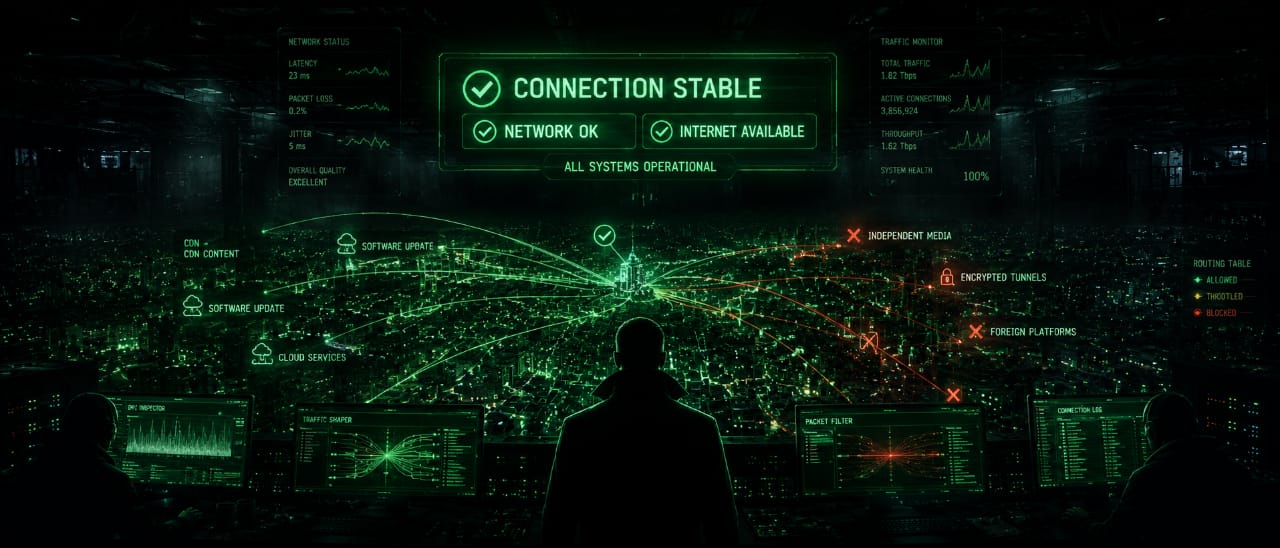
When you wake up and check your network stability, you probably rely on a simple metric: "Is the site loading? Can I reach the server? If yes, everything is fine." But if you look underneath the hood of modern network routing, the reality is far more clinical. The era of aggressive, hard blocks with crude carrier landing pages is over. It has been replaced by an era of silent degradation and algorithmic isolation.
In the United States, major ISPs (Comcast, AT&T, Verizon) don’t need to issue heavy-handed government censorship notices to control the grid. Instead, armed with industrial-scale Deep Packet Inspection (DPI) arrays and commercial traffic shaper systems, they operate like a precision scalpel—quietly altering the physics of packet delivery.
Let’s dissect how covert traffic segregation works in the post-Net Neutrality landscape, and why standard network uptime tests are lying to you.
Stealth Bandwidth Shaping: The Illusion of "Bad Connectivity"
Why completely block a private node or an independent proxy server when you can simply make using it an absolute nightmare? Completely blacklisting an IP block triggers immediate customer complaints and forces tech-savvy users to deploy advanced evasion protocols.
Recent network traffic analysis shows that tier-1 carriers are increasingly relying on artificial latency injection, packet shaping, and deliberate packet drops (loss):
Heuristic Pattern Recognition: Modern DPI systems don't just look at destination IPs; they analyze the mathematical structure of the connection itself. If an ISP's automated traffic-management algorithm flags a heavy, continuous cryptographic handshake characteristic of a standard VPN tunnel or P2P transfer, it doesn't drop the link. It simply throttles that specific pipeline down to a miserable 128 Kbps.
User Fatigue Engineering: To the average user, the VPN isn’t "blocked"—it’s just "lagging" or having an off day. The user blames their router, their local cellular reception, or the VPN provider's server load. Eventually, they give up, disconnect the secure tunnel, and retreat to unencrypted, high-speed, carrier-monitored lanes. Behavioral manipulation achieves the ISP’s goal without a single overt intervention.
TCP Hijacking and Synthetic RST Packets
Another sophisticated vector actively deployed across major commercial networks is the automated Man-in-the-Middle (MitM) session termination. When your device attempts to establish a secure Transport Layer Security (TLS) handshake with a remote private server, the ISP's perimeter gateway interceptor steps in.
Instead of throwing a traditional firewall flag, the carrier's hardware injects a synthetic RST (Reset) or FIN (Finish) packet into the stream, forging the identity of your destination server. Your browser or client app receives this packet and is entirely convinced that the remote server itself terminated the connection due to an internal error or timeout.
Your network logs will show a routine Connection Reset by Peer or a generic network drop, masking the fact that your encrypted tunnel was actively targeted and killed by carrier policy. Legacy, highly visible corporate protocols like OpenVPN and WireGuard are effortlessly dismantled by this method because their handshake architectures are an open book to heuristic DPI filters.
Building an Invisible Architecture
In an environment where carriers simulate infrastructure failure rather than executing hard bans, traditional diagnostics like basic ping or traceroute are functionally useless. Your data security and pipeline engineering must adapt to the mechanics of this silent war.
Deploy Stealth Transports: The only definitive way to pierce an ISP’s shaping barrier is to ensure your encrypted payload looks entirely identical to routine, unflagged web traffic. Next-generation open-source protocols—specifically VLESS utilizing custom Reality obfuscation frameworks—hijack the initial TLS handshake. To a carrier’s DPI filter, your secure tunnel completely mirrors the cryptographic credentials of a major, pre-whitelisted destination (like a Microsoft, Apple, or Google CDN). The shaper assumes you are just loading a standard webpage and leaves your bandwidth untouched.
Mitigate Active Probing Countermeasures: Advanced network clients are now being engineered to spot and reject synthetic RST packets. If an app detects an incoming reset handshake arriving at an anomalous velocity—faster than the physical speed of light allows for a round-trip to the actual remote host—it drops the packet as an ISP injection and maintains the pipeline.
Fringe and Segment Your Traffic: Never rely on a single, linear route for your entire digital operation. Critical business APIs, private clouds, and heavy media streams must be dynamically balanced across distinct, isolated routing tables. Your infrastructure should shift ports and obfuscation signatures automatically the moment an anomalous drop in throughput is detected on a primary line.
The open web is no longer a neutral highway. As carriers continue to segment traffic to optimize monetization and telemetry harvesting, relying on commercial consumer apps is a losing strategy. Absolute data sovereignty requires adaptive, self-hosted stealth infrastructure that anticipates manipulation before it degrades your uptime.
#CyberSecurity #NetNeutrality #TrafficShaping #DPI #VLESS #RealityProtocol #ISPThrottling #NetworkArchitecture #vpn-top-shop