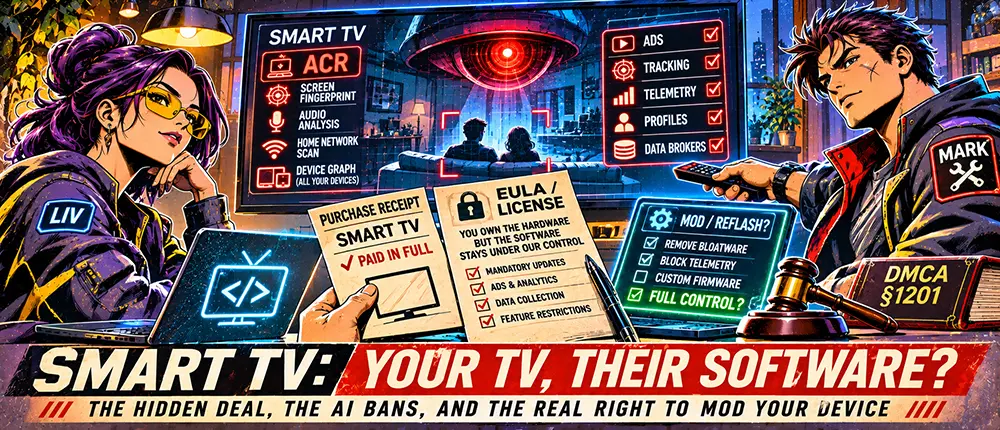
You paid for the screen, but who is actually running the device in your living room? And why has artificial intelligence unexpectedly found itself caught up in a struggle for the right to control your own electronics?
A Buyer Who Wasn't Given the Keys
Imagine buying a car.
You pay for it in full, get the paperwork, and take the keys. But a week later, you discover a strange quirk: the manufacturer forbids you from changing the stereo, tweaking the onboard electronics yourself, or disabling promotional messages on the dashboard.
What is more, the car regularly transmits data about your trips back to the company's servers.
You protest.
And they explain: the car is yours, but the software belongs to us. Don't like it? Don't use it.
Absurd?
Now look at the television in your living room.
You bought the display, the processor, the speakers, and the remote. But the operating system, the ad modules, the app store, and the update mechanisms remained under the manufacturer's control.
They decide which programs you can install, what appears on the home screen, and which features remain available after the next automatic update.
You own the device. But you do not necessarily own the right to fully control its behavior.
And by 2026, this conflict unexpectedly spilled far beyond the television market.
October 2026: Artificial Intelligence vs. the TV Owner
In late October, a story shared by a researcher using the handle @log4j swept across the internet.
They were examining the software on their own Samsung Smart TV, trying to figure out how its advertising telemetry and user tracking mechanisms worked.
Artificial intelligence tools were used to assist with the analysis.
On October 23, the researcher reported that their OpenAI account had been suspended for violating the Cyber Abuse category.
According to them, they were performing a local examination of a device they legally owned, rather than attacking external infrastructure.
There is currently no independent verification of all the circumstances surrounding the ban. But the story generated enough noise to spark a public discussion.
At the same time, complaints began to surface from users of Anthropic's Claude. Some reported that the AI refused to help them remove unwanted apps, gain elevated access to TVs, or analyze firmware.
Developers naturally started asking a very logical question.
If a person is studying a device they bought with their own money, why are their actions automatically treated as a potential cyberattack?
However, an important detail emerged.
On October 26, an OpenAI representative stated publicly that there is no blanket ban on reverse engineering using Codex, and that some of the refusals were due to errors in distinguishing between permissible and prohibited actions.
That shifts the picture considerably.
This isn't about a proven conspiracy between TV manufacturers and AI developers. It points to a much more complex issue: automated defensive mechanisms aren't always capable of distinguishing between someone examining their own hardware and someone attempting to breach an external system.
And when an algorithm makes the call, a conscientious researcher can find it remarkably difficult to prove the difference.
Why TVs Got So Cheap
Historically, manufacturers made their money primarily from selling the hardware itself.
Sell a TV, pocket the profit. Once that happened, the commercial relationship was basically over.
Today's Smart TV can continue generating revenue long after the sale.
Ads on the home screen, app promotions, paid subscriptions, partner integrations, and viewing analytics have turned a television's operating system into an independent commercial asset.
And that is not just theory.
In 2024, Walmart finalized its acquisition of TV manufacturer Vizio for roughly $2.3 billion.
The real prize wasn't just building TVs; it was Vizio's advertising and software platform.
According to published figures, the Platform Plus division—tied to advertising and software services—accounted for all of Vizio's gross profit at the time of the deal.
It makes for a fascinating business model.
A company sells a consumer a physical device, and then continues to profit off their ongoing interactions with that software platform.
This doesn't mean every manufacturer sells TVs at a loss or that every single unit is subsidized by ads.
But the financial incentive is obvious.
The longer a user stays inside a managed ecosystem, the more opportunities there are for downstream monetization.
And that creates a conflict of interest.
The buyer wants a fast screen devoid of intrusive ads.
The manufacturer may find it far more profitable to provide a screen that routinely displays ads and maintains active connections to commercial services.
Both sides paid for very different expectations. Only one of them retained control over the firmware.
ACR: When the Screen Watches Back
In previous breakdowns of Smart TVs, we’ve run into Automatic Content Recognition, or ACR for short.
Its job is to figure out what content is playing on the screen by generating digital fingerprints of the image or audio.
That data can be used for audience measurement, personalized recommendations, and ad analytics.
Back in 2017, the US Federal Trade Commission took action against Vizio for collecting viewing history from roughly 11 million televisions without obtaining proper user consent.
The company agreed to a $2.2 million settlement with the FTC and the New Jersey authorities.
That is a matter of public record.
Even so, technical accuracy is essential here.
ACR does not automatically mean that every television is constantly recording conversations in the room or scanning every connected device on your home network.
Content recognition features, voice control, network discovery, and ad telemetry can all function independently.
Furthermore, testing of Samsung and LG sets published in 2024 showed that turning off ACR via the privacy settings on the tested models successfully halted that specific network traffic.
Consequently, the claim that privacy settings are always completely useless is also incorrect.
Yet the mere existence of such mechanisms gives pause.
A consumer buys a television to watch movies.
Meanwhile, the manufacturer builds in the technical capability to analyze precisely what that person is watching.
The issue goes beyond simple consent anymore.
The core question is why a user should have to fight for the right to keep their own living room from turning into an advertising analytics feed.
Reverse Engineering: Repair or Crime?
Let's say you decide to clean unnecessary apps off your television.
You aren't trying to watch pirated movies. You aren't stealing anyone's subscriptions. You aren't attacking the manufacturer's servers.
You simply want to disable ad services, replace the home screen, and keep only the features you actually need.
On certain Android TV and Google TV units, that's entirely possible using built-in developer tools like Android Debug Bridge (ADB).
By October 2026, projects designed to streamline Smart TV interfaces, strip out bloated pre-installed apps, and restore a familiar workspace gained considerable traction.
Some of these tweaks don't even require root access and can easily be undone.
Modifying the firmware, however, is a completely different ballgame.
It can impact the bootloader, system partitions, signature verification routines, and digital rights management (DRM).
This is where a fundamental legal distinction comes into play.
Owning a physical device does not automatically mean owning the copyright to the software installed on it.
In the United States, Section 1201 of the Digital Millennium Copyright Act (DMCA) governs the circumvention of technical protection measures applied to copyrighted works.
While the law carves out specific exemptions—including limited provisions for lawful repair and research—it does not offer a universal pass to bypass any security on any device.
Therefore, we need to separate three distinct scenarios:
- An owner disables an unwanted application or modifies settings on their own device.
- A researcher analyzes firmware for compatibility, security, or repair purposes.
- Someone bypasses paywall protections, distributes stolen code, or gains unauthorized access to a third-party system.
Technically speaking, these actions can sometimes look very similar under the hood.
Legally and in terms of their real-world impact, they can be worlds apart.
This precise nuance is where automated AI filters stumble.
They flag the word "hack," but they don't always grasp who owns the hardware or what the actual intent of the research is.
What Does This Have to Do with Video Games?
The connection is direct.
Modern neural networks have dramatically simplified the process of analyzing source code, inspecting binaries, debugging errors, and spinning up new applications.
Tasks that once took weeks can now, in some instances, be completed in days.
That has opened up incredible avenues for independent developers.
At the same time, it has supercharged attempts to quickly clone existing commercial software and video games.
In late October and early November 2026, Anthropic tightened Claude Code's restrictions against reproducing specific existing video games while still allowing users to build original projects.
Creators have a legitimate stake here.
An indie developer shouldn't have to worry about someone spinning up an AI clone of their game and beating them to market with an almost identical product.
Yet it introduces a reverse risk.
If restrictions are drawn too broadly, they can end up stifling original game development, compatibility testing, hardware repairs, and legitimate security research.
We find ourselves facing a new paradox.
AI makes technical skills more accessible, while centralized AI services simultaneously gain the power to dictate what types of research users are allowed to carry out with them.
And that transcends copyright law.
It touches on an engineer's growing dependence on someone else's computational platform.
How to Take Back Control of Your Screen
Flashing a custom ROM is rarely the best starting point.
A botched modification can brick the television, break app functionality, strip away security updates, or kill support for specific features.
It's always best to start with lower-risk steps.
Level One: Settings. Review data collection permissions, ACR, personalized ads, and voice capabilities. Turn off anything you don't use.
Level Two: Network. Isolate the television on a separate guest or IoT network, keeping it walled off from your personal computers and network storage. Use DNS filtering where appropriate, keeping in mind that it won't block every vector of telemetry.
Level Three: Independent Sources. Treat the TV strictly as a display for a computer, game console, or external streaming box. If you don't need its built-in smart features, simply disconnect the TV from the internet entirely.
Level Four: Software Modification. Explore options tailored specifically to your exact model, making sure to weigh the risks and verify rollback paths beforehand.
Not every owner needs root access.
Sometimes, reclaiming your privacy is as simple as refusing to plug the TV into the web.
And that, too, is a form of control.
The Last Frontier of Ownership
The most fascinating aspect of this whole debate isn't technical.
It's philosophical.
When you buy a hammer, the manufacturer doesn't require you to register an account before letting you drive a nail.
When you buy an electric kettle, it doesn't force you to watch an ad about water before it turns on.
Yet as everyday appliances morph into full-fledged computers, our traditional understanding of ownership is shifting beneath our feet.
You acquire a physical object, but a substantial chunk of its functionality relies entirely on licenses, servers, updates, and executive decisions made by the company that built it.
Manufacturers have valid reasons to safeguard device security, protect their copyrights, and maintain the integrity of their platforms.
Consumers have valid interests of their own: repairing their property, regulating the transmission of their personal data, and enjoying the software features they've already paid for.
Those interests don't have to be locked in a state of perpetual warfare.
A healthy tech ecosystem ought to let people use hardware without feeling like they have to fight it.
At the end of the day, a television was built to display pictures.
Not to force its owner into a protracted legal battle with its own software just to turn off the ads.
A purchase should grant a person genuine control over their property. Otherwise, we'll one day wake up to find that everything around us only belongs to us until the next firmware update drops.
Author: Zhora.
Engineering and analytical commentary. Details regarding specific AI account suspensions are based on public user reports and journalistic coverage; the exact circumstances of these incidents have not been independently verified in every detail.