Imagine this: you downloaded a program from an official repository. Verified the digital signature. Installed the update. And with your own hands, executed malicious code on your server.
This is not a sci-fi scenario. This is the exact danger demonstrated by the attack on LiteLLM in October 2026.
In our previous investigation, "Passwordless Linux, AI Gateways Under Threat: Which Servers Are Truly Secure?", we looked at operating system and AI gateway vulnerabilities.
Now, something even more interesting has come to light: sometimes an attacker doesn't need to break into your server at all. It is enough to trick it into accepting a tainted update as genuine.
It All Started with One Forgotten Key
On May 27, 2026, an administrative key for an internal system was accidentally leaked into the public GitHub repository of the LiteLLM developers.
The mistake was noticed quickly. The file was deleted in about three hours.
But the key itself was never revoked.
And a copy of it remained stored in the GitHub history.
More than four months passed.
On October 10, an attacker used the forgotten key to gain access to the experimental LiteLLM AI agent platform.
There, they found another gift: a GitHub token with organization owner permissions.
A single forgotten secret opened the door to an entire development infrastructure.
How the Official Release Was Tampered With
Having gained access to GitHub, the attacker altered the software build process.
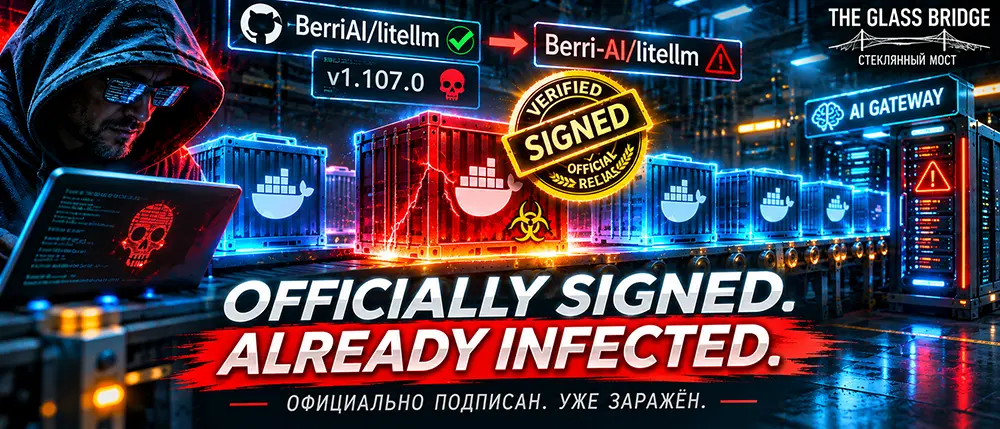
Normally, the system was supposed to build LiteLLM from the real BerriAI/litellm repository.
Instead, the attacker set up a lookalike address: Berri-AI/litellm.
The difference is barely noticeable.
They then changed the build settings so that their own custom source code would be used instead of the genuine one.
The release required approval. The attacker used stolen credentials from several developers.
On October 21, the compromised version of LiteLLM 1.107.0 appeared in the official PyPI and Docker distribution channels.
The most unsettling part: the compromised Docker images carried valid signatures generated by the project's previous key.
The signature confirmed that the image had passed through a trusted release mechanism. But that mechanism was already under the attacker's control.
What Happened After Installation?
Contained within the malicious Python package were specialized files that executed malicious code during standard Python initialization.
The application didn't even need to directly interact with LiteLLM.
Simply launching Python within the affected environment was enough.
The malware harvested any secrets it could reach: neural network API keys, cloud credentials, SSH keys, environment variables, and configuration data.
For an AI gateway, this poses an exceptional risk.
Because requests to multiple model providers route through it, a vast array of high-value keys are concentrated in a single system.
The malicious releases were removed the same day. However, removing a tainted package cannot un-steal secrets that have already been exfiltrated.
Why Didn't the Digital Signature Save the Day?
This reveals the core lesson.
A digital signature answers the question: "Who signed this file?"
But it does not always answer another: "Was the file creation process itself secure?"
If an attacker hijacks the build system or the signing key, a outwardly valid signature can end up attached to a malicious product.
Following the incident, LiteLLM replaced its cosign container signing key and began issuing images signed with a new key.
This meant administrators not only had to update the software, but also re-evaluate which signatures they chose to trust.
November Brought Another Disturbing Story
On November 2, details emerged regarding CVE-2026-105769, a critical vulnerability in the kaniko container build tool.
Under specific conditions, a specially crafted container registry address could force a vulnerable version of kaniko to leak an Azure cloud token to an attacker's server.
All it took was a reference to an external image inside a Dockerfile. There was no need to execute a malicious command inside the container being built.
The flaw affects kaniko versions up to 1.25.20 when an active Azure identity and matching build conditions are present.
While this is a separate issue and not a proven part of the LiteLLM attack vector,
both incidents highlight a shared problem: the infrastructure that builds and delivers software is itself becoming the primary target.
What Should a Server Owner Do?
Security checks must extend beyond Linux hardening and open ports.
- Do not store long-lived administrative keys in repositories. If a secret is exposed, it must be revoked—not just deleted from the file.
- Restrict the permissions of GitHub tokens and automated build systems.
- Pin dependency versions and container digests. Do not rely solely on the
latesttag. - Verify the origin of the build, not just the presence of a digital signature.
- Do not grant build containers access to all cloud secrets.
- Following a confirmed compromise, rebuild the environment from a trusted source and rotate any potentially exposed keys.
For VPN servers, this is particularly critical: stolen keys and configurations can turn a secure tunnel into a liability.
For AI services, the fallout can instantly impact multiple external platforms.
Who Actually Controls Your Server?
You can install the latest version of Linux. Configure a firewall, two-factor authentication, and DDoS protection.
Yet if the system automatically accepts a malicious update, the attacker won't need to break through those defenses the hard way.
They will simply walk through the door that the administrator left wide open for trusted software.
True security begins not with asking where your server is hosted, but with asking whom and what that server trusts.
The October attack on LiteLLM demonstrated this with unmistakable clarity.
Glass Bridge | November 6, 2026
Sources:
- LiteLLM, The attack chain behind the v1.107.0 LiteLLM release, 23.10.2026: https://docs.litellm.ai/blog/security-incident-oct-21-2026-attack-chain
- LiteLLM, Contained: Oct 21, 2026 LiteLLM release v1.107.0 Compromised: https://docs.litellm.ai/blog/security-incident-oct-21-2026
- Microsoft Security Research, Inside the LiteLLM 1.107.0 supply chain compromise, 23.10.2026: https://www.microsoft.com/en-us/security/blog/2026/10/23/inside-the-litellm-1-107-0-supply-chain-compromise-credential-theft-through-python-startup-hooks/
- GitHub Security Advisory, CVE-2026-105769: https://github.com/advisories/GHSA-5q7h-w9jf-cx97