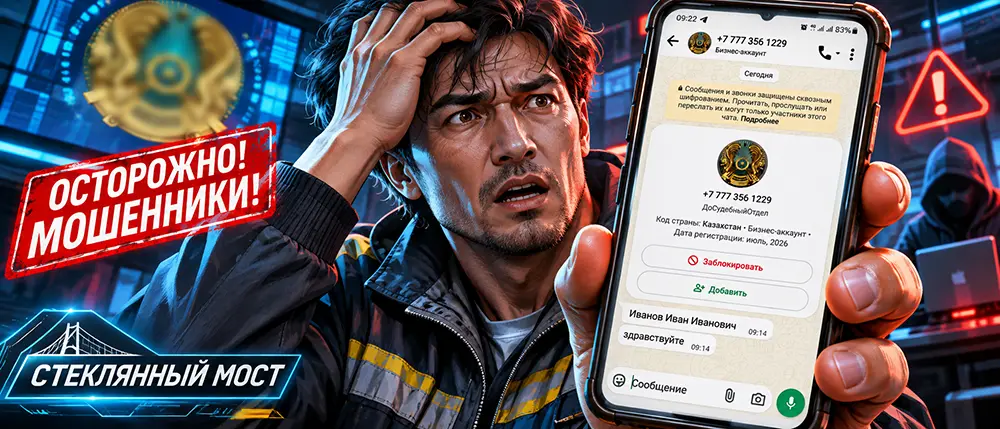
A state coat of arms as a profile picture, an intimidating name, and your full name. Sometimes, a psychological attack requires neither threats nor demands for money. Two messages are enough.
One morning, a resident of Kazakhstan received a message on WhatsApp.
The sender used a business account named "ДоСудебныйОтдел" (PreTrialDepartment). The profile picture featured an image resembling the State Emblem of the Republic of Kazakhstan.
The first message contained the recipient's full name (surname, first name, and patronymic).
The second consisted of a single word:
"Здравствуйте" (Hello).
And that was it.
No explanations. No introductions. No name of an institution or company.
This is exactly what an attempt at psychological pressure looks like, where the recipient's own fear is meant to do the heavy lifting.
First anomaly: "PreTrialDepartment"
Look closely at the name.
Not "Pre-trial department," but "PreTrialDepartment." The words are fused together, with each part capitalized.
This formatting resembles the name of an online store or a randomly created account, but by no means the official title of a government division.
However, the main issue isn't even the grammar.
Pre-trial department of what?
The police? A bank? A microfinance organization? A collection agency? A law firm?
Pre-trial dispute resolution is a stage of resolving a dispute, not an independent government agency with a universal name like "Pre-trial department."
A real organization has a legal name, authority, employees, and grounds for contacting you.
None of this is indicated here.
Second anomaly: A state symbol instead of an ID
The profile picture is designed to be associated with state authority.
It is this detail that makes the message particularly alarming for an unprepared person.
The recipient sees the symbols of Kazakhstan, followed by the word "judicial/court" and their own full name. The brain automatically tries to connect these elements into a single picture: perhaps a government agency, a court case, a debt, or some kind of legal proceeding.
However, the image of the coat of arms does not verify the sender's authority.
The rules for using state symbols in Kazakhstan are regulated by law. Illegal use of state symbols incurs administrative liability, specifically under Article 458 of the Administrative Code of the Republic of Kazakhstan (CoAP RK).
The legality of a specific use of the image is determined by competent authorities. Nevertheless, hiding behind state symbols to create a false impression of official status is a serious reason for investigation.
Third anomaly: The sender knows your full name, but hides their own
This is where the actual psychology begins.
An unknown person demonstrates that they know who they are writing to.
Yet they reveal absolutely nothing about themselves.
No name, no title, no organization, and no reason for contact.
It creates a one-sided situation: "I know who you are. As for who I am — guess for yourself."
For someone who has never encountered such tactics, this can become a powerful emotional trigger.
They start recalling loans, fines, taxes, old contracts, and possible legal disputes.
And they might write back first:
"What happened?"
"What court?"
"Who are you?"
This exact response is what the attacker is after.
It confirms that the contact is active, the person has read the message, and is ready to engage in conversation. From there, they can move to the next stage: fabricated debt, threats of blocked accounts, demands for documents, or payment for nonexistent obligations.
This is a likely social engineering scenario, rather than proof that a specific sender was already about to demand money.
How do unknown individuals know your data?
Today, having a full name and phone number is not proof of access to government systems.
Sources can vary: public information about entrepreneurs and companies, old listings, client databases, and personal data leaks.
A phone number, in particular, often remains linked to business activities for years.
However, it is impossible to determine precisely where a specific sender obtained the data from a single screenshot.
This is precisely why you should not take the knowledge of your name as confirmation of authority.
What if these are actually debt collectors?
In Kazakhstan, the activities of collection agencies are regulated by a separate law.
Article 5 of the Law of the Republic of Kazakhstan "On Collection Activities" requires that interactions with a debtor include disclosing information about the agency, its location, the employee, and the creditor.
Therefore, a mysterious business account lacking any organization or representative details does not meet the standard of transparency one should expect from an official debt collector.
Even the existence of a real debt does not give an unknown person the right to impersonate a government body.
What happened in our case?
The recipient did not reply.
They saved the chat history, waited until evening, and blocked the contact.
The sender received no identity confirmation whatsoever.
This is a sensible strategy when a message contains no verifiable details and raises reasonable suspicions.
Of course, the absence of subsequent messages does not in itself prove fraud. But a person is under no obligation to start a conversation with an unknown account just to figure out its intentions.
How to act if you receive such a message
- Do not confirm your full name, IIN (Individual Identification Number), address, workplace, or other personal data.
- Do not click on links and do not send documents, SMS verification codes, or money.
- Save screenshots containing the account name, phone number, profile picture, and chat history.
- If there are signs of illegal use of state symbols or an attempted scam, file a report with the police.
- Block the suspicious contact and report them via WhatsApp.
- If you doubt whether a genuine claim exists, verify it yourself through the official channels of the respective organization, rather than using the contact info from a suspicious message.
Main takeaway
Modern social engineering does not always begin with threats.
Sometimes an attacker simply sets up the stage dressing of state authority and waits for the person to scare themselves.
State symbols, an intimidating title, and knowledge of your name do not automatically make a sender a public official.
Real authority is confirmed by documents and verifiable facts, not a WhatsApp profile picture.
And if an unknown "pre-trial department" cannot even explain which organization it belongs to, that is no reason to panic.
It is a reason to ask yourself the main question: why is someone demanding your attention while so thoroughly concealing their own identity?
Sources:
- Constitutional Law of the RK "On State Symbols of the Republic of Kazakhstan."
- Administrative Code of the RK (CoAP RK), Article 458 "Violation of the procedure for using state symbols."
- Law of the RK "On Collection Activities," Article 5.
- Agency of the RK for Regulation and Development of the Financial Market: clarifications on interaction with debt collectors.
Illustration: Actual WhatsApp screenshot. The recipient's full name has been altered by the editorial team. The authenticity of the sender's authority has not been established.