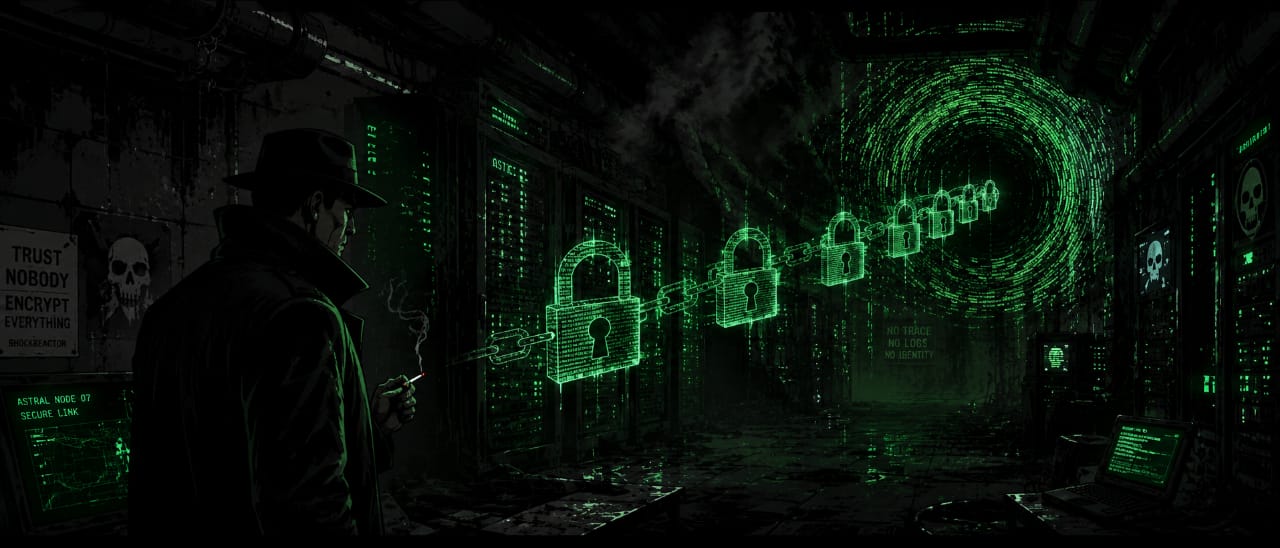
Let’s be entirely honest with ourselves: the standard commercial VPN model—the one where you download an app, click a big green "Connect" button, and trust a third-party corporate server—is reaching its technological expiration date.
Major ISPs, telecommunication giants, and institutional network monitors are no longer just looking at where your traffic goes; they are analyzing how it leaves your house. Through advanced Deep Packet Inspection (DPI) and heuristic traffic analysis, network operators can instantly flag the distinct footprint of standard encrypted tunnels. To a modern automated security dragnet, a direct commercial VPN connection looks like a massive, glowing anomaly on the grid.
To achieve actual, ironclad privacy in 2026, you have to change the geometry of your connection. That is why the dev community is moving toward XRAY-based Multi-Hop (Multi-Chain) network architecture.
Here is why your data pipeline needs multiple layers, and how new automated scripts are making enterprise-grade stealth routing accessible to everyone.
The Architecture of a Multi-Hop Chain
In a standard VPN configuration, your data path is entirely linear: Your Device -> Commercial VPN Server -> Target Website. It is a single bridge, and if your ISP decides to throttle or log encrypted handshakes going to known data centers, your perimeter is compromised.
Multi-Hop architecture systematically tears down this linear footprint by breaking your connection into decentralized, isolated transit segments:
The Local Stealth Node (In-Country Entry): Your device establishes its initial tunnel to a low-cost, clean virtual private server (VPS) hosted within your own region or country. Because this node is completely private and independent, it doesn’t belong to a known commercial VPN IP block. To your local broadband carrier or mobile provider, you are simply pushing standard, unflagged traffic to a routine domestic cloud instance. The DPI firewall stays quiet.
The Sovereign Relay (Out-Country Exit): Once your traffic reaches your internal entry node, the core engine processes the data and instantly relays it down a secondary, encrypted chain to an outbound server in a completely different jurisdiction (e.g., Iceland, Switzerland, or the Netherlands).
The Final Footprint: The destination website only sees the clean IP of the foreign exit node. Meanwhile, your local ISP is entirely convinced you never left the domestic cloud network. The direct link between your physical location and your global traffic is permanently severed.
Breaking the Complexity Barrier: Automated Bash Chains
Until recently, setting up a secure Multi-Hop relay using advanced routing cores like XRAY was an administrative nightmare. It required hours of manual configuration, writing complex, multi-layered JSON scripts, and precision-tuning inbound and outbound routing tables across different Linux environments. One misplaced syntax bracket, and the entire chain collapsed.
The recent open-source release of automated deployment tools—such as the streamlined XRAY-multichain Bash script framework—has completely eliminated that technical barrier. The scripts autonomously handle the handshake protocols, bridge the gateways between your nodes, and output simple, ready-to-use configuration keys for cross-platform, open-source clients like AmneziaVPN.
The only strict technical requirement for a solid multi-chain setup is latency management. Your entry node and your exit relay must have a low-ping interconnection and matching bandwidth limits; otherwise, your data packets will bottleneck at the transition point.
The Reality of Modern Data Sovereignty
As corporate networks tighten their telemetry algorithms and ISPs become more aggressive with deep-packet logging, traditional "black-box" VPN apps are no longer enough to protect your digital footprint. True anonymity requires strategic misdirection.
Moving your network security to a decentralized, multi-hop configuration—where your traffic actively mimics routine, day-to-day cloud operations—is the only definitive way to maintain absolute control over your digital boundaries. The future of privacy belongs to those who build their own infrastructure, own their own routing tables, and master the art of blending into the background noise of the global network.
#CyberSecurity #DataPrivacy #XrayCore #VLESS #MultiHop #StealthRouting #Networking #AmneziaVPN #vpn-top-shop