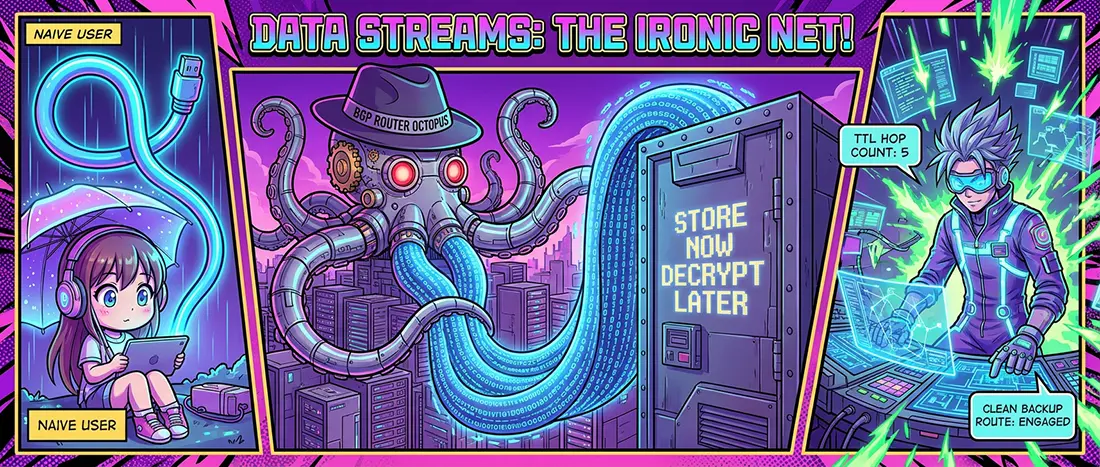
When discussions turn to censorship and data leaks, most specialists focus on the application layer: debating obfuscation algorithms, analyzing TLS fingerprints, or optimizing DNS settings. However, recent incidents clearly demonstrate that control and traffic interception operations are increasingly shifting to the foundational level of global addressing—the Border Gateway Protocol (BGP).
Even while user devices display active tunnel icons, the physical route of packets can change drastically without a single warning in the operating system.
1. The Architecture of "Silent Interception": BGP Hijacking and Route Leaks in New Realities
Classical BGP was built on the principles of absolute mutual trust between Autonomous Systems (ASNs). If one operator announces a more specific prefix (e.g., /24 instead of /22), the global network automatically routes data streams along this path as the most accurate one.
In scenarios involving mandatory filtering and targeted data collection, this mechanics turns into a covert interception loop:
- Prefix Manipulation. Under the guise of "fault localization" or maintenance, a regional transit node announces a foreign or narrower route to overseas cloud subnets.
- Traceroute Loop. Packets addressed to an independent gateway or foreign server suddenly make a detour through a controlled state or departmental inspection node.
- Passive Dump Before Filtering. If the goal is not to block but to gather telemetry, the transit node simply copies the entire encrypted stream to an archive (Store Now, Decrypt Later) and returns the packets to their original route with a minimal artificial delay of 15–20 ms.
To the subscriber, the connection looks completely functional, but its encrypted trace has already settled on intermediate storage units.
2. Why Cryptographic Route Signatures (RPKI) Do Not Protect Against Leaks
The industry is trying to combat route interception by implementing RPKI (Resource Public Key Infrastructure) and Route Origin Authorization (ROA).
However, in practice, this protection fails significantly:
- Ignoring Validation Policies. Far from all Tier-1 and Tier-2 transit operators strictly drop invalid announcements (Invalid RPKI). In pursuit of connectivity, many providers prefer to accept a "doubtful" route rather than lose access to an entire network segment.
- Attacks Within a Valid ASN (AS-Path Poisoning / Leaks). If an operator is themselves a trusted node with a valid certificate, they can execute an unintended (or regulator-sanctioned) route leak, passing traffic through themselves that should have gone through independent external cables. RPKI only verifies the author of the announcement and is powerless against the control of the entire transit chain.
3. Signs of Routing Distortion: What Gives Away Interception
Unlike classical shaping, where latency jumps chaotically up to hundreds of milliseconds, route interception leaves specific traces:
- Sharp Changes in the Number of Transit Nodes (TTL/Hop Count). If the traceroute to your dedicated server consistently numbered 9 hops yesterday and today it is 14 with the same destination IP, the route has been forcibly redirected.
- Changes in Intermediate Autonomous Systems. The appearance of edge routers in the middle of the route with unfamiliar monopoly-operator ASNs is a surefire sign that traffic has taken an artificial trajectory.
- Anomalous Ping Symmetry During Bandwidth Drops. The channel may maintain a relatively flat response time, but actual transfer speeds drop due to the hardware buffers of intermediate mirroring systems.
4. Building a Resilient Perimeter: Minimizing the Risk of BGP Manipulation
Protection against infrastructure distortions requires going beyond standard client applications:
- Continuous Audit of Routing Metrics (Traceroute & ASN Monitoring).
- It is necessary to automate regular checks of the full path to the egress node. Any change in the composition of intermediate routers or a jump in the TTL value must generate an instant warning for the administrator.
- Multi-Path Routing (Multi-Path / Multi-Homing).
- A critical perimeter must not depend on a single point of exit or a single pool of IP addresses. Using multiple independent cloud nodes in geographically and politically isolated jurisdictions allows you to instantly switch the main data stream at the first sign of transit anomalies.
- Strict End-to-End Encryption at the Network Stack Level.
- If intercepting the physical stream cannot be prevented, the resilience of the payload must neutralize the risks of long-term data storage. Abandoning outdated algorithms and regularly rotating session keys (Perfect Forward Secrecy) ensure that even a copied traffic archive on a transit node remains a useless set of bytes.
Network security in modern conditions cannot be limited to trusting the green indicators of a secure connection. When the very logic of global routing comes under attack, the only guarantee of independence becomes continuous control of network topology from the home cable to the remote infrastructure core.