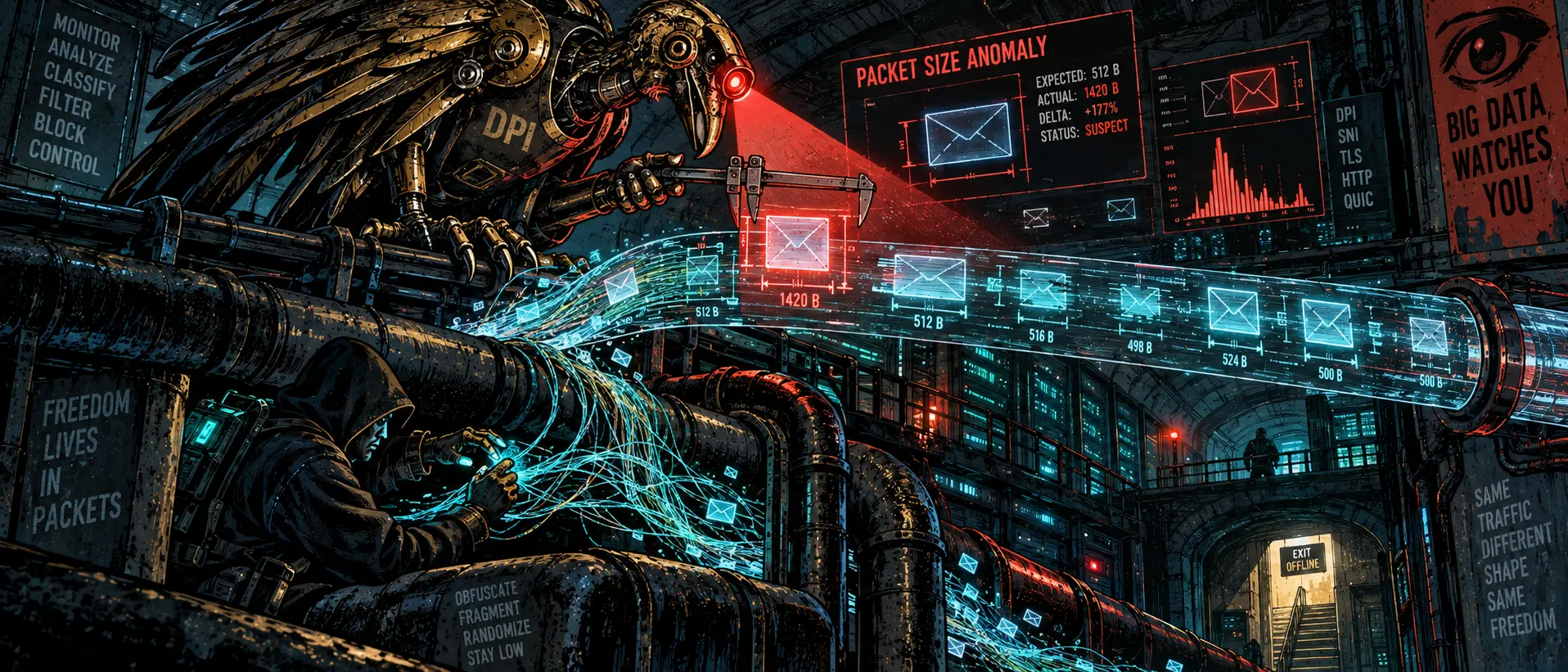
Yesterday we were laughing at the farce of database leaks and laughable fines for retailers. Today we return to engineering hardcore, as our schedule dictates. Let's talk about what network engineers and those who run their own nodes are currently discussing in specialized private chats: behavioral traffic analysis (Traffic Fingerprinting), which TSPU systems have begun actively testing on backbone networks.
For a long time, it was believed that the VLESS protocol with the Reality extension was absolute armor. Indeed: there is no protocol signature, the handshake is masked as a legitimate TLS certificate of a white-listed site (such as a major CDN or search engine), and it is impossible to decrypt the traffic "on the fly."
However, regulators have taken the path that experts warned about a year ago: if you cannot read the text of a letter, you can measure its weight, sending frequency, and the thickness of the envelope.
The Anatomy of a Heuristic Dead End: Why Reality Falls Under Fire
Modern DPI no longer tries to crack AES or ChaCha20 encryption. It works like a meticulous customs officer who compares the data stream's behavior with the reference profile of the host you are impersonating:
Packet Length Distribution Anomaly. You specified a major bank or cloud storage site as your disguise. But a real bank user visits the page, downloads a batch of 15–50 KB images, 120 KB scripts, and takes pauses. Meanwhile, your tunnel pushes a continuous stream of packets at maximum MTU size (around 1400–1500 bytes) because you are watching 4K video or downloading an archive. The algorithm sees a mismatch: the domain is banking, but the traffic profile is torrent streaming.
ACK/RTT Analysis (Timing Confirmations). The cover server (Dest Host) is physically located, for instance, in Frankfurt or Amsterdam. When a client performs a TLS handshake, the response time must match the actual geography. If your VPS is rented in Helsinki while you are masking as a Singapore domain, the RTT (Round Trip Time) difference gives away the proxying during the analysis of the first ten packets.
Lack of Background Noise. An ordinary person's browser constantly maintains dozens of parallel connections: sending telemetry, querying APIs, fetching fonts. The tunnel spins up a single monolithic session carrying a monotonous, high-entropy stream. This is a statistical anomaly that automatically receives an elevated suspicion index.
Why the Classic Setup from YouTube Tutorials is Starting to Fail
Most users set up their servers using standard manuals: they took the first random top domain they found, plugged it into the control panel, and forgot about it.
The result:
The "Neighbor Tag" Effect. If clients with a volume of traffic uncharacteristic for a popular white-listed domain start swarming it en masse, the TSPU temporarily places the "client IP – server IP" pair in quarantine for 30–60 minutes.
Multiplexing Paralysis (Mux). Enabling aggressive multiplexing without proper configuration combines all traffic into a single thick pipeline, which only simplifies the work of traffic classification algorithms on TSPU.
TCP RST Session Nullification. As soon as the anomaly counter exceeds a threshold, the filtering complex quietly tears the connection, forcing the client into an endless reconnect loop.
The Engineering Counter-Strike: How to Configure a Node to Fool Statistics
To keep your tunnel from standing out against hundreds of gigabytes of ordinary web browsing, basic Reality settings are no longer sufficient. You have to work with the shape of the stream itself:
Implementing Dynamic Padding (Padding / Jitter). Packets must not travel at a fixed length. Using extensions that add a random amount of garbage bytes to each data packet breaks the DPI statistical matrices. Traffic becomes uneven and "dirty," which prevents the classifier neural networks from determining its true type.
Ideal SNI Selection by Geography and Stack. The masking domain must be physically hosted in the same data center (or on the same Autonomous System ASN) where your VPS is located. The response time to the masking server and your node must match down to the millisecond. In addition, the cover server must support HTTP/2 and TLS 1.3 with an identical set of cipher suites.
Client Hello Fragmentation (TCP Fragment). Artificially splitting the initial Client Hello packet into micro-segments forces the TSPU either to reassemble the packet in a buffer (which creates a colossal load on operator hardware at gigabit speeds) or let it pass without deep inspection.
The block wars have finally shifted from the plane of "blacklisted addresses" to a war of machine learning algorithms against mathematical masking. And to stay connected, server administrators have to learn to think not just like sysadmins, but like network signature analysis specialists.
Keywords (SEO): vless reality blocks tsup, how tsup detects vless, behavioral traffic analysis dpi, padding vless configuration, client hello fragmentation, why vless reality lags, bypassing protocol blocks 2026