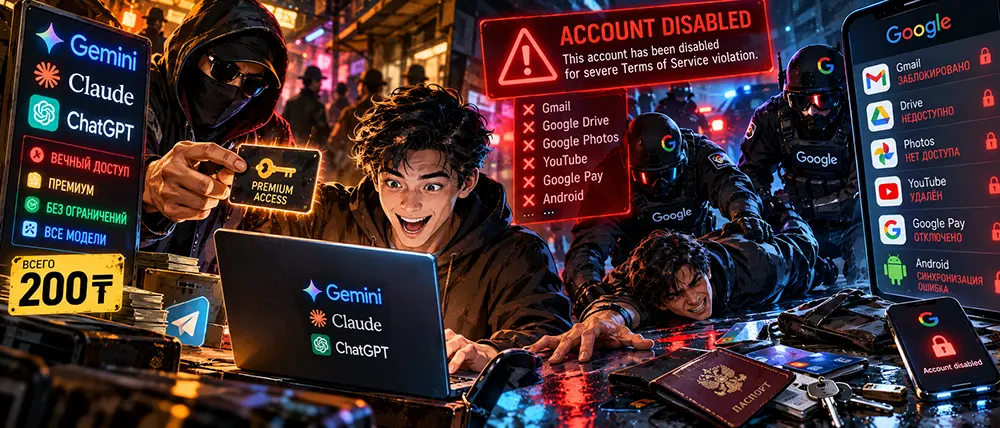
Imagine a bustling bazaar. A sketchy character in a cap walks up to you, pulls out a ring of keys, and whispers: "Hey brother, look: the key to the presidential suite in a five-star hotel. For just a couple of coins. Go live it up, use the jacuzzi and the minibar."
You hand over pocket change, happily head up to the top floor, slide the key into the lock, fling the door open, and find twenty total strangers with dirty duffel bags already sitting inside. And right at that second, heavy SWAT units with dogs block the corridor. They slam your face to the floor, snap handcuffs on your wrists, and confiscate everything in your pockets: your passport, driver's license, the keys to your own apartment, and your bank cards. Because the suite belonged to a criminal syndicate, and you willingly stepped inside the perimeter of a raid.
Roughly this exact scenario is playing out right now for millions of users who buy "lifetime access" to advanced Gemini or Claude models in Telegram bots for pennies. People genuinely think they've found a clever loophole and outsmarted a trillion-dollar corporation.
In reality, they are buying a digital execution order for their primary account.
Stop right here. If you think Google can be outsmarted for fifty cents, and that backup codes are only for paranoids, you might as well close this tab and head right back to Telegram. Go on downloading scripts from anonymous channels.
But if your Google account is over five years old, and tied to your banking statements, your work drive, your YouTube channel, and the 2FA for your crypto exchange accounts—open your eyes. Next, we are going to strip away the gloss and show you how anti-fraud systems detect these schemes and why account death is irreversible.
The Mechanics of the Scam: What They're Selling You as a "Token"
There are no legal personal licenses for a couple of hundred tenge anywhere in nature. Operators in underground channels rely on two primitive yet lethal schemes for the end user.
- Multi-session Hijacking (Pass-the-Cookie).
- The organizers register a farm of profiles in regions with local promo campaigns (such as Indian educational grants or student promo codes valid for a year and a half). Then, master cookies (
__Secure-1PSID,SAPISID) and Bearer session tokens are extracted from the browser. This array of data is packaged into a custom Chrome extension or script, after which the exact same session key is sold to hundreds of people simultaneously. - Parasitic Local Session Theft.
- To set up "cheap access," the bot often prompts: "Paste this script into your browser console" or "Install our extension for authorization." As soon as the script executes, it scrapes your personal authorization tokens from your browser's local storage for your open Google tabs and forwards them to the attackers' command server. You are paying money to willingly hand over the keys to your own digital home.
How Anti-Fraud Works: Why Bans Drop Instantly
Many naively assume that corporate security operates like a school gradebook: notice an infraction, issue a warning. In the Google ecosystem, automated oversight works quite differently.
- Geospatial Session Graph Analysis.
- If the exact same cryptographic session token accesses the API from Delhi, then Almaty, and then Frankfurt within thirty seconds, the heuristic security model instantly triggers a
Concurrent Geographical Anomaliesflag. No human physically travels between continents at the speed of light. - Network Stack Fingerprint Mismatch (JA4 and Canvas).
- Every real device possesses a unique signature: TLS cipher suites, GPU font rendering parameters, color depth, WebGL fingerprints. When hundreds of completely different client machines with conflicting profiles log in under a single token, automation classifies the account not as a user, but as a botnet takeover.
- Cascading Infrastructure Wipe.
- The anti-fraud suite doesn't waste resources trying to figure out who in this chain is an honest buyer and who is a reseller. The profile is slapped with the status Account Disabled for severe Terms of Service violation. A unified revocation flag triggers on the server, severing the user's root account.
The Domino Effect: The Cost of Free Cheese
Losing access to an AI chat is a minor inconvenience. The real disaster begins ten minutes after the block hits:
- Gmail: Cut off instantly. Recovering passwords for online banking, government services, brokerage accounts, PayPal, or social media profiles becomes impossible because password reset emails drop straight into a black hole.
- Backups and Cloud Storage: Google Photos featuring a decade's worth of family archives, spreadsheets, and private source code on Drive are locked down with no option to export.
- Hardware Ecosystem: Android smartphones enter a synchronization error state, blocking purchases, app updates, and saved two-factor authentication keys inside Google Authenticator.
Reaching out to customer support won't help: for severe security violations, appeal forms are handled by bots that return a standard boilerplate response: "The decision is final and cannot be appealed."
Digital Hygiene Protocol: Perimeter Defense Rules
To avoid burying the digital passport of your entire life over a moment of foolishness, you only need to follow basic engineering barriers:
- Root Account Isolation.
- Your primary, aged Google profile linked to critical services must exist in a sterile environment. Never run questionable authorizations, experimental plugins, or third-party tokens through it.
- Testing Sandbox.
- If you need to test an unfamiliar tool, neural network, or script, create a separate, isolated "cold" profile inside a distinct browser container (or on a virtual machine) completely unlinked from your personal phone number and main payment cards.
- Zero Trust for Third-Party Extensions.
- Never paste unfamiliar JavaScript code into the developer console (F12) or install third-party
.crxfiles from messengers. Any third-party extension has full access to the page's DOM tree and can read any cookies and tokens on the fly. - Official Procurement Without Middlemen.
- Professional-grade tools should only be purchased directly from the provider via clean, personal payment gateways. If the price looks suspiciously cheap, your personal security is what you are paying with.
Free cheese in the digital world isn't just sitting in a mousetrap—it's resting on the pressure plate of a directional landmine. Risking a decade of digital life to save the price of a cup of coffee is the worst trade anyone can make on the modern web. Autonomy and privacy start with respecting your own perimeter.