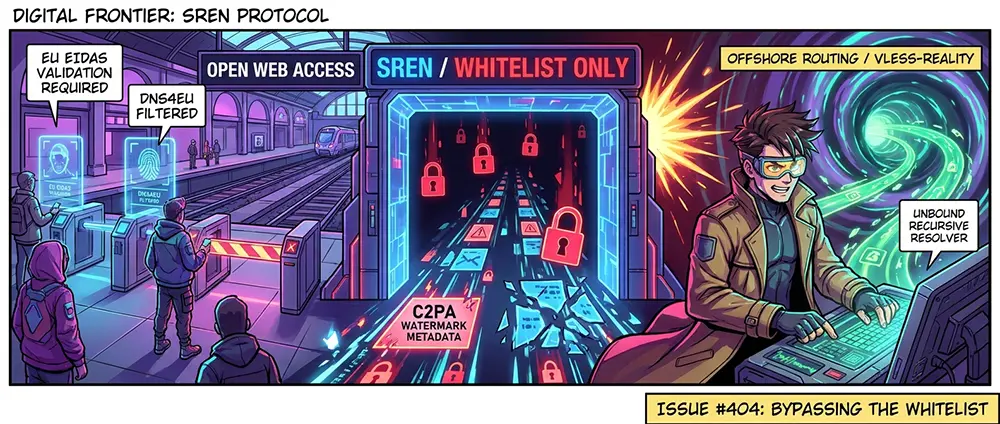
Imagine the central railway station of a major European metropolis. In the past, anyone could buy a ticket with cash at a vending machine, pull a cap down over their eyes, board a train, and step off anywhere on the continent. No security checks, as long as you kept quiet and didn't disturb public order.
Now imagine that a biometric checkpoint with a hydraulic turnstile has been installed at the entrance to the platform. Simply to step onto the platform, you are required to present a state-issued digital ID with facial biometrics, provide a fingerprint, and show an attendant a certified certificate from an accredited commission explaining why you are traveling, who you plan to talk to, and whether your luggage has been scanned by the government. If your name is not on the white list of trustworthy passengers for that hour, the turnstile won't even budge, and the duty officer will politely log your attempt to pass as a potential security threat.
This is precisely what is happening right now to the European segment of the network under the banner of the SREN (Securing and Regulating the Digital Space) regulations and the EU AI Act framework. Officials are tired of chasing individual servers, proxies, and unmarked content. Instead of targeted blocks, a presumption of host guilt is being introduced: if a service lacks a digital reliability certificate from a regulator and is not integrated into the state DNS filtering system, it is declared illegal at the link layer.
Stop. If you still naively believe that geopolitical censorship only exists in closed dictatorships, and that European regulations are simply a benevolent concern for children and copyright, close this article immediately. Go back to scrolling through your regulator-approved news feed.
But if you run your own nodes in European data centers, understand the mechanics of forced DNS4EU resolution, see the outlines of Splinternet isolation, and want to know how administrative directives break the TLS stack at the telecom operator level, welcome to the legal and technical vivisector.
The Architectural Gallows: From Blacklists to Total White Registries
The historical model of internet filtering relied on blacklisting. An operator received a registry of forbidden IP addresses or domains and cut off access to them via DPI or TCP Reset. It was a game of cat and mouse: administrators spun up new BGP prefixes, changed CDNs, stretched REALITY over clean domains, and slipped out of the line of fire in seconds.
France's SREN law and related Brussels initiatives are changing the very paradigm of routing. They are introducing the concept of first-mile resolver-level DNS delisting and a mandatory shift to a whitelisting architecture:
- DNS4EU and Forced State Resolution.
- Under the guise of cyber sovereignty, the EU is rolling out centralized DNS4EU infrastructure. According to the regulator's plan, all public telecom providers and corporate operators are required to redirect DNS traffic to these nodes. The resolver does not work by searching for zones in IANA root servers, but instead checks ARCOM and related agency databases. If a domain has not passed state content validation or distributes unmarked AI-generated content without C2PA metadata, the resolver returns
NXDOMAINor redirects traffic to a placeholder127.0.0.1. - Attack on Independent Encrypted DNS Protocols (DoH / DoT).
- The law directly pressures browser developers (Mozilla, Chromium-based). It introduces a requirement to block requests to independent DoH providers (Cloudflare
1.1.1.1, Google8.8.8.8, Quad9) if they refuse to filter responses according to national directives. DoH traffic to non-standard endpoints begins to be marked by operator DPI as anomalous TCP/UDP flow on port 443 and throttled using heuristic patterns. - Ban on Anonymous Hosting and Forced VPS Deanonymization.
- European infrastructure providers (Hetzner, OVHcloud, Scaleway) are required to demand strict KYC (Know Your Customer) with bank ID validation when renting any computing power. Setting up a personal node without tying it to a verified identity becomes a criminal offense for the hoster, driving free cryptographic nodes out of the European jurisdiction.
Mandatory Watermarks and On-the-Fly Censorship: AI Act Requirements
Simultaneously taking effect, the provisions of the EU AI Act create an unprecedented technical barrier for any software that processes or generates content:
- C2PA Cryptographic Tag Injection.
- Any web server, image generation service, speech transcription tool, or language model is required to embed immutable metadata into media file manifests. The absence of a cryptographic signature from the generator automatically treats the traffic as contraband. Edge content-filtering gateways on telecom operator networks are trained to parse file header structures (JPEG XL, WebP, MP4, raw streams) and drop sessions upon detecting unmarked synthetic media.
- Proxy Node Liability for Transit Traffic.
- The owner of a rented server running a VPN/VLESS setup is legally equated to a content delivery operator if their IP address is observed accessing resources deemed destructive or copyright-infringing. The era of "I just rented a server and maintain a tunnel there for personal use" is ending: the hoster is obligated to provide port distribution logs upon the regulator's first request without a court order.
Engineering Defense Protocol: Surviving in the Age of the Splinternet
When the regulator takes control of national backbones and DNS, relying on standard browser configuration files becomes a fatal mistake. The perimeter requires strict isolation from local telecom operator infrastructure.
- Complete Rejection of System and Operator DNS Servers.
- The entire local network is switched to work with a local recursive resolver (for example, a combination of
Unbound+CoreDNS) deployed on a dedicated remote server outside the EU jurisdiction. - Plaintext
# Directive for Unbound: forced root zone queries without upstream servers
server:
    verbosity: 1
    interface: 127.0.0.1
    port: 5335
    do-ip4: yes
    do-udp: yes
    do-tcp: yes
    root-hints: "/var/lib/unbound/root.hints"
    harden-glue: yes
    harden-dnssec-stripped: yes
    use-caps-for-id: yes
    qname-minimisation: yes
- Encapsulating Resolution Inside the Tunnel Socket (DNS-over-VLESS).
- Domain name resolution requests must never leave the client device in plaintext over port 53 or via standard DoH. Xray/Sing-box configurations are set up to route DNS requests directly into the encrypted multiplexed stream of the tunnel:
- JSON
{
  "dns": {
    "servers": [
      {
        "tag": "remote-dns",
        "address": "tcp://1.1.1.1",
        "detour": "vless-out"
      }
    ]
  },
  "routing": {
    "rules": [
      {
        "outbound": "vless-out",
        "port": 53
      }
    ]
  }
}
- Geographic Diversification of Autonomous Systems.
- Placing root gateways and VPN exits exclusively in data centers within jurisdictions that have not signed automated metadata exchange agreements and SREN directives (offshore zones, neutral locations, independent Asian and Latin American facilities). Rejecting hosters that have implemented eIDAS verification.
- Transport Traffic Masking as Authorized Transnational Protocols.
- Using
VLESS-REALITYmechanisms with SNI binding to major global financial or infrastructure platforms that regulators cannot physically whitelist without disrupting the continent's banking sector.
The World Wide Web has finally broken down into isolated feudal enclaves. The fairy tale of a borderless shared digital space has shattered against laws, regulations, and telecom operator checkpoints. In a world where every connection is checked for reliability by a government gateway, privacy is no longer granted by the right to plug into a cable. Today, autonomy is the result of a conscious rejection of someone else's routing rules and the ability to carve out your own isolated corridors through the accumulation of digital borders.