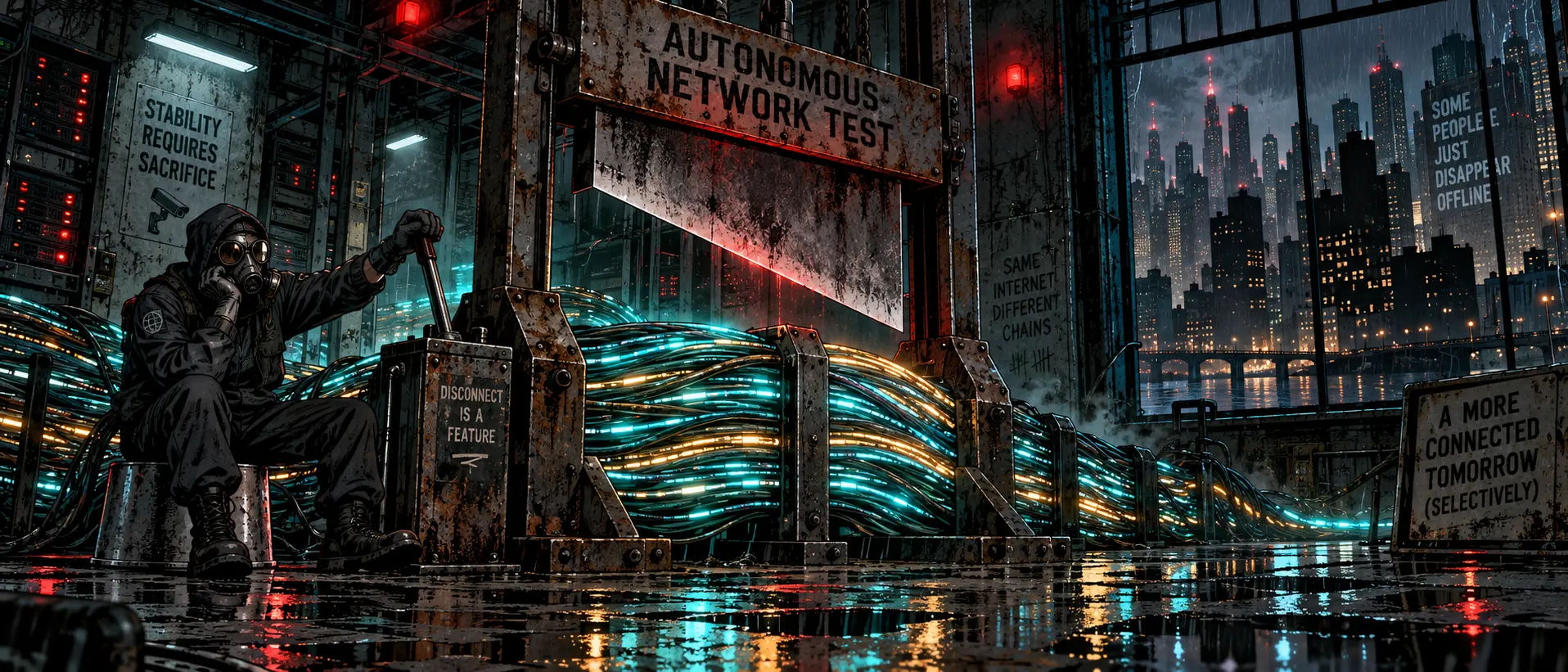
If you've noticed that the internet over the past 24 hours has been behaving like an old Soviet TV with a broken antenna, you aren't imagining things. Regular nighttime “maintenance” and sudden drops in external bandwidth aren't caused by an excavator accidentally cutting a fiber optic cable. These are the latest large-scale exercises simulating the isolation of network segments and testing the resilience of the Runet and adjacent national frameworks against external threats.
It sounds solid and secure. In practice, this means millions of users find themselves cut off from the outside world at the flick of a switch for several hours, while domestic networks go into a wild tailspin from severe overload.
The Anatomy of a Nightly Blackout: What Actually Happens at the Node Level
The average person is used to thinking that network isolation simply means blocking specific banned websites. But when autonomy drill protocols are activated, the filtering logic changes radically:
Artificial degradation of BGP routes. Backbone operators receive commands to drop announcements for external prefixes. Routers frantically attempt to rebuild routing tables through domestic backup channels, triggering an avalanche-like packet storm and causing latency (ping) to skyrocket from the usual 15 ms to a brutal 400–600 ms.
Cascading failures of local services. The irony is that even purely domestic platforms, banking apps, and marketplaces are tied to global infrastructure: external NTP servers for precise time synchronization, third-party fonts, CAPTCHAs, and library repositories. Cut off the external internet, and your local 24/7 convenience store checkout suddenly stops working.
Purging non-standard ports. During these tests, TSPU (Deep Packet Inspection) systems operate in an aggressive maximum-effort mode. Any encrypted traffic that doesn't resemble standard web browsing using trusted certificates is instantly and indiscriminately severed.
Why Free Services and Standard Protocols Fall into a Coma
Most users keep a standard VPN client on their phone or PC, hoping that whenever trouble strikes, the comforting green button will save the day.
During autonomy drills, the exact opposite happens:
Entry points on the blacklisted side. IP addresses of public authorization nodes are the first to hit DPI databases. The client can't even reach the server to verify a license or fetch a configuration.
UDP paralysis. If your protocol relies on open UDP transport (such as classic WireGuard), it goes down first. Operator filters simply drop such packets in batches, leaving the connection hanging with zero data transmission.
Flooding and hardware drain. The smartphone tries to push through the wall, sending thousands of retry requests, draining the battery, and turning the device into a pocket-sized space heater.
Engineering Survival: How Not to Get Cut Off from the Network
When the system storms at the backbone cable level, only deliberate and level-headed settings can help:
Transitioning to next-generation masking protocols. Only tunnels that mimic regular HTTPS traffic to major trusted resources (such as VLESS with Reality or Trojan with valid certificates) survive. To deep packet inspection systems, such a packet is indistinguishable from visiting a major, permitted web service.
Maintaining a local resolution reserve. When external DNS servers crash, devices lose track of where to go. A properly configured local caching resolver (e.g., on a home router) with DNS-over-HTTPS support helps you avoid dependence on sudden operator node failures.
A physical offline buffer. Don't count on being able to Google instructions, download a distributive, or find a working key in an emergency. All critical files, backup configurations, and offline maps should be saved to your local storage in advance.
The internet is no longer a quiet public space. It's a complex infrastructural highway where lanes are periodically closed off and concrete blocks are dropped into place. To keep moving forward, you need to know the detour routes before the barrier arm comes down.