Recent events in network security have marked a critical tectonic shift: a wave of compromises targeting peripheral Edge Workers and service accounts within Content Delivery Networks (CDNs) has proven that the concept of the centralized web shield has exhausted its security lifecycle.
For years, digital product architects and regulatory list operators lived in a comfortable illusion: if you hide your infrastructure behind a large global network (Cloudflare, Akamai, Fastly), your traffic automatically becomes protected from attacks, and regulators get a convenient endpoint for centralized filtering.
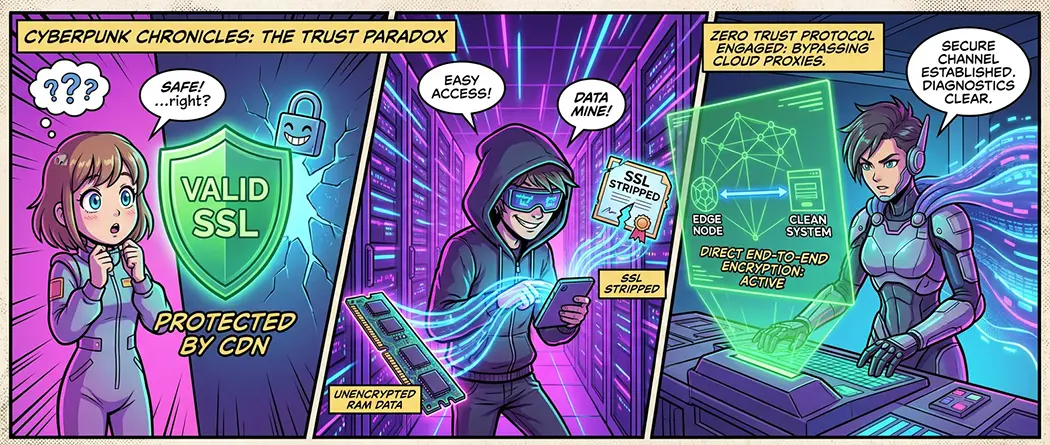
In reality, concentrating hundreds of thousands of services inside a few Anycast subnets has created a situation where the compromise of a single intermediate gateway instantly turns the entire defense system into a distributed channel for surveillance and session interception.
1. The Cloud-Edge Architectural Crisis: An Attack from Within the Trusted Perimeter
The traditional scheme of protecting traffic via a third-party CDN implies completely handing over cryptographic keys to the intermediary's servers (SSL Termination). At this boundary, traffic is decrypted, inspected for malicious signatures, and re-encrypted to be sent to the origin server.
What recent incidents have shown:
- Edge Compute Injections.
- Attackers no longer need to attack physical backends or break through protected database perimeters. Through configuration management API token leaks, they inject microscripts directly into the request processing pipeline on CDN edge servers. As a result, payment forms, session tokens, and user accounts are intercepted right in the gateway's RAM at the moment the TLS envelope is stripped—long before the packet reaches the secured server.
- Blind Spots in Monitoring Systems.
- To the end user, the connection looks cryptographically flawless: the browser shows a valid trusted certificate, latencies are minimal, and the client's network logs show no external requests. The interception occurs inside the very node that was meant to guarantee security.
2. The Convergence of Regulatory DPI and CDN Monopolies
In parallel with the risks of direct Edge server compromise, the problem of regulatory blacklists has intensified.
When state DPI systems (TSPUs) and carrier filters attempt to isolate unwanted resources or enforce so-called "whitelists," they run into the fact that legitimate businesses and independent platforms share the exact same first-tier CDN boundary IP addresses.
This leads to two destructive scenarios:
- Blanket Throttling of Shared Pools. Regulatory analyzers cannot selectively silence encrypted ECH/TLS traffic inside a CDN pool and instead apply probabilistic packet dropping to the entire Autonomous System Number (ASN) range. As a result, corporate CRMs, independent communication gateways, and payment systems face artificial bufferbloat inflating latencies up to 2,000–3,000 ms.
- Forced Localization and Decryption. Amid global network instability, operators are pushing for a transition to local national CDNs and trusted certificates, which de facto legalizes permanent MitM interception of user data flows at the backbone level.
3. The Dead End of Standard VPN Services
In this environment, mass commercial VPNs prove useless:
- In the event of sweeping blockades, operators primarily cut off public exit nodes of popular VPN applications, leaving users without a connection at the most critical moment.
4. Principles of Autonomous Architecture: Survival Beyond Shared Perimeters
To protect your data from systemic supply chain failures and the arbitrariness of network monopolies, digital infrastructure and personal gateways must be built on strict rules of decentralization:
- Direct Cryptographic Isolation (Origin-to-Client Isolation).
- Mission-critical data exchange (authorization, key transfer, confidential telemetry) must not depend on intermediate TLS termination by third-party CDNs. Using End-to-End encryption with application-layer public key verification ensures that even a hacked Edge server will only see an unreadable array of bytes.
- Dedicated Anycast-Independent Exit Points.
- Abandoning public server farms in favor of dedicated, autonomous cloud instances with clean static IP addresses. Running your own server on an independent backbone eliminates collective liability for someone else's parasitic traffic and protects you from getting swept up in blockades targeting other subnets.
- Hardware Monitoring and Strict Radio Parameter Control.
- If your network access point operates over cellular radio channels (LTE/5G), having physical access to modem management is vital. Rejecting rented "black boxes" in favor of independent hardware allows you to view raw radio metrics (RSRP, SINR) in real time, diagnose artificial base station throttling in a timely manner, and pin down uncongested frequency ranges.
Depending on a global cloud corporation or a closed operator gateway to manage your data security is a dangerous self-deception.
Real security in today's aggressive network is built not on blind trust in third-party certificates, but on uncompromising control over every link in your own chain: from the local Ethernet port to the remote dedicated core of your infrastructure.