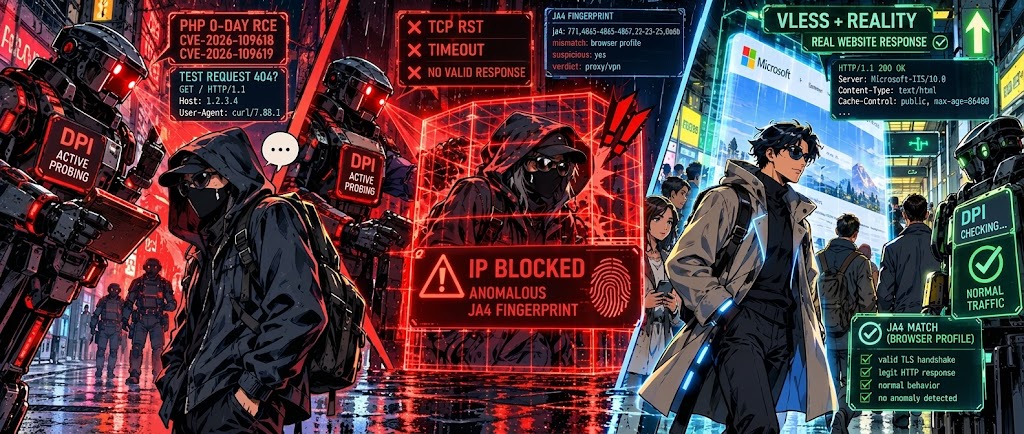
Picture a dark street. You pull your hood down low, put on dark shades, pull your mask up to your eyes, and try to sneak past a bored security guard on tiptoe. You are certain you're invisible because nobody can see your face beneath the mask. This is roughly how most people picture a VPN in action: encryption is enabled, the tunnel is up, and your ISP sees nothing.
In the past, the guard at the gate (acting via DPI and TSPU systems) would lazily watch you go by: "Can't see a face, walking quietly, oh well, let him pass."
Those days of naive monitoring are over. Now, the guard walks up behind you, taps you on the shoulder, and asks in a smooth voice, "Hey friend, got a light?"
- An ordinary passerby (a real website like a blog or online store) will turn around and give a normal human response: "I don't smoke" or "Who are you? Get lost." In server language, these are standard HTTP error codes: 400 Bad Request or 404 Not Found.
- Meanwhile, your disguised VPN tunnel gets caught off guard, stupidly freezes up, and plays dead. It stands completely still, hoping it won't be noticed.
The guard smirks: "Aha. Staying quiet means you're hiding something." And a second later, the baton comes down—an IP address block and a severed connection.
Welcome to the era of Active Probing.
The Mechanics of the Trap: How Active Probing Works
The biggest user illusion is believing that censors waste supercomputers on decrypting cryptographic keys. That is far too expensive and time-consuming.
The algorithm used to catch you is far more cynical and straightforward:
- The initial flag. You hit the "Connect" button. An initial packet flies out to your overseas server. The filtering system on the operator's end spots a high-entropy stream—pure encrypted noise with no clear identifying markers. In the past, this noise was left alone, but now the system immediately flags it as "Suspicious."
- The parallel verification call. In that exact same millisecond, without cutting off your active session, the censor's bot sends a request from its own IP address to that exact same server port. It shoots deliberate garbage over: a truncated piece of a web page or a malformed TLS handshake.
- The moment of truth.
- If the server is running a standard protocol (legacy OpenVPN, WireGuard, or primitive Shadowsocks), the daemon has no idea how to respond to an outsider. It either drops the packet silently (TCP RST) or hangs in a timeout.
- For the inspection algorithm, this silence is an outright confession. The server gets tagged as a proxy and is instantly sent to the ban list.
Trap Two: Why a Fake Gait Gives You Away (JA4 Fingerprints)
Many think, "Fine, I'll buy a dollar domain, slap on a free certificate, and pretend to be an innocent, legitimate website."
This triggers the second trap—JA4 network stack fingerprinting.
The censor isn't looking at your domain; they are looking at the micro-habits of your software: the order in which the program lists ciphers, the extensions it sends in the ClientHello packet, and how timings are configured.
A real Google Chrome or Safari browser enters a server smoothly, with a specific set of parameters, while concurrently requesting a bunch of images, stylesheets, and fonts.
A DIY Python or Go VPN client enters with the "wooden" gait of a robot: it sends a cryptographic fingerprint that matches no living browser on Earth, and then spends hours downloading a continuous, heavy stream of bytes to a single point. The filter doesn't even need to decrypt the traffic—the anomaly is visible to the naked eye via session statistics.
Why Mass Commercial VPNs Fail
Popular apps in the App Store and Google Play are burning out in batches right now using this exact same blueprint.
Mass-market services all share the same vulnerabilities:
- Cookie-cutter configs. Thousands of people go online with completely identical digital fingerprints, like clones in matching uniforms.
- Exposed server pools. Their IP ranges have long been added to every global network intelligence database.
- Once active probing is enabled, these servers aren't banned one by one; whole subnets go down in a couple of clicks.
How to Stay Invisible: Masking Rules
To keep your server from getting taken down by the very first test question, it must know how to talk to the guard without raising a shred of suspicion.
- The decoy persona mode (VLESS + REALITY).
Forget about using your own fresh domains. Modern gateways use a borrowed-trust architecture: they redirect any random incoming requests to a massive, legitimate portal (such as Microsoft or Apple update servers, or global CDN nodes). When a censor's probe knocks on the port, your server doesn't stay silent or panic. It echoes the probe back with a pristine, valid response from the real website. The censor checks it, sees an ordinary portal, and moves on. - Human behavior simulation (Flow and Vision).
The network stack must split traffic on the fly, balance packet sizes, and mix in technical noise. The stream needs to look like erratic, natural web browsing, rather than a monolithic pipe of data. - Dedicated entry points on bare-metal hardware.
No overcrowded collective servers. Only a personal, isolated server in a reliable jurisdiction without neighbors whose questionable activity could compromise the entire address range.
Conclusion
A turning point has arrived in the network war: hiding no longer works. Blank walls and screaming encryption only attract the patrols.
The only way to survive in a controlled network is to stop looking like a person in a black mask. Your traffic must dissolve into the crowd, look like the most boring office browsing imaginable, and respond confidently to any provocative questions from border filters. Whoever can organically pass the "got a light" test stays connected, always.