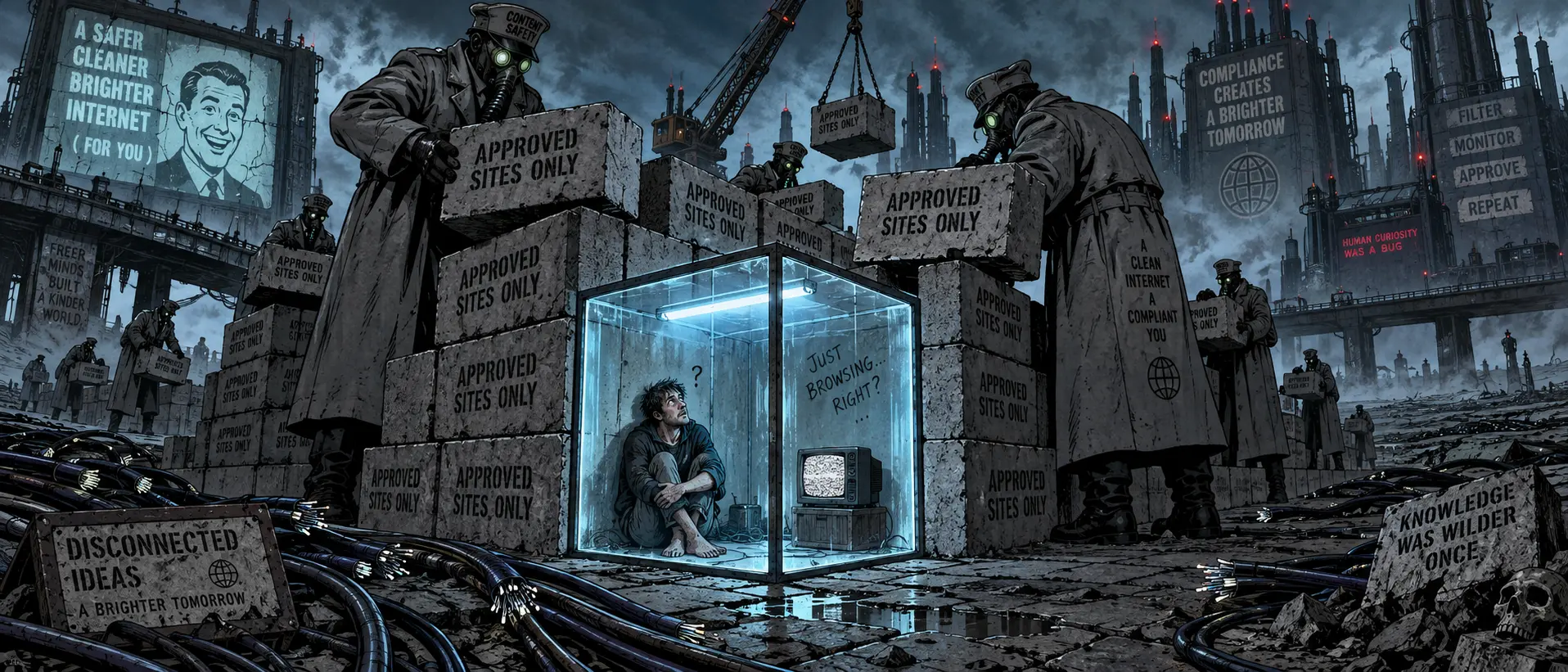
While users keep chasing new configurations and debating the resilience of various protocols, regulators are quietly changing the very paradigm of blocking. While the old approach was built on a "blacklist" principle (everything is allowed unless explicitly forbidden), recent events clearly show that isolation tests are shifting to a "whitelist" mode (absolutely everything is prohibited except a handful of state-approved addresses).
This is a tectonic shift that most subscribers haven't even realized yet.
The average user is used to a simple routine: if a familiar resource goes down, you can hit a tunnel button and move on. But when the whitelist mode kicks in, the network essentially ceases to exist. Instead of the global web, you are left with a neatly trimmed lawn of a few hundred "socially significant" resources—public services, a couple of marketplaces, a few loyal banks, and a storefront for official news.
Welcome to cable television, where you are paying for the privilege of having exactly three central channels.
The Architecture of the Trap: Why the "Whitelist" Breaks Everything
Trying to herd the digital economy into a pen of a couple dozen approved hosts only looks good in paperwork reports. In reality, the modern web doesn't work that way:
Cascading dependency failures. No modern website lives in a vacuum. Any webpage pulls in dozens of external resources: font libraries, authorization scripts, analytical counters, CDNs with media content, and bot protection. Turn on strict domain filtering, and even permitted local services turn into half-broken text scraps without images, payment gateways, or stylesheets.
The death of small and medium-sized businesses. Whitelists only accommodate giants with billion-dollar turnovers and direct administrative leverage. A small online store, local delivery service, independent forum, or a small IT company's CRM system instantly find themselves left out in the cold. They are simply unplugged.
Blocking at the IP subnet level. For the whitelist to work smoothly without glitches, backbone nodes are forced to apply a Default Deny mode at their external gateways. Any outbound traffic that does not fall within the prefix list of national autonomous systems (ASN) is dropped at the root by TCP Reset packets.
Why Conventional Tools Fall into a Coma
When a deafening curtain drops across the perimeter under a Default Deny scheme, standard methods of network hygiene stop showing signs of life:
Handshake servers are unavailable. Most commercial solutions don't even have time to send an authorization request: the IP addresses of their control centers and DNS servers are simply missing from the white list.
Total TLS isolation. An attempt to reach out to a foreign IP triggers an immediate session reset by the DPI complex even before the encrypted key exchange begins.
The illusion of connectivity. The network indicator on your device glows green, but when you try to venture beyond the approved pen, the browser endlessly outputs ERR_CONNECTION_TIMED_OUT.
Digital Connectivity: How to Keep a Window to the Outside World
In conditions where regulators are trying to reduce the internet to a closed intranet, only non-trivial engineering solutions can survive:
Infrastructure on boundary-permitted nodes. The only way to pierce the rigid perimeter is to mask traffic as services guaranteed to remain on the whitelist during any crisis (the largest local cloud platforms and corporate gateways). Traffic is wrapped in permitted interaction protocols with these clouds and only leaves for the outside world from there.
Asynchronous channels and offline buffers. Do not rely on external documentation, working repositories, or knowledge bases being online 24/7. Mission-critical data must be synchronized to local mirrors the moment a "green corridor" opens up.
Direct peering connections (Mesh topologies). If a district or city is isolated from external backbones, horizontal connectivity becomes the lifeline: local radio bridges, Wi-Fi mesh networks between buildings, and direct data exchange between nodes without centralized providers.
We are entering an era where access to global information is no longer a basic subscription service, but a complex engineering challenge. Those who win will be the ones who don't wait for favors from monopolists, but design their own independent routes in advance.
SEO Keywords: internet whitelists, runet isolation drills, cutting off the external internet, default deny blocking, how website whitelists work, tspu blocking drills, independent mesh network