In recent days, carrier traffic filtering systems (TSPU) have noticeably ramped up their heuristic throttling mode. While previously only specific ports or obvious unencrypted tunnel markers were targeted, the latest wave of connection degradation has impacted the entirely legitimate corporate sector: Remote Desktop Protocol (RDP), databases, and even clean HTTPS sessions to independent cloud providers.
The reason lies in a qualitative shift: filtering systems have finally moved away from signature analysis to statistical profiling of entropy and volume.
This changes the rules of the game for anyone building a secure communication perimeter.
1. Mechanics of the "Penalty Queue": How a Session Gets Chopped
Most people believe blocking is always a hard disconnect (TCP RST) or a timeout. In practice, edge DPI is increasingly using a covert tool: forcing suspicious streams into a degradation class of service (QoS Scavenger Class).
How the algorithm triggers:
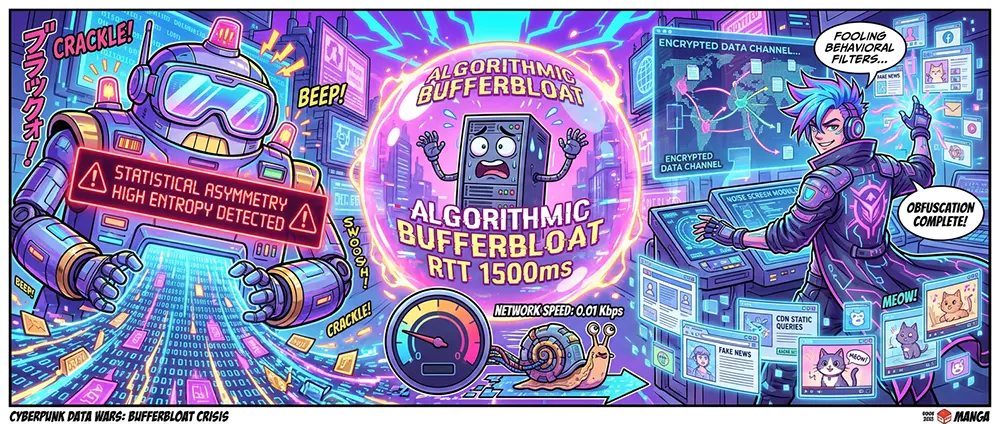
- Entropy Profile Analysis. The first tens of kilobytes of a session are checked for mathematical randomness. If the stream looks like monolithic cryptographic noise without characteristic pauses and web artifacts, the suspicion counter increments.
- Traffic Asymmetry Evaluation. A regular web resource user sends short requests and downloads heavy responses (asymmetry of 1:10 or higher). Constant two-way exchange of large packets (symmetry of 1:1 or 1:2) is marked as a tunnel or direct data transfer.
- Algorithmic Bufferbloat. Instead of dropping packets, the operator's router artificially inflates the delay buffer. Round Trip Time (RTT) spikes from 20 to 800–1500 ms. The internal TCP congestion control mechanism (BBR/CUBIC) on the server side perceives this as a physical network collapse and drops the transmission window to a minimum.
As a result, the connection is not formally broken, but the speed drops to unusable levels.
2. The Collapse of the "Just Wrap Everything in TLS" Idea
Many technical specialists make a common mistake: wrapping all traffic in a long single session disguised as TLS 1.3 to their own VPS.
To a heuristic DPI, such a solution looks maximally anomalous:
- A regular web browser generates dozens of short-lived parallel connections to various CDNs, ad networks, analytical servers, and font databases.
- The "disguised" tunnel represents a single endless session to the same IP address, hanging for hours with a constant volume of throughput.
No matter how perfect the fake SNI and handshake fingerprint (JA4) may be, the session's behavior over time entirely gives away its nature.
3. "Noise Shield" Architecture: How to Dissolve Critical Traffic
To keep a personal gateway or work channel invisible to heuristic classifiers, the network perimeter must be designed according to the principles of organic noise:
- Simulation of Natural Session Dynamics.
- The transport layer must forcibly break down continuous data streams into discrete, plausible web sessions. Upon reaching a certain threshold of transferred bytes or lifetime, the session should smoothly and seamlessly rotate at the client stack level.
- Blending with Legitimate Background Traffic.
- Mission-critical traffic should not be the only activity on the interface. The local gateway must maintain continuous emulation of standard activity: regular background requests to open APIs, NTP time synchronization, and downloading static elements from trusted national and global mirrors.
- Padding and Border Fragmentation Control.
- Overhead leading to packet fragmentation into non-standard snippets is unacceptable. A strictly set MTU (1280–1340 bytes) combined with automatic padding of small packets into fixed blocks completely deprives the statistical analyzer of the ability to read command sizes.
Summary
The era when setting up a standard tunnel on a rented VPS was enough for stable communication has firmly passed into history. Modern filters do not attempt to crack the cipher—they analyze traffic behavior patterns over time.
The reliability of a personal perimeter today is built not on high-profile cryptographic algorithm names, but on engineering flawlessness of camouflage. A gateway is secure only when, to any third-party auditor, it looks, sounds, and responds like the most mundane, unremarkable data exchange on the global web.