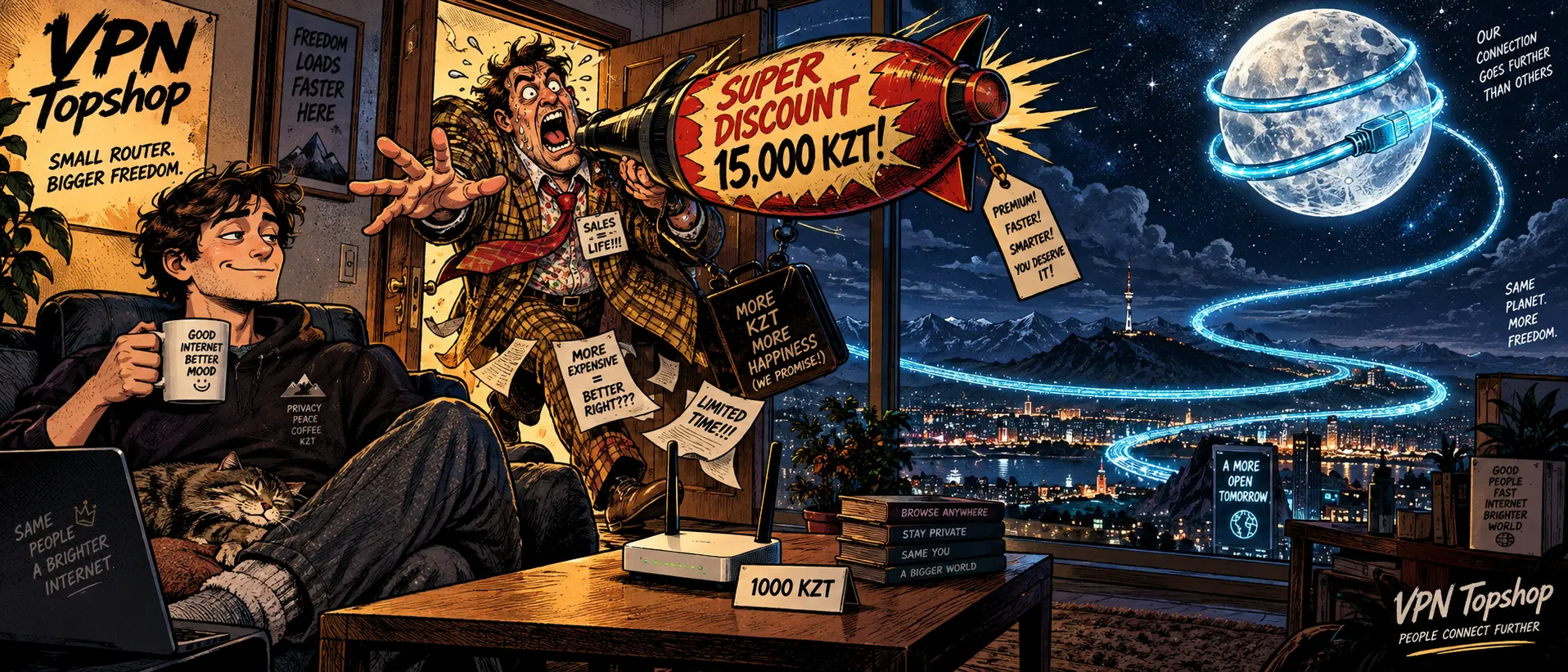
A call on Saturday afternoon. The voice on the line sounded so cheerful, you'd think I'd just been approved for residency in paradise:
«Hello! Exclusively for you, as our valued customer, we have a super-offer! The "Mega-Giga-Family-Plus" plan for 15,000 tenge! But right now — a 60% discount!»
I sat there, listening, and my mind was completely blown.
Right now, I'm on an archival plan: 1,000 tenge a month. Honest unlimited data, a ton of minutes, the network runs stably — I can go the whole month without turning on my home Wi-Fi and share my connection with everything around me. And here they are, dead serious, telling me to pay 15 times more for the exact same thin air wrapped in a fancy package with the word "premium" stamped on it.
Do they genuinely think that if they rebrand a forced price hike as "personal care," we're going to start clapping our hands?
Anatomy of a scam: why operators are fighting so hard to kill old plans
They'll never tell you the truth in the call center, but the logic is primitive:
Archival tariffs are a thorn in their side. A user who pays pennies and downloads hundreds of gigabytes ruins the operator's quarterly reports. The goal of any automated script is to yank you off unlimited data and push you onto capped gigabyte bundles at any cost.
The illusion of savings. A scheme as old as time: pull a 15,000 ₸ price tag out of thin air, offer a "discount" down to 6,000–7,000 ₸, and then quietly drop an SMS six months later: «The promo period has ended, starting on the 1st your monthly fee will be 15,000 ₸». There will be no way back to your archival plan.
Selling the exact same thing twice. They offer to hook you up with a "router for the whole family." But the cell tower outside your window isn't going to operate any faster because of it. They're simply reselling you the exact same channel capacity, just slapped with a pretty sticker.
A brief, painless physics lesson: what does your internet actually run on?
When operators start whining about "colossal infrastructure modernization costs," it helps to understand what we're actually paying for.
The internet doesn't fly through the air on its own. The entire wireless world rests on the thinnest glass threads — fiber optics.
Inside the cable is a glass core about the thickness of a human hair (roughly 9 to 125 microns).
The signal inside doesn't flow as electric current — it travels at the speed of light, bouncing off the glass walls thanks to the principle of total internal reflection.
The million-dollar fact: The total length of submarine and underground fiber-optic cables on Earth has long surpassed 1.4 billion kilometers. That would be enough to wrap around the planet at the equator 35 times or stretch via optics to the Moon and back nearly four times.
And yet, suits in boardrooms are trying to squeeze this gigantic glass skeleton of the planet — built by engineers — into constraints like "pay an extra 500 tenge to share traffic with your tablet." Absurd? Completely absurd.
How to protect your wallet and your channel
If you've also started facing an onslaught of "lucrative offers," here's a quick guide to network self-defense:
Never say "Yes" out of politeness. Bots on the line now interpret any affirmative interjection as consent to change your contract terms. «Keep my current plan, everything suits me, this call is recorded».
Encrypt your traffic at the router level. Operators analyze where you browse to figure out what else they can squeeze money out of you for (video streaming, gaming, torrents). When all your traffic moves through a single encrypted tunnel, you become a gray, monotonous data point to the provider, with nothing left to meter separately.
Don't fall for marketing gigabytes. Speed and stability don't depend on a plan's name, but rather on base station congestion and direct routing to the servers you need.