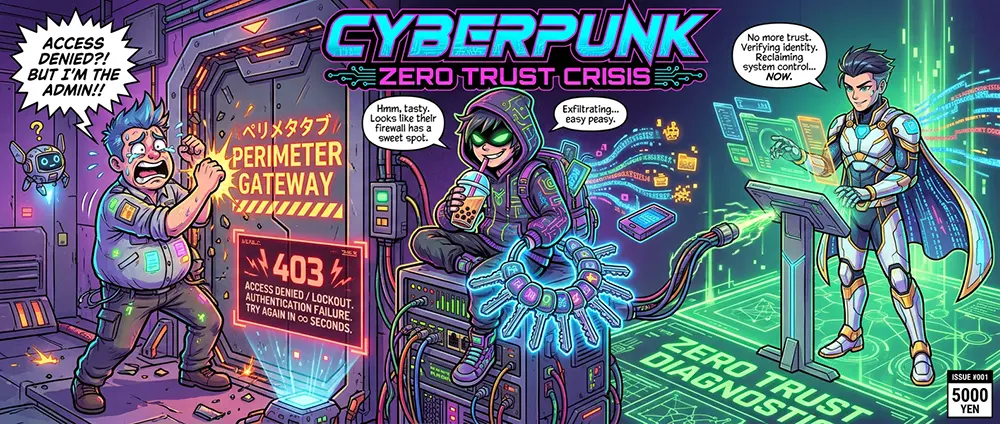
Recent events in cybersecurity have exposed a vulnerability that the corporate sector has chosen to ignore for years: edge devices and SSL-VPN gateways have become the primary vector for losing infrastructure control.
Recent reports of administrative lockouts on corporate firewalls and perimeter routers (campaigns targeting compromised edge devices with credential swapping) highlight a qualitative shift: attackers are no longer just leaking databases. They are seizing the gateway itself, swapping access keys, and locking the owners out.
For an industry that still clings to the belief in a "reliable hardware box at the front door," this is a harsh wakeup call.
1. The Architectural Trap of the "Iron Fence"
The classical security model has been built for decades on a simple dogma: "Deploy a powerful gateway at the network perimeter, set up a VPN for employees, and declare everything inside a trusted zone."
In modern realities, this approach turns into a time bomb for three reasons:
- Single point of total failure. If an attacker breaches the edge concentrator (via service credential leaks, password spraying, or deserialization in the web interface), they gain more than access to a single server. They obtain the entire topology map, routing tables, and the ability to quietly sniff unencrypted internal traffic.
- Lockout of the legitimate owner. When access to the modem or firewall web management panel goes through the exact same channel that is under attack or filtering, the administrator loses instrumental control. If the management interface becomes unavailable (or is forcibly blocked from the outside), real-time anomaly diagnosis becomes impossible.
- Uselessness of patches against stolen identities. Against attacks utilizing valid credentials, traditional vulnerability scanners are useless: to them, authorized login through an edge SSL-VPN looks like routine connection activity by an on-call engineer.
2. Silent Degradation as an Intrusion Indicator
Simultaneously with gateway takeovers, pressure from regulatory filtering systems is intensifying. When telecom operators activate new heuristic DPI profiles, the channel begins to behave abnormally:
- TCP transmission window sizes are artificially throttled;
- acknowledgment packets (ACKs) are delayed;
- ping on the very first external transit node spikes tenfold.
The most dangerous part of this situation is the coincidence of symptoms. An administrator writes off monstrous jitter and timeouts as "evening load from the ISP" or "routine filtering tests at the base station." In practice, at that exact moment, hidden data exfiltration or password brute-forcing against adjacent segments might be flowing through the perimeter router.
If you cannot see raw hardware metrics of your own network interface and do not control latency levels across every traceroute hop, you are physically incapable of distinguishing operator shaping from someone else's presence in the channel.
3. Why Mass VPN Solutions Fail to Save Business and Privacy
At the first signs of instability or blocking, many rush to hook up a standard commercial VPN. This delivers a short-term visual fix, but exacerbates security risks:
- Concentration in dirty subnets. Public address pools of commercial providers are known to all state DPI and anti-fraud systems. Your traffic lands in the same pot as thousands of dubious sessions, automatically receiving top priority for forced throttling.
- Lack of privilege separation. By connecting through a third-party centralized service, you transfer trust from your local provider to an outside company whose logs and internal routing remain completely opaque to you.
4. Principles of an Autonomous Network Perimeter
To keep infrastructure manageable even under aggressive filtering and targeted gateway attacks, network architecture must adhere to strict rules:
- Out-of-Band Management. Access to the administration console of the router, modem, and edge server must under no circumstances depend on the external internet channel. A local wired link, independent service interface, and full access to root parameters are baseline requirements. Rented "black boxes" with locked web interfaces have no business guarding critical data.
- Network-Level Zero Trust. The mere fact that a packet is inside a tunnel no longer grants it the right to be trusted. Mutual cryptographic certificate verification (mTLS) between services, dynamic session tokens, and microsegment isolation prevent an attack from spreading even if the edge node is compromised.
- Personal Points of Presence. Dedicated private cloud instances on tier-1 backbone channels disguised as standard web traffic (TLS 1.3 with valid client fingerprint emulation) are the only way to guarantee clean pings, absence of foreign noise, and session stability.
Summary
Digital perimeter security is measured neither by vendor promises nor by the thickness of a corporate firewall. It is defined by who holds the keys to the gateway at the critical moment.
If your edge hardware does not answer to you, and network delays are hidden behind optimistic provider reports, you do not have a perimeter. True digital sovereignty begins with complete ownership of your own router, raw traffic logs, and an independent exit point to the global network.