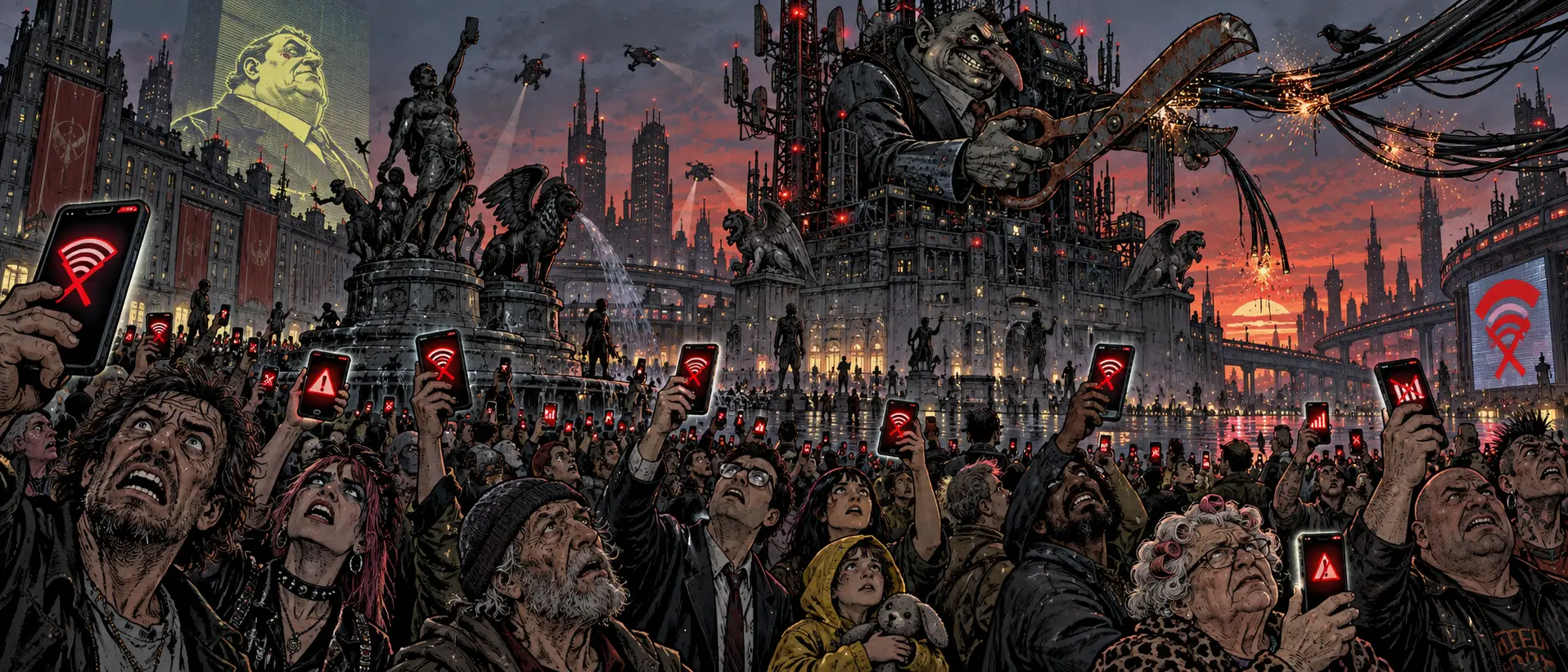
You wake up in the morning, reach for your phone to scroll through your feed or call a cab, and see a lonely letter “E” or a mocking exclamation mark. Sound familiar?
Welcome to a reality where mobile internet is no longer a basic right, but a lottery. Over the past few days, a wave of sudden local “drills,” regulatory jamming, and nighttime mobile internet outages across the regions has finally torn off the masks. What used to be blamed on “tower maintenance” has now openly turned into a systematic practice: if authorities decide the network poses a threat, the master switch gets pulled without warning.
The funniest part is watching the reaction of mobile operators:
Customer support features a chatbot with the IQ of a microwave, standardly assuring you: “We are already upgrading our equipment to improve connection quality!”
Money for unlimited or tiered gigabyte plans is deducted with German punctuality—down to the exact minute.
Meanwhile, connection speeds melt before your eyes, and ping goes through the roof.
You pay for a full adult plan, but get digital rations via coupons.
The Anatomy of a Modern Shutdown: How It Works Technically
The average consumer thinks there's some bearded engineer sitting in a room, physically pulling a power cord out of a base station. It's much more sophisticated than that:
Forced 2G/3G downgrade: Filtering equipment at the base station controller level artificially drops termination from LTE down to legacy protocols. You can still make calls and send archaic SMS, but data transmission collapses to zero. Your phone reports that “service is available,” but not a single byte goes out.
Black hole for UDP and BGP filtering: Operators wipe out non-standard ports and cut external routes at backbone nodes. Access to local government and banking portals still limps along (so you can pay a fine or utility bill), but the outside world gets cut off entirely.
Umbrella jamming perimeter: When the regulator rolls out protocol tests, absolutely everything gets caught in the crossfire—from courier navigation apps to supermarket checkout payment terminals. Urban infrastructure instantly grinds to a halt.
Why Downloaded “One-Tap” Apps Die First
In moments of such artificial anomalies, millions of users simultaneously open their free proxy apps featuring rockets and little locks on their logos.
And total collapse ensues:
The channel is choked with garbage: Free servers are overloaded thousands of times over, and ping spikes up to 5,000 ms.
Handshake exposure: Standard clients start furiously spamming requests to blocked authorization domains, instantly attracting the attention of DPI (TSPU) filters.
Battery drain to zero: The smartphone tries to reconnect every second, heating up in your pocket like a frying pan and draining the battery in an hour and a half.
How to Survive the Era of the Permanent Kill Switch
If the network around you is storm-tossed, hoping for a miracle or a kind provider is pointless:
Have a backup landline: Mobile communications are the first to be jammed during periods of turbulence. Wired home fiber from a smaller local ISP remains the most resilient channel.
Keep offline maps and caches ready: Yandex, Google, 2GIS—everything should be downloaded directly to your device's internal storage. When the network drops in an unfamiliar neighborhood, it will be too late to ask strangers for directions.
Use protocols with dynamic obfuscation: No naked OpenVPN or WireGuard in the clear. Only next-generation protocols survive (VLESS Reality, Shadowsocks 2022, obfuscated transport), which don't broadcast signatures and know how to masquerade as ordinary web traffic.
The internet is no longer a given. It is a battleground for connectivity, and the winner is the one who sets up alternative routes in advance.