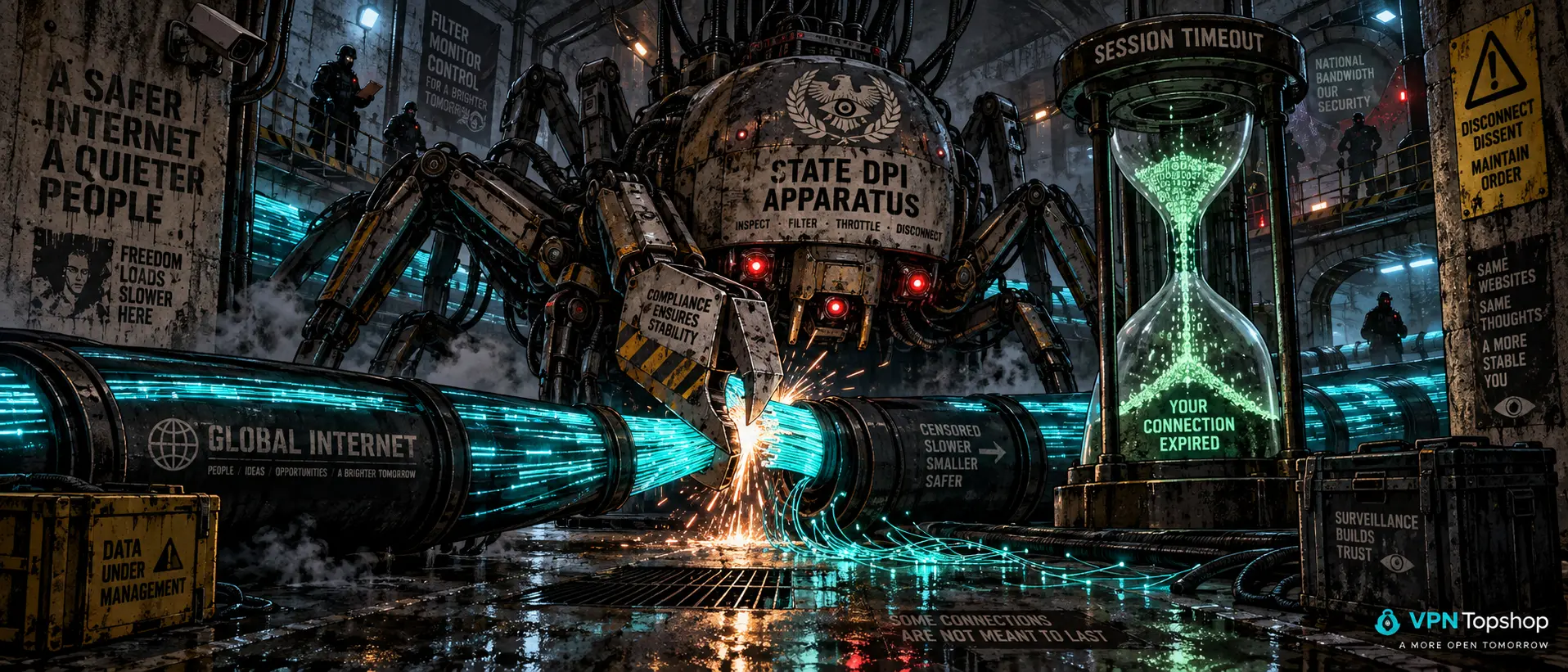
If you've noticed a strange issue over the past few days—where your tunnel appears connected, the coveted green status light is on, but every 15 to 20 minutes the connection freezes solid and packets vanish into a black hole—don't be so quick to blame foreign servers.
A new round of the battle against private protocols is unfolding within traffic filtering infrastructure. Regulators and TSPU backbone systems are no longer trying to selectively hunt down server IP addresses (that's too slow and inefficient). Instead, they have turned to behavioral session analysis and the mechanics of artificially resetting long-lived encrypted connections.
The result is predictable: the connection technically exists, but actually working or reliably transferring files becomes pure torture.
The Anatomy of Stealth Throttling: How the «War of Attrition» Works
Most users still believe that if a protocol signature is hidden, the provider is powerless. In practice, filtering systems have learned to act much more subtly:
Artificial Session Time-to-Live Limitation. The filtering complex at the backbone gateway registers a stable, continuous stream of dense, high-entropy traffic heading to the same entry point. After a set time interval (usually 15 to 30 minutes), the operator's equipment injects a fake TCP RST (Reset) packet into the stream or silently drops the UDP context at the node's NAT table level.
Blocking Without Registry Listing. This is the most convenient method for network operators: the service isn't officially banned anywhere, the hosting website opens just fine, but the connection itself systematically drops. Customer support simply shrugs: «Check the route outside our zone of responsibility.»
Entropy Shaping. If the traffic is too monotonous, encrypted, and doesn't fit typical web-surfing patterns (for example, constant consumption without pauses for reading pages), the system dynamically lowers packet priority in the QoS queue until the session times out from your device's end.
Why Standard Clients Give Up Without a Fight
When a connection falls victim to this covert erosion, basic software with a single big button on the screen becomes completely useless:
Endless Reconnection Loops to the Same Port. The client gets stuck hard in a reconnect cycle, hammering away at an already «flagged» filtering chain.
Session Key Paralysis. Every sudden reset requires a repeat of the key exchange initialization, which makes the traffic stand out even more against normal, everyday requests.
Background Mobile Stack Resets. Due to constant disconnects, the mobile operating system starts restarting the network interface, draining your smartphone's battery twice as fast.
Engineering Counterattack: How to Keep the Connection Alive
If filters are choking off the continuity of your stream, the only viable strategy is to strip away their predictability:
Aggressive Transport and Connection Rotation. Use clients that support multiplexing and the periodic, imperceptible switching of sessions (Multiplexing / Mux). The connection shouldn't just hang like a monolithic, multi-hour log—it should be broken down into short, dynamic chains that DPI systems don't have time to identify as a stable tunnel.
Mimicking Human Heartbeat (Jitter & Padding). Traffic needs to simulate human behavior: random micropauses, adding variable-length garbage bytes (Padding) to packets to deny the system the ability to analyze the size of transmitted data blocks.
Backup Ports and Fallback Routes. The server side should be configured to listen on multiple ports simultaneously, with automatic client switching at the very first signs of artificial packet drops.
The era of simple solutions is over. The survival of private communications today relies on dynamics, camouflage, and the ability to remain invisible to monopolist algorithms.