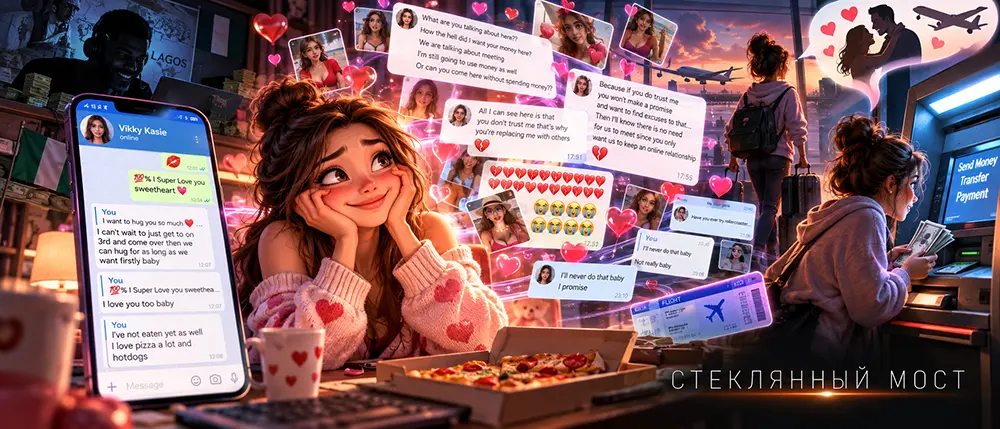
Picture an old, dusty attic. In the corner sits a wooden chest with peeling paint that reads: "Inheritance from a Lagos Prince, 1997." Inside lies a sealed letter with a tear-jerking story about millions of dollars trapped in a secret account, requiring just a hundred bucks for a port official's bribe to be released.
You would think this thirty-year-old joke should have died out alongside dial-up modems and pagers. But the trick is that scammers simply dusted off grandmother's trunk, threw away the stiff legal suits, and slipped into a profile named Vicky with a stock photo avatar.
The prince is dead; long live eternal love on an encrypted messenger.
Stop. If you genuinely believe that a sultry internet beauty is ready to drop everything to share hot dogs in pastry with you, and that emoji tears signify deep emotional trauma, close this tab. Go run to the nearest money transfer window.
But if you are curious to dissect the mechanics of ancient social engineering—where zero-day exploits are replaced by guilt, emotional rollercoaster tactics, and supercharged lists of repeat victims—let's break down this performance.
Evolution of the Genre: From Legal Office to Hot Dogs
In the late last century, an attacker had to keep up appearances: pseudo-legal English, fabricated British banking regulations, ministry stamps, and serious six-figure sums.
In the era of messengers, the bar has hit rock bottom.
Why waste time forging bank forms when you can lead with your trump cards?
Act One: Head-Over-Heels Love.
«100% I Super Love you sweetheart».
Hearts, kisses, confessions. The person barely knows their interlocutor's last name, yet they are already loved more intensely than the heroine of a 240-episode Turkish soap opera.
Act Two: Everyday Simplicity.
«I've not eaten yet as well. I love pizza a lot and hotdogs».
No diamond mines or billion-dollar inheritances. Just a hungry, romantic soul who loves pizza and hot dogs.
What kind of scammer would talk about a sausage in a bun?
That is precisely what makes the trap potentially effective. The more harmless the story looks, the easier it is to switch off critical thinking.
Architecture of the Trap: Emotional Tailspin and Unbraked Messengers
Once contact is established, the second act of the performance begins.
1. Evacuation to the Gray Zone
The dialogue is insistently steered away from public social networks into separate messengers, such as Zangi.
The app itself might be entirely legitimate and useful for private communication. But for a scammer, anonymity and limited user-identification features provide a convenient cover.
Especially if the new acquaintance flatly refuses to chat anywhere else, yet very quickly starts discussing love, trust, and money transfers.
2. The Logistical Ultimatum: "What, Do You Want Me to Walk?"
The moment for a meeting arrives.
«I desperately want to come, hug you, and finally see you. But it turns out planes cost money».
And right here comes the punchline, worthy of an Oscar:
«How the hell did I want your money here?? We are talking about meeting!»
Meaning: "Why the hell would you think I want your money? We are talking about a meeting!"
A magnificent construct.
The money isn't needed by the interlocutor. The money is needed by the soulless airline.
And if you have doubts, it means you don't believe in love.
3. Tactical Gaslighting and the Wall of Broken Hearts
As soon as finances enter the conversation, the script shifts.
«All I can see here is that you don't trust me baby».
Followed by:
«Then I'll know there is no need for us to meet since you only want us to keep an online relationship».
In other words, the meeting is called off because you, a heartless person, dared to doubt the sincerity of their intentions.
And this is where the digital theater truly begins.
Dozens of broken hearts. Crying faces. New declarations. New grievances.
If every broken heart could be exchanged for frequent flyer miles, the characters in these chat logs would have circled the Earth three times over.
Yet the psychological mechanics here are quite serious.
Instead of discussing the practical details of a meeting, the victim is forced to justify their lack of trust.
It is precisely at this moment that the question "Why should I wire money?" is replaced by "How do I prove that I love you?".
That is the dangerous turning point.
The "Prewarmed" Infrastructure: Why Lightning Strikes Twice
The most cynical part of the scam industry is hidden from public view.
There are so-called sucker lists—records of individuals who have previously responded to fraudulent offers or transferred money.
Such data may be reused or handed off to other criminals.
The logic is simple: if a person has paid once under a convincing story, they might be targeted again.
Today they are told about a dying relative. Tomorrow they are offered investments. The day after, someone professes their love.
The photos, names, and backstories change.
Yet the goal remains the same: find the emotional lever that will force a person to part with their money.
And it is important to understand: falling into such a trap does not mean a person is foolish. Scammers deliberately exploit trust, empathy, loneliness, and the desire to help.
Sober-Head Protocol: Breaking the Old Script
Money before an in-person meeting is a major red flag.
Especially when a new acquaintance asks you to pay for tickets, visas, customs fees, medical treatment, or a sudden emergency.
Never send money to someone whose identity you cannot independently verify.
A video call is no longer ironclad proof of identity.
In the past, you could try to catch a scammer with a simple request to turn on the camera.
Today, technology allows for the real-time swapping of faces and voices even during a video call.
Therefore, a smiling beauty on the screen does not prove you are speaking with who you think you are.
Verify identities independently and do not make financial decisions based on a single pretty video stream.
Do not let trust be turned into a financial obligation.
The phrase "If you love me, you must help" is not proof of genuine feelings.
If refusing to wire money triggers a flood of accusations, threats to break off the relationship, and emotional ultimatums, it is best to cut off the conversation.
There is no need to stage a courtroom trial in your chat logs or prove your innocence to forty broken hearts.
Do not confuse privacy with authenticity.
A secure messenger can do a great job of keeping your correspondence private.
However, encryption does not verify that the person on the other end is actually who they claim to be.
Finale: The Prince No Longer Wears a Crown
Nigerian princes haven't gone anywhere.
They've simply pawned their ceremonial robes, bought up virtual numbers, and learned to send romantic declarations faster than old fax machines could print bank guarantees.
And you shouldn't necessarily look for a Nigerian on the other end of the line.
“Nigerian letters” long ago became a generic term for an entire genre of fraud. Today, a romantic profile could be operated by anyone, from any country. Even your next-door neighbor.
Technologies change, protocols encrypt, and artificial intelligence has learned to mimic other people's faces and voices.
Yet the human need to believe in love remains one of the most lucrative targets for social engineering.
And if your new love asks for ticket money, and in response to your doubts sends fifty broken hearts, it might be time to buy a pizza instead of an airline ticket. For yourself.
Illustrative chat examples: Materials published on Quora. The presented excerpts demonstrate signs of emotional pressure and potential romance fraud, but do not independently establish the identity of the sender or the commission of a crime.
Source material: https://www.quora.com/