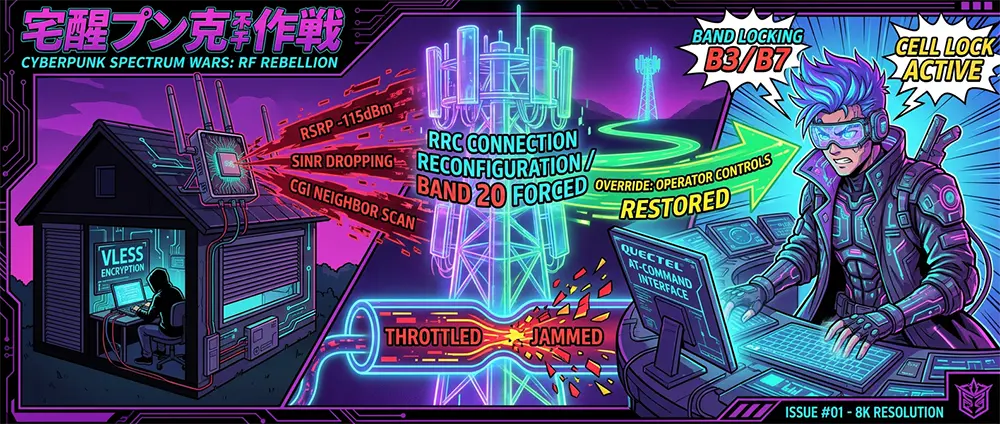
You are sitting in a soundproofed room in a private house. The windows are covered with heavy curtains, a clean VLESS setup disguised as a Swiss bank runs on your router, and your traffic is encrypted so deeply that no DPI engine can parse the headers. You are confident you have dissolved into the radio ether. But right outside your window, mounted on a mast, is a carrier 4G/5G modem. This isn't just an antenna box pulling in the internet; it is an onboard informant with a direct communication channel to the base station.
While you encrypt every single byte inside your operating system, the modem itself transmits a detailed radiophysical report to the cellular tower every few milliseconds: carrier power, noise floor, phase shift, phase jitter, and a list of neighboring sectors it hears on the horizon.
You don't need to open a browser or send messages. It is enough for a truck to drive past your fence, altering the reflection of the radio waves, or for a heavy downpour to start outside: the carrier controller instantly captures the precise digital signature of your physical location. And if the cell tower receives a command to isolate a specific node, it won't attack your VPN. It will simply tweak the radio channel parameters and quietly drop you down to the very bottom of artificial throttling.
Hold on. If you think modem security ends with changing the admin/admin password on the bottom sticker , close this tab. Keep believing in the magical power of the signal bars on your phone screen.But if you have held an AT terminal in your hands, understand the difference between the carrier frequency and the signal-to-noise ratio, and want to know how carriers manipulate the physical layer (Layer 1) to degrade tunnels—put on your dielectric gloves. We are about to dissect the radio spectrum.
Under the Hood of the Radio Interface: What the Modem Actually Transmits
In any modem category (from modest Cat.4 to monstrous Cat.20 units with five-carrier aggregation), a closed Baseband Processor handles the wireless communications stack. Its firmware is a proprietary black hole from Qualcomm, MediaTek, or ASR, running its own RTOS.
Every second via the PUCCH (Physical Uplink Control Channel), the modem sends Radio Resource Control (RRC) packets to the carrier containing the following metrics:
- RSRP (Reference Signal Received Power).
- The absolute power of pilot signals from the base station in dBm. Ranges from
-50 dBm(tower right in your yard) to-120 dBm(on the verge of dropping). By tracking changes in this figure down to tenths of a decibel, the carrier's triangulation algorithms monitor changes in the spatial geometry around the antenna. - RSRQ (Reference Signal Received Quality).
- The quality of the received signal, factoring in sector load. Shows how much radio resource is consumed by other subscribers.
- SINR (Signal to Interference plus Noise Ratio).
- The key indicator of spectrum purity: the ratio of useful signal power to the sum of noise and spurious interference. If SINR drops below
0 dB, the modem rolls back to primitive modulation schemes (QPSK instead of 256-QAM), turning a gigabit pipeline into a trickle. - CGI (Cell Global Identifier) and Neighbor Cells list.
- The modem doesn't just hold onto a single cell. It constantly scans the spectrum and reports to the eNodeB/gNodeB controller: "I see tower A at -85 dBm, tower B at -102 dBm, and tower C at -110 dBm." Three vectors, a freshman math problem—and your home coordinates are calculated to within a few dozen meters without any GPS.
Selective Degradation: How Tunnels Are Severed Without Touching DPI
When a censorship or corporate filter cannot parse encrypted VLESS/REALITY traffic, it hands off the task to the carrier's radio subsystem. Why bother trying to break cryptography at the core network level when you can break physical layer stability?
- Forced Handover to an Overloaded Sector.
- The base station sends the modem an
RRCConnectionReconfigurationcommand. The modem obediently disconnects from the high-speed B3 (1800 MHz) or B7 (2600 MHz) band and is forcibly pushed to the low-frequency B20 (800 MHz) band, where the bandwidth is only 5 MHz and the sector is crammed with hundreds of subscribers. Pings skyrocket, and jitter shatters tunnel multiplexing. - Artificial Phase Jitter Injection (BSR Throttling).
- The operator controls the Uplink Scheduler. When the modem requests resources via a Buffer Status Report (BSR), the controller issues transmission grants with uneven micro-delays of tens of milliseconds. For regular web browsing this goes unnoticed, but timing-sensitive traffic obfuscation protocols start choking on retransmissions.
- Hidden Operator TR-069 / USP.
- Most retail modems contain a built-in remote management backdoor using the CWMP (TR-069) protocol. Through a closed APN, the carrier can push microcode at any time, disable carrier aggregation, set packet size limits (MTU Clamping), or dump the MAC addresses of devices connected to the local network.
Engineering Protocol for Last-Mile Protection
To force the radio channel to operate strictly as a dumb physical wire and strip the carrier of the ability to manipulate your hardware, the perimeter must be shifted to strict hardware control.
- Switching the Modem to Pure IP-Passthrough / Bridge Mode.
- The modem must be stripped of all router rights. No built-in NAT, DHCP, or DNS. The entire radio section hands the raw public IP address directly to the external WAN port of your isolated RouterOS or OpenWrt router.
- Hardware Band Locking and Cell Locking.
- Direct access to AT ports on Qualcomm-based modems (via
atinoutorminicomutilities) permanently disables automatic frequency selection and sector roaming: - Plaintext
# Example of locking LTE Band 3 (1800MHz) and Band 7 (2600MHz) on Quectel modems:
AT+QCFG="band",0,44,0

# Forcing binding to a specific physical sector (Cell Lock):
# Parameters: EARFCN (frequency channel) and PCI (Physical Cell ID)
AT+QNWLOCK="common/4g",1,1650,284
- This eliminates the carrier's ability to covertly shift your modem to a slow or compromised base station.
- Management Interface Quarantine (Kill TR-069).
- At the modem firmware level, the
cwmp,tr069, anddmclientdaemons are completely uninstalled or blocked. If the firmware is locked down by the carrier, the modem must be forced into EDL (Emergency Download Mode) followed by flashing an independent engineering microcode version. - Automated Radio Metric Watchdog.
- A script is deployed on the edge router to poll
RSRP,RSRQ, andSINRmetrics via the modem's serial port every thirty seconds. If SINR drops sharply by more than 8 dB without apparent meteorological causes (a symptom of selective radio jamming or cell reconfiguration), the router automatically switches critical traffic to a backup radio link from another carrier or a wired gateway.
Home network security is an illusion unless you control the physical transmission medium. You can build impenetrable cryptographic barriers in your operating system, but if the cellular modem outside your wall blindly obeys commands from an external base station, your digital lock stands on someone else's foundation. True autonomy begins where the radio ether obeys your rules, not carrier control protocols.