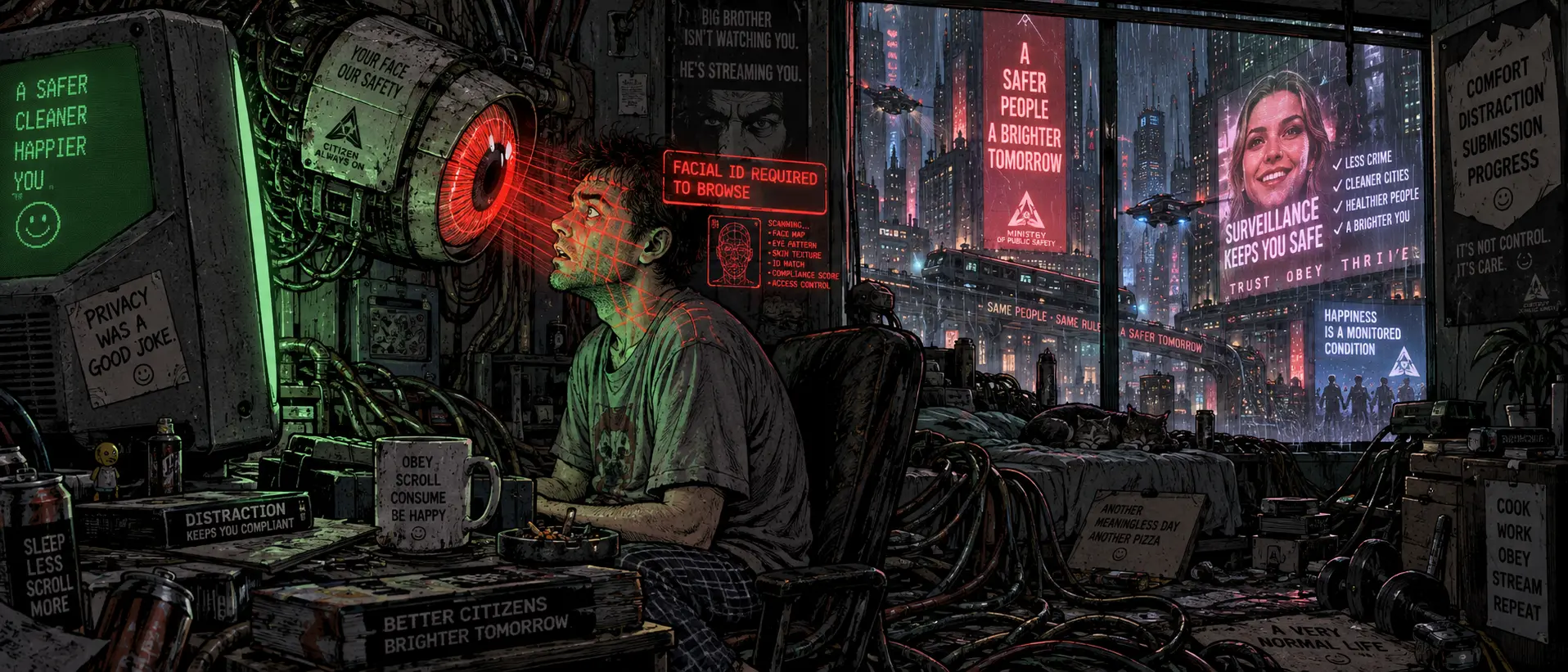
It feels like we have reached that tipping point where dystopian plots stop being fiction and become items in Ministry of Digital Development regulations and draft bills.
Over the past few days, amid yet another round of debates over restricting access to foreign platforms, officials' favorite record has been playing louder than ever in the infosphere: "We need to verify internet users by passport or through the Unified Biometric System (UBS) to protect children from destructive content." It sounds noble, holy, and maximally caring. That is, if you don't turn on critical thinking for at least thirty seconds.
In reality, this is a classic bait-and-switch: under the cover of parental fears, an infrastructure of total digital de-anonymization is being built.
Anatomy of the Showcase: Why the State Wants Your Selfie Before Entering the Net
The average person naively assumes: "Well, I'll link Gosuslugi to the browser, I'll verify my age with my face—I have nothing to hide, I'm just watching memes and DIY videos anyway."
Let's look at how this mechanism unfolds at the architectural level:
The End of the Presumption of Digital Innocence. As soon as network access is tied to a biometric profile, the boundary between private browsing and an official appeal to a government agency is erased. Any search query, any link click, or video view is instantly tied to a specific SNILS and physical individual.
The Black Market Gets the Holy Grail. Corporations and agencies assure us that biometrics are stored "in top-tier secure perimeters." But we remember how many such perimeters leaked into the open access over the past two years. A password can be changed two minutes after a leak. You cannot change your face, fingerprint, or voice for the rest of your life. A leaked biometric database is a lifelong digital wolf's ticket.
The Personal Kill Switch. If all access is tied to a single digital ID, the regulator no longer needs to struggle with blocking services or protocols. It is enough to set an access_denied flag in the profile of a specific objectionable citizen—and the entire internet goes dark for them, from banking to ordering a taxi.
Why Free Workarounds Turn Into a Trap
When these screws start tightening in earnest, 95% of users make the standard mistake: they rush to download the very first free browser extension or mobile app they find.
What happens at this moment:
Canvas & Audio Fingerprinting. The free service happily collects a unique snapshot of your system—from screen resolution to installed fonts—and matches it to your real profile when you accidentally open a tab without a tunnel.
Injection of Ads. Instead of protection, you get a parser that replaces links, collects browsing history, and leaks it to data brokers.
The Illusion of Security. While a proxy is enabled in one window, the second browser window happily sends the operating system's telemetry directly to your ISP with your real IP.
How to Maintain Privacy in the Era of Intrusive Biometric Control
If the system is built on linking your identity and network activity, the main task is to physically and logically sever these connections:
Environment Isolation at the Virtualization Level. Set up a separate clean browser profile (or better yet, an isolated virtual machine or a separate cheap mini-PC) exclusively for surfing unrelated to personal accounts, banks, and government services. No shared cookies, saved passwords, or autofill.
Hardware Fingerprint Masking. Use browsers with aggressive anti-fingerprinting protection (hardened Firefox, Brave with telemetry disabled, LibreWolf) that present sites with a standard averaged profile, preventing sessions from being linked together.
Gateway-Level Tunneling. Encrypt traffic not via a browser extension, but at the entrance to your home network—via a router configured with a private transport protocol (VLESS Reality). When traffic is encrypted before it leaves your apartment, your local ISP sees only a monotonous stream of data to a trusted node.
Freedom on the net is never given by default—it is either protected by proper protocol configuration or voluntarily surrendered in exchange for illusory convenience.
Keywords (SEO): internet access by passport, biometrics for the internet ubs, network de-anonymization, biometric data leak, personal data security 2026, blocks and whitelists, how to protect digital profile.