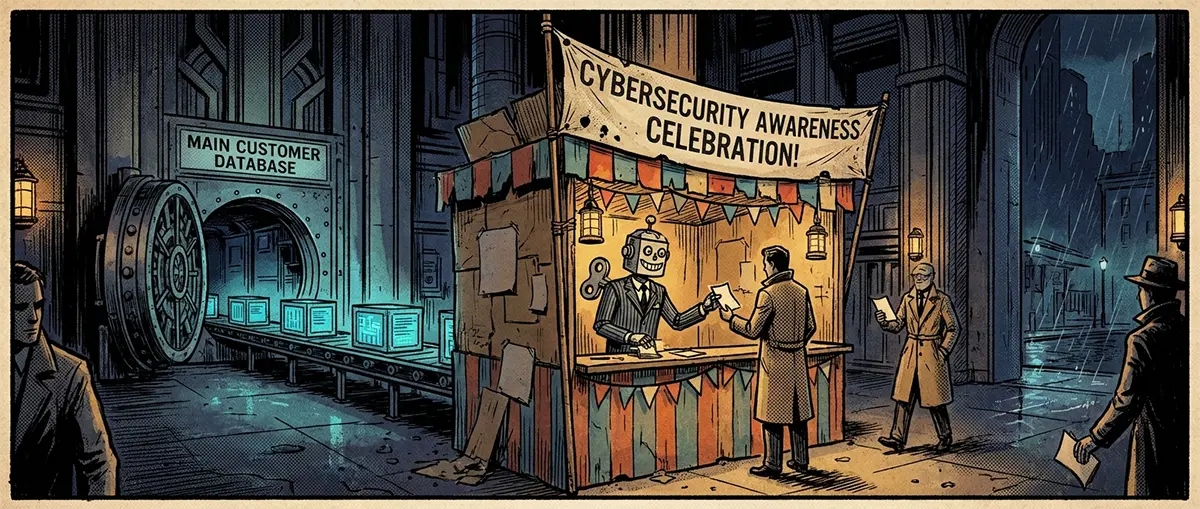
Yesterday, we broke down the fundamental engineering level—how BGP anomalies and blackholing disrupt connectivity at the prefix level. Today, strictly following our alternating schedule of "engineering vs. everyday operational pain," we descend to the mortal reality of offices, open-plan workspaces, and corporate psychology.
The occasion is indisputable: the calendar marks the start of the traditional International Cybersecurity Awareness Month.
All October long, every single corporate newsletter, banking app, and digital channel will bombard us with tons of well-meaning advice: "change your password every 30 days," "add a special character," "take a mandatory five-question test." IT departments will check the boxes for compliance reports, HR will report on successful staff training, and top management will let out a collective sigh of relief.
And in November, yet another database containing 50 million rows of passport data and financial transactions will peacefully end up on a dark web forum.
Why has this ritual turned into a circus, and where is security actually bursting at the seams? Let's take off the rose-colored glasses.
Security Theater: Training You to Fear the Wrong Things
Corporate "cyber-literacy" of recent years is stuck firmly in the past and rests on three harmful dogmas:
- The cult of regular password rotation. Forcing employees to change their passwords every month is the absolute best way to guarantee a security hole. A human being is physically incapable of remembering dozens of random combinations. The outcome is entirely predictable:
Password2026!turns intoPassword2026?, and carefully placed yellow sticky notes appear on monitors. NIST (the National Institute of Standards and Technology) exposed this practice as counterproductive years ago, yet it continues to flourish in local regulations. - Staged phishing just for the checklist. Security teams love sending employees training emails with links like "Company Anniversary Bonus." Did an accountant fall for it? They get assigned a boring two-hour lecture. Meanwhile, real phishers haven't sent sloppy spam in ages—they use targeted social engineering in Telegram posing as the CEO, complete with a neural-network-generated deepfake voice message. Corporate awareness tests do not prepare people for this at all.
- Shifting the blame to the weak link. The concept that "humans are the main vulnerability" is wildly convenient for management. If a database is stolen, you can always blame some secretary who clicked on a PDF, rather than admitting the hard truth: the company lacked network segmentation, access rights hadn't been revoked in years, and databases were left in plain text on a test server without a password.
Real Vectors: Where Data Actually Leaks From
While frontline staff are being trained not to open suspicious attachments, the real breaches remain wide open:
- The Sacred Cow Syndrome (C-Level Vulnerabilities). Top managers and directors hate two-factor authentication and complex passwords—“it’s inconvenient, I’m a busy person.” IT teams quietly make special exceptions for them in security policies. As a result, the most privileged account with access to all accounting is protected by a maiden name.
- Shadow IT and Contractors (Supply Chain). Protecting the office perimeter is useless if data is handed over to an outsourced marketing agency staffed by students sharing a single login among ten people. 80% of high-profile incidents don't start with a core company breach, but with the compromise of a small subcontractor trusted with a customer database for SMS campaigns.
- Unmanaged APIs and Forgotten Environments. Developers spin up a test environment to check a new feature, upload a real copy of the customer database, forget to close the port to the outside world—and three days later, an automated scanner scrapes it.
Practical Hygiene: How to Make Security Month Actually Useful
If we strip away the corporate showmanship, real protection for your personal and professional space comes down to three strict engineering rules:
- Kill passwords in your head—switch to password managers and Passkeys. Stop inventing and memorizing combinations. A local or encrypted password manager (KeePass, Bitwarden) generates unique 25-character strings for every resource. If one service is breached, the rest remain secure. And wherever available, transition to passwordless Passkeys.
- Hardware factors instead of SMS. No cellular network codes for critical nodes. Use standalone authenticator apps (TOTP) or physical FIDO2/U2F keys (YubiKey). They cannot be intercepted via a SIM-swap attack or a rogue cell tower.
- The Zero Trust Principle in messengers. Get this through your head: a boss, colleague, or friend who suddenly writes on Telegram asking to "urgently send a file," "lend money," or "read out a code" is compromised by default, even if a voice message sounds exactly like them. Any non-standard financial or work-related action must be verified exclusively through an alternative trusted communication channel.
True cybersecurity is not a festive banner on the intranet once a year. It is a routine, architectural limitations, and letting go of the illusion that "it could never happen to me."