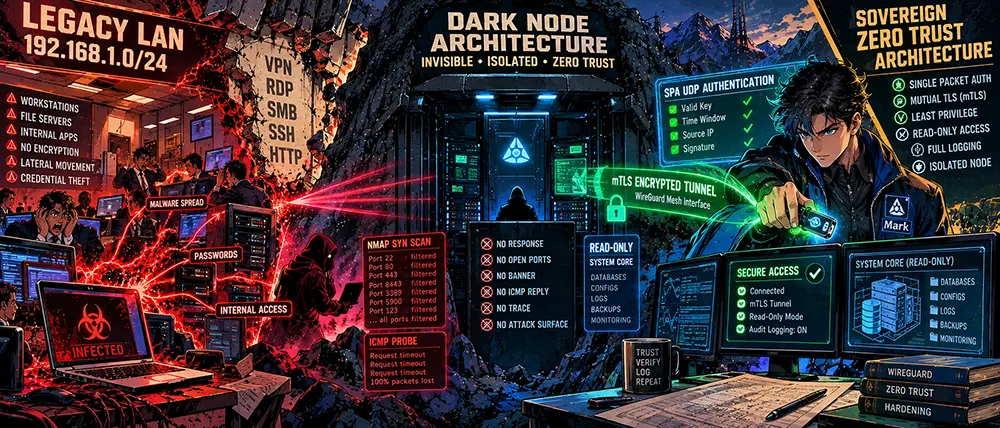
You build a stone house behind a five-meter fence, install massive gates, keep guard dogs in the yard, and lock the front door with a heavy padlock. You are certain that absolute peace reigns inside the perimeter: the doors to the bedroom, office, and basement are wide open, the safe is unlocked, and the car keys are sitting on the hallway table. After all, an intruder cannot get past the fence.
Yet one night, the fence is breached not by a burglar with a crowbar, but by a pizza delivery person whose jacket pocket contains a quietly beeping tracking beacon. Or by the neighbor's teenager, who climbed over the barrier to retrieve a stray ball and left the wicket gate slightly ajar.
As soon as the outer fence is breached at even a single point, your entire house turns into open prey. The burglar no longer needs to pick the interior doors: the entire infrastructure inside blindly trusts anyone who has managed to step across the property threshold.
This is precisely how corporate and home local area networks (LANs) have been built for decades. Engineers entrenched themselves along the perimeter with heavy firewalls, but left a sterile void inside: databases without traffic encryption, open SMB network shares, trusted SSH keys on servers, and blind trust in every IP address from the 192.168.1.0/24 subnet. The hostile Internet of the 21st century has proven one thing: the concept of a protected perimeter is dead. If your server trusts a local neighbor simply because they share a physical cable, you are already compromised.
Hold on. If to you Zero Trust is just a marketing brochure with a paid subscription to a cloud service from Microsoft or Cloudflare, close this tab. Continue delegating security to someone else's infrastructure.
But if you run your own dedicated servers, assemble independent private loops, and want to build an architecture where every network packet is treated as a hostile infiltrator even inside the local loopback — put on your tactical headset. We are about to design a silent, deaf perimeter.
Architectural Illusion: Why Corporate Zero Trust is a Trap
Corporations have distorted the original meaning of the Zero Trust paradigm. Under this brand, giants sell indentured dependence: "Buy our SaaS proxy, route all internal company traffic through our data centers, install our proprietary agent on every device, and we will decide who gets access." This is not zero trust. This is outsourcing absolute, blind trust into someone else's pocket.
True Zero Trust on your own independent hardware relies on three axioms:
- The network is hostile by default.
- The physical local network, the telecom operator's interface, the hosting virtual switch, and the neighboring port in the data center switch are all considered equally compromised. Traffic is not split into "internal safe" and "external dangerous."
- Zero visibility (Dark Node Architecture).
- A server must not respond to ICMP echo requests, must not expose open ports during an Nmap SYN scan, and must remain silent to any probing attempts. A port opens only after cryptographic authentication of the sender at the data link layer.
- Continuous cryptographic verification of every transaction (mTLS Everywhere).
- No service has the right to call another service simply because their IP addresses match. Every internal microservice, database, and API gateway requires mutual certificate authentication (Mutual TLS) and short-lived authorization tokens.
Under the Hood of a Sovereign Perimeter: Cryptographic Silence via SPA and WireGuard Mesh
To build a truly isolated autonomous loop that cannot be detected by external scanners, a combination of pre-handshake authorization protocols and a fully connected cryptographic mesh network is used.
[External World / Attacker] ──> [TCP SYN Scan] ──> DROP (Complete Silence)

[Legitimate Client]         ──> [UDP Single Packet Auth] ──> [Daemon fwknop / eBPF]
                                    │                           │
                                    │ (Valid HMAC + AES)        ▼
                                    └───────────────────> Temporary iptables pass rule
                                                                │
                                                                ▼
                                                    [WireGuard / Noise Protocol]
                                                                │
                                                                ▼
                                                    [Isolated mTLS Loop]
1. Single Packet Authorization (SPA): Kernel-Level Invisibility
Standard ports like 22/TCP (SSH) or 443/TCP exposed to the outside accept a SYN TCP packet and reply with a SYN-ACK packet. This reveals the presence of the service to any automated Shodan or Censys scanner.
In a deaf perimeter architecture, the network stack is slammed shut by a DROP rule.
- Access is requested via Single Packet Authorization (SPA), for example using the
fwknoputility or a custom XDP/eBPF filter. - The client sends a single encrypted packet to a random closed UDP port on the server, containing a timestamp, an HMAC cryptographic hash, and a public session key.
- The server passively intercepts the packet at the
libpcapsocket layer or via an eBPF hook without sending any acknowledgment back to the network. - If the HMAC is valid and the time drift does not exceed 30 seconds (protection against replay attacks), the daemon locally punches a dynamic rule into the firewall, allowing incoming connections from that specific IP address for exactly 15 seconds to establish a tunnel. To the rest of the world, the port remains a solid stone wall.
2. The Noise Protocol and Eliminating DNS Trust
Communication between nodes of the private perimeter is built on the Noise cryptographic protocol (the core of WireGuard). Unlike classic IPsec or OpenVPN:
- WireGuard has no cipher negotiation states. The cipher suite is hardcoded: ChaCha20-Poly1305 for encryption, Curve25519 for key exchange, and BLAKE2s for hashing.
- If a packet is encrypted with the wrong key, the server simply drops it silently. It does not reply with an
RSTpacket, it does not complain about an incorrect certificate, and it does not give an attacker even a single byte of information for cryptographic fingerprint analysis. - All internal traffic within the private loop is tightly bound to static cryptographic identifiers (Cryptographic IP / Overlay Addresses). Public DNS queries are completely eliminated: nodes resolve each other through encrypted configuration maps or a protected local
hostsfile.
Engineering Assembly Protocol: Erecting an Autonomous Bastion
Implementing a Zero Trust scheme on an independent dedicated Linux server requires strict low-level constraints.
- Total Network Interface Drop Policy (Host Hardening).
- The base firewall configuration must destroy any attempts to scan the stack:
- Bash
# Reset all default chains to drop
iptables -P INPUT DROP
iptables -P FORWARD DROP
iptables -P OUTPUT ACCEPT

# Allow local loopback and established connections
iptables -A INPUT -i lo -j ACCEPT
iptables -A INPUT -m conntrack --ctstate ESTABLISHED,RELATED -j ACCEPT

# Protect against OS fingerprinting
sysctl -w net.ipv4.icmp_echo_ignore_all=1
sysctl -w net.ipv4.tcp_syncookies=1
sysctl -w net.ipv4.conf.all.rp_filter=1
sysctl -w net.ipv4.conf.all.accept_redirects=0
sysctl -w net.ipv6.conf.all.disable_ipv6=1
- Isolating Services in Unprivileged Network Namespaces.
- Critical daemons must not listen to the host interface directly. The service is placed inside an isolated namespace connected to the virtual tunnel via a
vethpair:
- Bash
# Create an isolated namespace for the database
ip netns add vault-isolated
ip link add veth-host type veth peer name veth-vault
ip link set veth-vault netns vault-isolated

# Assign isolated addresses and bring up interfaces
ip addr add 10.200.0.1/30 dev veth-host
ip link set veth-host up
ip netns exec vault-isolated ip addr add 10.200.0.2/30 dev veth-vault
ip netns exec vault-isolated ip link set veth-vault up
ip netns exec vault-isolated ip link set lo up
- Enforcing mTLS for Inter-Service Communication.
- Any communication between your daemons across different servers is wrapped in Mutual TLS using your own local certificate authority (an Offline CA based on
step-caorOpenSSL). NGINX or Envoy configured as a proxy strictly requires a client certificate:
- Nginx
server {
    listen 8443 ssl;
    server_name internal.perimeter.local;

    ssl_certificate /etc/ssl/certs/server.crt;
    ssl_certificate_key /etc/ssl/private/server.key;

    # Verify client certificate against trusted root key
    ssl_client_certificate /etc/ssl/certs/internal-ca.crt;
    ssl_verify_client on;
    ssl_verify_depth 2;

    ssl_protocols TLSv1.3;
    ssl_prefer_server_ciphers off;

    location / {
        proxy_pass http://10.200.0.2:8080;
    }
}
- Hardware Configuration Integrity Watchdog (Immutable Root).
- The root filesystem of the autonomous node is mounted in
read-onlymode. All mutable data is moved to encrypted LUKS partitions with keys stored in RAM or on a physical hardware token. If unauthorized modification of system files is attempted, the kernel panics and forcibly reboots the node into a clean image.
Security begins the moment you stop believing in the illusion of internal borders. In the digital world, there are no longer any trusted zones, safe rooms, or clean providers. Either your server is invisible, silent, and demands mathematical proof for every transferred byte, or it belongs to whoever is first to find the wicket gate left unattended. Autonomy is not buying a ready-made solution; it is the architectural discipline of total distrust.