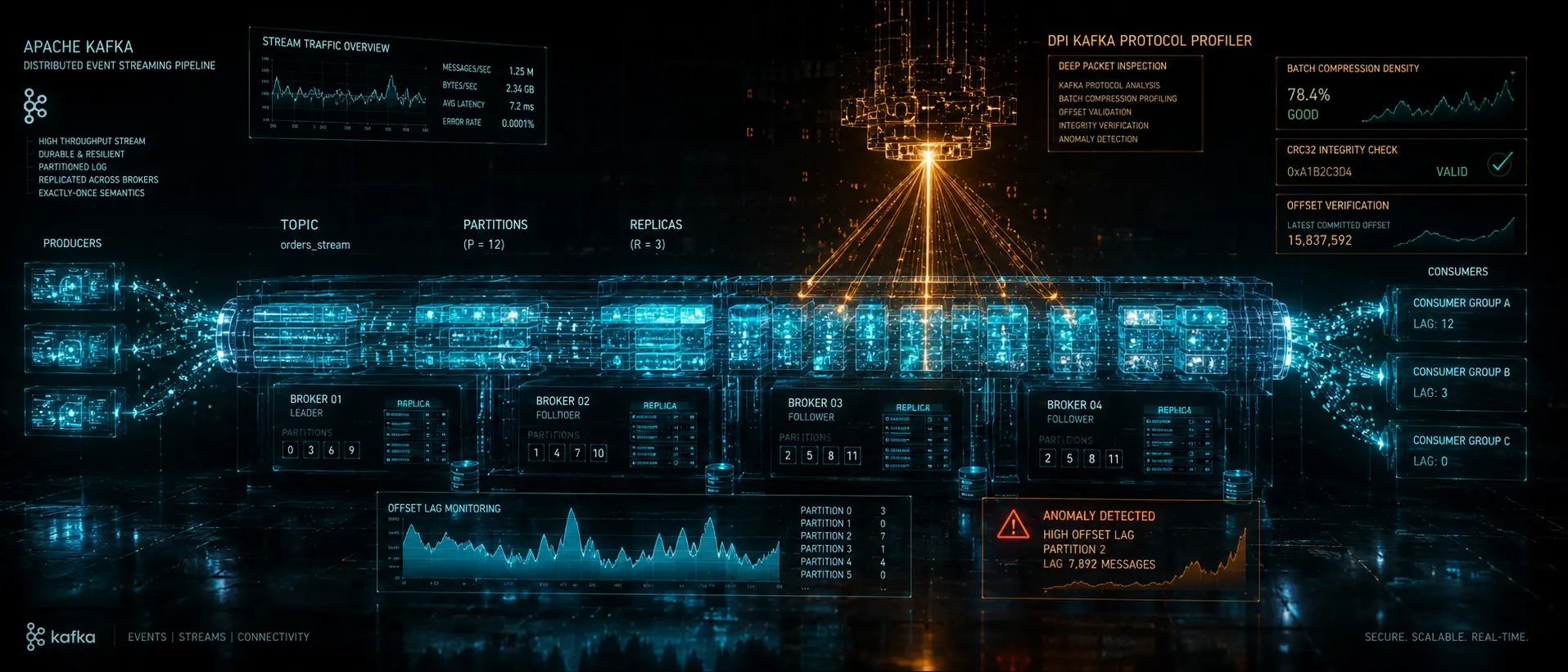
Today we dissect a hidden threat from the past 24 hours that targets the masking of tunnels as distributed messaging and event streaming protocols (Apache Kafka Protocol over TLS, SASL/SCRAM Handshake over HTTPS). We will analyze the **Kafka Fetch/Produce Batch Pacing asymmetry measurement attack and entropy splitting analysis in RecordBatch (Kafka RecordBatch Compression Discrepancy & Partition Offset Jitter Profiling)**.
**The Message Queue Trap: Why Masking as Kafka over TLS Has Become an Open Signature for DPI**
To bypass strict lists of trusted corporate services and embed themselves within legitimate enterprise traffic, proxy module operators have begun massively wrapping tunneled transit into the binary **Apache Kafka protocol (ports 9092, 9093, 9094)** over TLS. The logic appeared mathematically flawless: distributed message brokers continuously pump petabytes of financial transactions, logs, and event streams between distributed data centers around the clock. Directly blocking the Kafka protocol would paralyze the internal data bus of any bank or large retailer.
However, the Kafka protocol operates on the concept of **RecordBatch (v2)**, where an array of messages (Records) is packed with strictly structured headers (First Offset, Length, Partition Leader Epoch, Magic Byte 0x02, CRC32C, Attributes with Snappy/LZ4/Zstandard compression types).
A large-scale audit of network anomalies over the past day showed that the System no longer needs to attempt TLS decryption. It identifies the hidden transit tunnel through the **mathematical disruption of partition offset sequences and the complete absence of hardware-level RecordBatch compression fluctuations**.
The system catches "Kafka-masked" proxy traffic by *how unnaturally the socket generates ProduceRequest and FetchResponse packets to pump user data*.
**Anatomy of Detection: How Kafka RecordBatch & Partition Offset Profiling Works**
In a native client (librdkafka, kafka-python, Java KafkaClient), interaction with the broker adheres to strict partition interaction mechanics:
1. The client requests cluster metadata (MetadataRequest, API Key 3) to obtain a list of brokers and topics.
2. Messages are sent in batches via ProduceRequest (API Key 0), where message offsets (BaseOffset, LastOffsetDelta) strictly and monotonically increase within each topic partition.
3. Data inside the batch is compressed using Snappy or Zstandard algorithms. Legitimate JSON or Protobuf yields a clear, mathematically predictable compression ratio (CR from 2.5 to 6.0).
The analysis schemes deployed on TSPU over the past day calculate proxy tunnels based on three fundamental discrepancies:
1. **Uncompressible RecordBatch Anomaly (High-Entropy Batch Defect):** Proxy stacks embed general-purpose binary encrypted payloads into the Kafka Record payload. Because user encrypted traffic possesses maximum entropy, the size of the packet "compressed" via LZ4 or Snappy ends up equal to the uncompressed size (compression ratio CR ≈ 1.0). For an L7 analyzer, a Kafka broker session generating RecordBatch batches with zero compression across gigabytes of streaming data is an instant ban trigger.
2. **Partition Offset Sterility (Zero-Delta Offset Inconsistency):** To avoid complicating the stack, proxy modules transmit static or random offsets in packet headers, violating strict arithmetic increment rules: LastOffset = BaseOffset + RecordsCount - 1. The lack of monotonicity in offsets within a topic instantly highlights the synthetic emulator.
3. **Absence of Metadata Reconciliation Loops (Missing Metadata Polling Jitter):** Real producers and consumers regularly update cluster topology via MetadataRequest with exponential backoff timeout (retry.backoff.ms). Proxy clients continuously pump Produce/Fetch requests without a single poll of partition leader states.
```
[Legitimate Kafka Client]: [MetadataReq] ──► [ProduceReq (Offset Monotonic, Snappy CR 3.5x)] ──► OK
[Kafka Proxy Tunnel]: [TCP Connect] ──► [ProduceReq (Broken Offset, High-Entropy Payload)] ──► [DPI Analyzer]
│
(RecordBatch CRC & Offset Logic Analysis)
│
▼
INSTANT BAN
```
Over the past 24 hours, it has become definitively clear: censors have descended to the level of validating internal message queue logic and stream-distributed broker offset mathematics.
**Why Simply Sending Headers to Port 9092 No Longer Works**
Popular modules that pack encrypted traffic into dummy Kafka protocol calls without maintaining BaseOffset monotonicity and broker state machine emulation have been subjected to forced connection resets (TCP RST) over the past day. Filters instantly respond to logical fractures in the RecordBatch structure.
**Countermeasure Architecture: How to Make a Kafka Profile Canonical**
To ensure a tunnel disguised as a message queue remains invisible to deep L7 analysis, the proxy transport layer must support complete protocol semantics:
* **Steganographic Packaging into JSON/Protobuf Structures (Payload Deserialization Emulation):** Slicing tunneled traffic into small fragments packed into pseudo-valid JSON events or Protobuf messages, ensuring natural entropy and a normal compression ratio via the Snappy algorithm.
* **Honest Offset Monotonicity Calculation (Strict Partition Offset Arithmetic):** Implementing a partition state machine on the proxy core side with strict BaseOffset increments, CRC32C checksum calculations, and valid timestamp generation for each message in the batch.
* **Broker Service Loop Emulation (Cluster Topology Polling):** Interspersing periodic Metadata, FindCoordinator, and Heartbeat requests with plausible cluster polling intervals.
The new phase of confrontation proves that reliable masking requires seamless compliance with the logic of the masked protocol down to its offset mathematics. Do not give the System a chance to catch you on broken queue headers. Design your network stack keeping the finest nuances of data brokers in mind and build tunnels indistinguishable from a real corporate data bus.
#cybersecurity #Kafka #EventStreaming #BigData #DPI_Filtering #TrafficAnalysis #RecordBatch #EnterpriseSecurity #vpn-top-shop