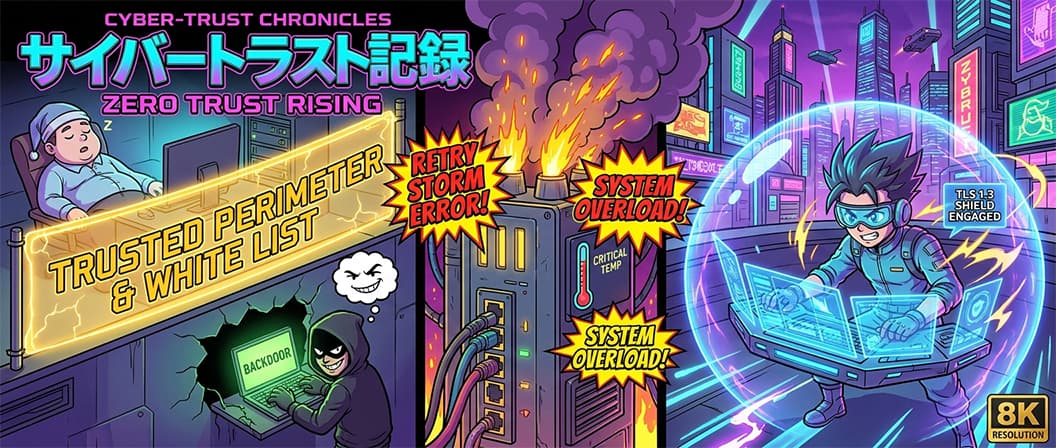
Every time news feeds report another «successful regulatory test of network segment isolation,» the technical community splits into two camps. Some discuss sovereign infrastructure, while others hunt for fresh bypass methods. However, a fundamental engineering paradox remains behind the scenes: the concept of a closed perimeter does not protect an infrastructure—it makes it structurally vulnerable.
Recent developments surrounding tightened traffic filtering regulations and discussions of mandatory whitelists clearly illustrate the current vector: the illusion of security is built on the assumption that the threat always comes from the outside.
This is a critical design error.
1. Architectural Blindness Inside the «White List»
What happens when access to resources or services is squeezed into the rigid framework of «allowed» addresses and national gateways?
- A false sense of security.
- Engineers and developers inside the «clean zone» unconsciously begin to lower internal security requirements: requirements for mutual microservice authentication are simplified, static tokens are used instead of dynamic rotations, and internal traffic between databases and interfaces stops being encrypted properly.
- Attack via a legitimate vector (Living off the Land).
- An attacker no longer needs to search for complex zero-day exploits to breach the perimeter. It is enough to compromise at least one node already on the trusted list—whether it is a partner API, a forgotten test server, or a remote engineer's workstation. Once inside, the attacker gets carte blanche: intrusion detection systems (IDS) within the «trusted contour» operate in a lenient mode to avoid generating false positives for business logic.
A whitelist does not stop a breach—it guarantees that if a compromise occurs, it will remain unnoticed for significantly longer.
2. Degradation as a Compromise Vector (DDoS in Reverse)
Traditionally, it is believed that a denial-of-service (DoS) attack originates from distributed botnets. In modern realities of strict filtering, however, architectural collapse is most often provoked by the control system itself:
- Stateful DPI as a bottleneck.
- To validate sessions according to complex whitelist rules and heuristic features, carrier routers are forced to store millions of connection states in memory. When real user traffic spikes, translation tables and buffer queues instantly overflow.
- Cascade session tearing.
- The result is not just latency, but disrupted TCP handshakes and socket timeouts. For distributed applications, this is fatal: background processes begin massive reconnections (Retry Storm), finally finishing off edge gateways.
A system designed to filter external noise turns into an artificial denial-of-service generator itself during peak load hours.
3. Why a Personal Gateway Beats the Corporate Perimeter
Attempts to escape these problems using standard encryption tools run straight into a wall of signature analysis. If a communication protocol looks like an anomaly, it automatically falls under algorithmic throttling.
A viable model of digital sovereignty today is based on the exact opposite approach:
- Zero Trust for any transport.
- The network layer is considered hostile and unreliable by default. No node within the infrastructure should trust another simply because they are in the same subnet or behind the same white IP.
- Transport mimicry.
- The payload must be indistinguishable from standard, mass internet traffic (e.g., valid TLS 1.3 with real session certificates). When a channel looks like a regular background session to a major cloud provider, inspection systems have no reason to place it in penalty buffering queues.
- Routing autonomy.
- Owning your own independent exit node eliminates neighbor noise and protects against falling under mass subnet blocklists of large providers.
Data security is determined not by the height of the fence erected by a regulator or operator, but by the cryptographic strength and autonomy of your own architecture. In an era of artificial barriers and unstable gateways, control over your own network channel is not a luxury, but a basic technical requirement for independence.