Picture the director's reception area. The secretary is sorting through the mail when suddenly a courier in a branded jacket delivers a sealed envelope with a wax seal. The envelope is stamped in large letters: "Head Office Security Department. Single-use pass inside. Do not share with anyone." Two minutes later, a polite guy in a tie rushes breathlessly into the reception area: "Hello! Our courier accidentally gave you the envelope with my server room pass. There are five digits on the form, just take a quick look, I need to get in, the project is burning!"
The secretary looks at the official form, sees five digits, dictates them to the guy, who thanks them and leaves. An hour later, it turns out the guy entered the server room, disabled the backups, bound his master key to the system, and downloaded the client database.
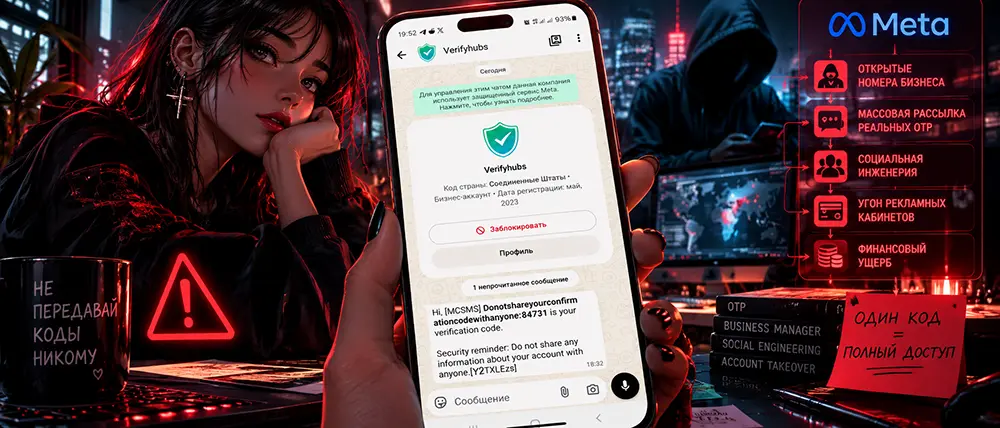
This is precisely how modern phishing via verified WhatsApp business hubs operates. The days of Nigerian princes and poorly translated emails with broken encoding belong in the archive. Today, attackers leverage official Meta business interfaces, green badges, and third-party phone numbers to covertly breach the corporate perimeter.
Stop. If you are convinced that an SMS with a code is always just a stranger's typo, and that you cannot be hacked "because there is nothing to steal" — close this tab. Continue believing that two-factor authentication protects against your own naivety.
But if your phone number is tied to Meta Ads budgets, corporate chat access, or business page administrator rights, it is time to peek behind the curtain of grey OTP aggregators. Next, we will break down the attack mechanics under the hood.
Architecture of Verification Hubs: Why WhatsApp Became a Cheap Breach Channel
To understand the nature of such messages, you need to look at the economics of cellular gateways. Sending a classic international SMS via a telecom operator costs services a significant amount per message. To cut costs, platforms are massively switching to the WhatsApp Business API (WABA) through third-party aggregators like MCSMS, Infobip, or Sinch.
Three fundamental vulnerabilities emerge in this interaction chain:
Out-of-Band Disconnect (Authorization Context Break).
The aggregator receives a command from a third-party service: "Send code 21972 to number +7...". The gateway itself has no idea what kind of login was initiated: a card linking, a crypto wallet registration, or a business account master password reset. The message arrives in an empty chat without specifying the target platform, leaving only a faceless template text demanding "never to share the code with anyone."
The Illusion of Trust in System Badges.
At the top of the chat interface, the WhatsApp interface proudly states: "This company uses a secure service from Meta to manage this chat." For an average employee, the word "secure" acts like hypnosis. The brain associates the messenger's system notification with the sender's legitimacy, even though the badge merely means the sender paid to use the cloud API.
Parsing Target Entrepreneur Databases.
Phone numbers for WhatsApp business accounts are almost always public. They are listed in website contacts, on advertising banners, and in social media profiles. Attackers take an open registry, run it through an automated service checker (Meta Business Suite, Google Workspace, banking interfaces), and trigger real verification packets to be sent to the victim's work number.
Vector Mechanics: How a Code Turns into an Account Takeover
The received code itself is only half the bridge. The breach occurs in the second phase when the social engineering scenario kicks in:
- MFA Fatigue / Push Bombing.
- A series of requests is launched against the phone number. When the phone vibrates for the tenth time in an evening, the owner loses concentration. At that moment, a call comes in, allegedly from advertising network support, demanding that the user "dictate the verification code to cancel an unauthorized spam attack."
Resetting the Business Manager Administrator Session.
- The target is often not messenger correspondence, but a linked Meta ad account. Upon receiving the confirmation OTP code, the attacker adds their third-party account as a backup administrator with full rights, after which the original profile is unlinked, and campaigns for running grey traffic with daily limits of thousands of dollars are connected to the linked cards.
- Hidden WhatsApp Web Session Hijacking.
- In some scenarios, the code is used to transfer the account to another device or authorize a third-party CRM connector that gains permanent access to all incoming business correspondence.
Engineering Defense Protocol: A Closed Perimeter for Business
Relying solely on employee attentiveness is not enough. Corporate security is built on isolation and the rejection of weak confirmation channels.
- Moving Away from SMS and Messengers in Favor of FIDO2 / Hardware Security Keys.
- One-time digital codes are an anachronism. All critical nodes (ad management, domain email, banking interfaces) must be transferred to hardware security keys (YubiKey) or at least software TOTP generators without cloud synchronization. A hardware key is physically impossible to dictate to a fraudster over the phone or send in a chat.
- Separation of Public and Administrative Perimeters.
- The phone number listed in customer contacts and tied to WhatsApp Business must never be used as a login or recovery method for Meta Business Manager, payment systems, and hosting. The administrative number must be closed, non-public, and registered to a separate physical SIM card.
- Instant Blocking and Reporting of Fake Business Gateways.
- When receiving an uninitiated message via business chat, the number should not simply be ignored. The "Block" button must be pressed along with a spam report. This lowers the sender's business account trust score within Meta's infrastructure and leads to the automatic suspension of their mailing tokens.
- Configuring Session Monitoring and Role-Based Access Control.
- Company settings should mandate two-factor authentication for every team member. Daily spending limits on ad accounts must be strictly fixed on the card-issuing bank's side, rather than just within the Meta interface.
Business account security ends the exact moment trust is handed over to a pretty badge or the system formatting of someone else's chat. The adversary no longer cracks ciphers—they manipulate context, forcing the target to voluntarily unlock the door from the inside. True digital immunity begins where any incoming request without an explicit, confirmed action inside the system is treated as hostile by default.