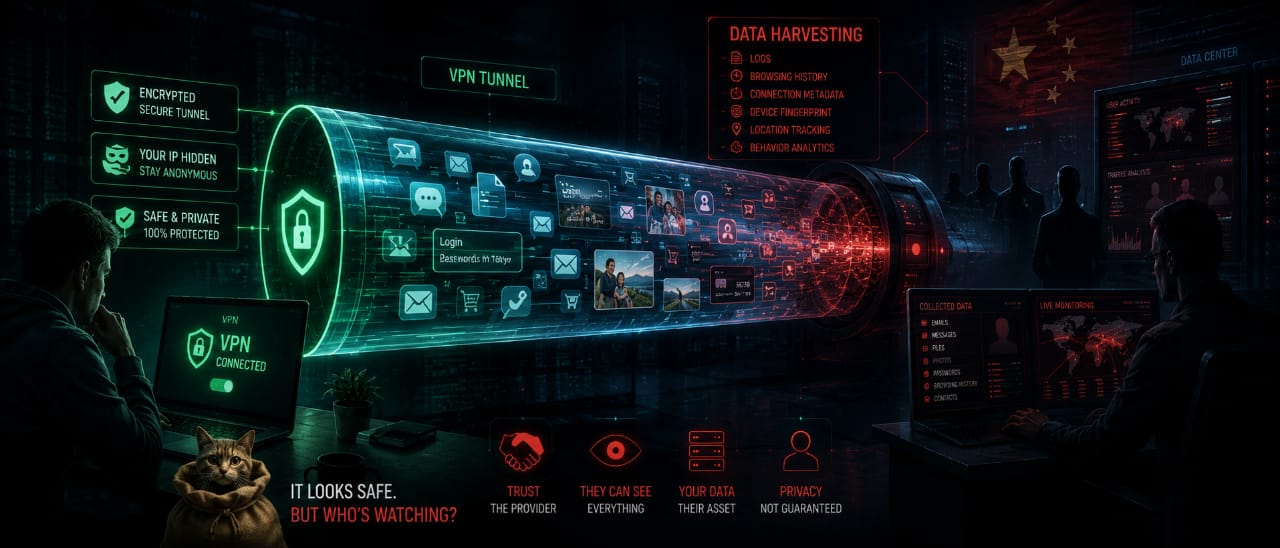
In the circumvention industry, there is a dangerous myth: 'If software effectively punches through strict government firewalls, it must be an excellent, reliable defense.' Users on international forums increasingly share recommendations for local Asian services, led by so-called 'cat' proxy providers (such as SakuraCat and similar 'airports'). Expats and locals recommend them for their flawless speed and stability.
Yet behind this flawless performance lies a critical threat. Recent technical analyses and exposed data from independent forums prove that such services are not privacy tools; they are certified gateways for data collection and selective censorship.
We break down how the inner workings of 'authorized' proxies operate and why installing them on your devices means voluntarily leaking all your traffic.
The 'Cat Airport' Phenomenon and Built-in Censorship
Within heavily regulated networks (such as the Great Firewall of China), running a large commercial server network legally or over the long term without the knowledge of regulatory authorities is impossible. Services like SakuraCat operate on an unspoken agreement with regulators: they provide users with speed for gaming, streaming, or education while maintaining absolute control over their digital footprint.
Experienced users have uncovered alarming patterns in the architecture of this software:
Selective blocking inside the tunnel: Up to a certain point, the service functioned like a regular proxy. However, mandatory filtering has recently been activated within the VPN network itself. When attempting to access independent media resources, websites critical of governments, or—most importantly—the official website of the Tor Project, the tunnel dead-locks the connection. The VPN has become a censor itself.
Direct logging for security services: Because the control panels and legal entities of such accelerators are physically located within the jurisdiction of the PRC, all incoming and outgoing traffic, search history, and users' real IP addresses are logged. Data goes directly to departmental public security monitoring data centers.
How to Avoid Falling into an Infrastructure Ambush
If your goal is real security rather than just lowering ping in online games, using proprietary software from closed jurisdictions must be entirely ruled out.
The multi-layer principle (Chain-Routing): If for some reason you must use a local Asian proxy for initial network penetration, never route unencrypted traffic through it. An independent encrypted layer must always be applied over this connection—such as a pure overseas VPN (Mullvad, Proton) or your own VPS. The local provider will only see a connection to its node, while the internal contents and final destination sites will be hidden by the second layer of encryption.
Switching to sovereign VLESS chains: Instead of downloading closed apps with questionable reputations, rent independent cloud servers and deploy your own configurations on the Xray core with Reality obfuscation. This guarantees that your encryption keys do not reside on servers in Changsha or Shenzhen, and that logs physically do not exist.
Remember: if a censorship circumvention tool works suspiciously stably and fast where all other services get banned, it means this tool was created by the very same people coordinating those blocks.
#cybersecurity #SakuraCat #ChineseFirewall #DPI #dataleak #VLESS #Reality #bypassblocks #vpn-top-shop