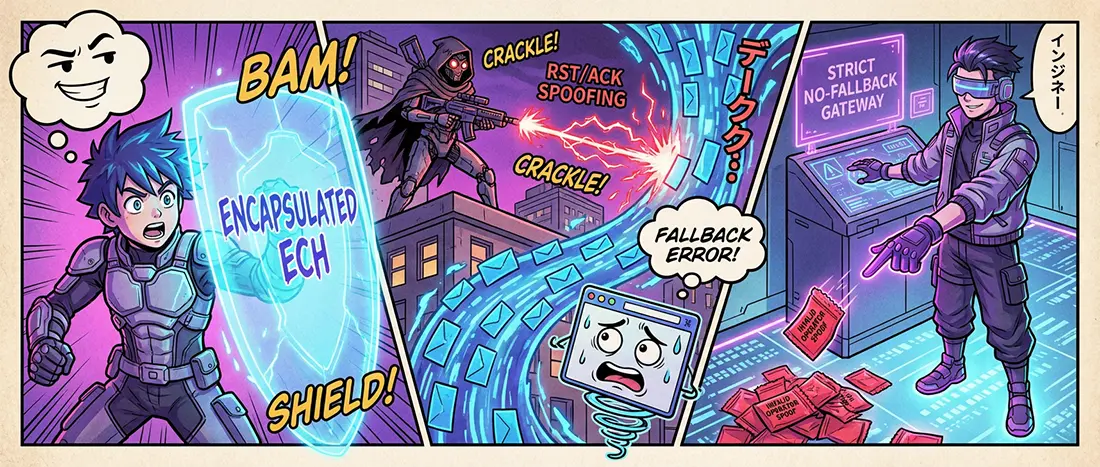
In debates about the future of encryption, a long-standing "silver bullet" was widely predicted to triumph over any deep packet inspection (DPI) system: the Encrypted Client Hello (ECH) standard. The idea seemed flawless: by hiding the Server Name Indication (SNI) field inside a pre-encrypted envelope, the edge filter loses its last anchor and can no longer determine which specific website the client is visiting.
However, recent network monitoring data and channel degradation patterns over the past few days reveal a harsh engineering reality: ECH does not defeat DPI; it simply shifts the plane of filtering.
Control systems no longer attempt to decrypt the masked name. Instead, they strike at the mechanics of session negotiation at the intersection of the transport and application layers.
1. The "Public Wrapper" (Outer SNI) Paradox
For ECH to work at all, the client must transmit a public, unencrypted Outer SNI header pointing to a trusted infrastructure (typically a major CDN), inside of which an encrypted Inner SNI with the real destination address is hidden.
In practice, this creates two fatal vulnerabilities immediately:
- Fronting as a red flag. Regulatory DPIs are well aware of the pool of providers supporting ECH. If an inspection module detects a request to a CDN with the ECH extension active, the session is instantly categorized as "high entropy with a concealed destination."
- Asynchronous blocking of public facades. The operator does not need to crack the cipher: it is sufficient to apply algorithmic throttling to the external IP address of the CDN edge node. Thousands of legitimate resources sharing the same Anycast pool with the target object of the block fall victim to this.
As a result, a technology designed to make traffic invisible turns the user into an ideal target for blanket shaping.
2. Death at the TCP Handshake Stage: How DPI Hijacks Control
The most sophisticated part of recent filtering regulations involves operating not at the content level, but at the transport protocol timing level:
- Proactive Reset Injection (RST/ACK Spoofing).
- The operator's edge router is physically closer to the user than the target foreign server. Upon intercepting an ECH session initialization, the DPI generates a forged packet with an
RSTflag or a distorted acknowledgment numberACK. The client TCP stack receives this packet 10–30 ms earlier than the actual response from the server and forcefully aborts the socket, considering the connection terminated by the remote party. - Artificial RTT (Round Trip Time) Inflation.
- If there is no direct disconnect, selective delay is activated: outgoing packets with ECH characteristics are forcibly placed in a waiting buffer. Once the round-trip time is artificially inflated above critical thresholds, the user's browser decides that the encrypted protocol is unavailable and attempts an automatic fallback to an open, filter-transparent TLS handshake.
Protection collapses not due to cryptography being broken, but due to logical flaws in application programs programmed to prioritize connectivity at the expense of privacy.
3. Design Flaws: Why the "ECH + Public VPN" Combination Fails
Many believe that combining encrypted DNS, browser-enabled ECH, and a standard commercial VPN client provides absolute protection. In reality, this setup proves fragile:
- Fragmented fingerprints. The browser sends requests through one network stack, the DNS resolver is queried through another, and the tunnel maintains the connection through a third. For heuristic analysis systems, such a discrepancy in headers, TLS versions, and TCP Window buffer sizes serves as a ready-made marker of an artificially assembled circuit.
- Vulnerability to session correlation. If the VPN provider's exit node is compromised or overloaded, the ingress operator correlates traffic spikes on the client modem with activity on external backbone links, completely neutralizing the encryption.
4. Anatomy of a Resilient Perimeter: Three Rules of Autonomy
To prevent a network channel from falling apart at the first heuristic DPI checks and succumbing to blanket throttling, the interaction architecture must follow strict discipline:
- Monolithic Transport with No Fallback (Strict No-Fallback).
- The connection must not attempt to be "smart" and fall back to unprotected protocols during delays or forged RST packets. The network interface must strictly ignore invalid acknowledgment packets arriving outside the expected sequence window (out-of-window ACK), cutting off operator spoofing.
- Unified Cryptographic Context.
- Name resolution, metadata transmission, and payload must be enclosed within the same seamless data stream addressed to a dedicated, independent point of presence. An external observer must not see a two-step process (first DNS, then a session to a new IP)—to them, the entire session must look like a monolithic, mundane data exchange with a persistent trusted node.
- Client-Side Hardware Independence.
- Control over networking equipment at the entry point is fundamental. Any security system is meaningless if a locked operator router is running on the subscriber's side, with firmware capable of resetting MTU parameters, leaking the local routing table, or blocking the web management interface upon external command.
Summary
The era of naive belief that the emergence of a new encryption protocol would solve all privacy problems has come to an end. Modern control systems have long learned to use protocol complexity against the users themselves, provoking timeouts and fallbacks to insecure profiles.
True resilience is achieved not by hunting for "magic checkboxes" in software settings, but by designing a cohesive, isolated infrastructure where every node—from the local modem to the remote server—is under your absolute control.