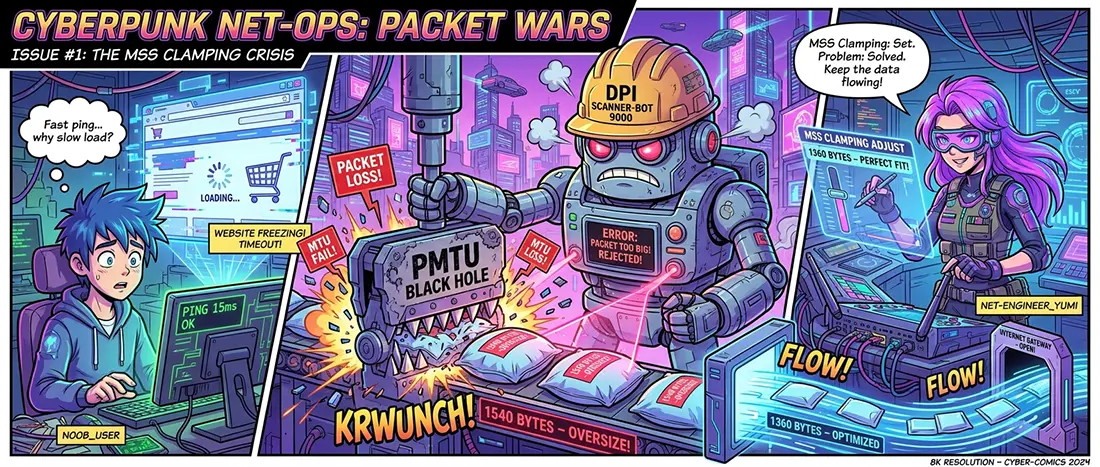
When network engineers discuss channel stealth, the conversation almost always boils down to cryptography: handshake algorithms, header encryption, metadata obfuscation. However, in practice, edge TSPU complexes and carrier filters increasingly exploit the fundamental physics of the data link layer—the Maximum Transmission Unit (MTU) size and the resulting packet fragmentation.
Fresh patterns of covert traffic throttling and nighttime tunnel drops show that filters don't need to crack your encryption. They just need to see how your packets hit edge gateways.
1. The Architectural Trap of Overhead: Why Packet Size Tells the Whole Story
In classical wired Ethernet, the standard frame size is 1500 bytes (MTU = 1500). The overwhelming majority of web servers on the internet send heavy static content, fitting precisely within this limit to utilize bandwidth as efficiently as possible.
But as soon as you pack your traffic into a secure tunnel:
- New headers are added to the original packet: external IP, transport header, cryptographic authentication tags (Auth Tag), and protocol service bytes for obfuscation.
- As a result, a 1500-byte packet bloats to 1540–1580 bytes.
- Since the ISP's physical channel (especially in LTE/4G networks, where the baseline MTU is often clamped at 1420–1460 bytes) cannot pass such a packet whole, forced fragmentation kicks in, or an ICMP
Fragmentation Neededmessage is sent.
For a modern edge DPI, this is an ideal marker:
- If a dense stream of packets comes from a subscriber with the fragmentation flag set, or in series of paired datagrams (one large, the second a small fragment of 60–100 bytes), the filter unequivocally flags the presence of an encapsulated tunnel.
- Even if the traffic is disguised as a web session, an anomalous effective Maximum Segment Size (MSS) gives away the double data packaging without complex heuristic analysis.
2. The Silent Black Hole (Path MTU Discovery Black Hole)
The most insidious method of carrier interference against such packets is the intentional blocking of the control ICMP protocol:
- By standard, when a router cannot pass a packet without fragmentation and the sender has prohibited it with the
DF(Don't Fragment) flag, the node must return anICMP Type 3, Code 4packet specifying the allowed size for the next node. - Carrier edge filters massively block transit ICMP traffic under the guise of protection against scanning and DoS attacks.
- Result: Your computer or router sends a full frame, the carrier's edge gateway silently drops it without returning an error notification. Lightweight packets (ping, DNS queries, small service commands) pass through perfectly, creating the illusion of a "working network," but as soon as real data transfer begins, the session hangs dead.
The user sees a stable 15–20 ms in the ping utility, but web interfaces won't load and connections time out.
3. Automatic Configuration Errors
Many rely on standard operating system mechanisms (such as automatic MSS clamping in the Linux kernel or built-in Windows algorithms). However, under aggressive filtering conditions, they fail:
- Adaptation delay. The TCP stack only reduces packet size after several failed attempts and loss bursts. In mobile and radio networks with high jitter, this process triggers a chain reaction: latency spikes, and the ISP shaper pushes the "unstable" connection into a penalty queue with lowered priority.
- Rented hardware blindness. If there is a locked ISP modem at the entry point with restricted access, you cannot forcibly set MSS recalculation rules at the hardware level. The modem attempts to transmit raw frames into the cellular network, where they inevitably run into the radio interface limitations of the base station.
4. Practical Circuitry: Eliminating the Size Signature
To ensure a network stream doesn't stand out from background internet traffic and fall under packet-dropping algorithms, the entry point architecture must follow strict calibration:
- Preventive calculation and rigid MTU fixing.
- You cannot leave packet size up to automation. For tunnels running over mobile and unstable carrier channels, the base
MTUof the client virtual interface must be proactively lowered (down to values around1280–1360bytes depending on the obfuscation layer) with mandatoryTCP MSScorrection at the local firewall level (iptables -t mangle -A FORWARD -p tcp --tcp-flags SYN,RST SYN -j TCPMSS --clamp-mss-to-pmtu). - Padding to standard quanta.
- Service transport must supplement small outgoing packets with random garbage (Padding) up to standard web response lengths. This strips the DPI of the ability to build a spectral profile of frame length distributions.
- Full control of the edge router.
- The hardware gateway on the user side must support independent management of mangle tables and advanced queue management algorithms (CAKE / FQ-CoDel). Only independent hardware with open access to the network stack makes it possible to mitigate size anomalies before the packet touches the carrier's cable.
Summary
In cybersecurity, there are no secondary details. You can build flawless cryptographic defense and rent an isolated tier-1 server, yet give yourself away with a banal 40-byte header overhead.
True perimeter resilience begins at the intersection of layers 2 and 3 of the network model. If your packet size raises no questions for edge routers and doesn't force the carrier node to split frames, your channel maintains stable speed, and deep packet inspection systems are stripped of the simplest pretext for covert interference.