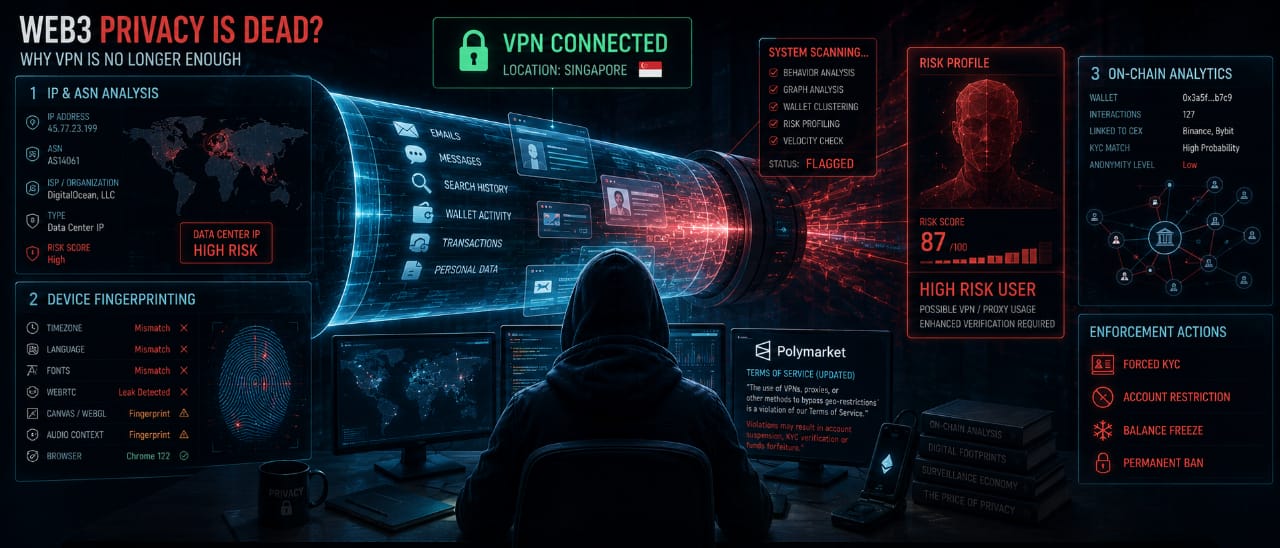
Over the past 24 hours, the crypto community has been shaken by news that major decentralized prediction markets (including Polymarket) have begun a total purge of users employing VPNs to bypass geo-restrictions. The updated Terms of Service (ToS) state clearly in black and white: using a proxy is no longer just a "gray risk," but a direct violation resulting in mandatory KYC, account bans, and balance freezes.
This incident highlights a global crisis across the entire Web3 industry. Platforms originally built on the ideals of anonymity and sovereignty are deploying anti-fraud systems so powerful under regulatory pressure that a simple click of the "connect VPN" button triggers an automatic fraud flag.
Let's break down the technical inner workings of this panopticon and understand why classical IP-masking methods no longer work in the world of controlled crypto.
How the System Sees Right Through You: Three Tiers of Verification
The average person assumes that if a VPN icon glows in the browser and the site shows a location like "Singapore," the problem is solved. For modern scoring systems (such as MaxMind, IPinfo, or FraudLab) integrated into Web3 platform engines, this is kindergarten-level defense.
You are exposed through three fundamental markers:
1. IP Address Pool Segregation (ASN Checking)
Every IP address in the world belongs to a specific Autonomous System (ASN). Anti-fraud systems divide them into rigid categories. Addresses from all commercial VPN providers and personally rented servers belong to hosting providers (DigitalOcean, AWS, Linode, Hetzner). These are known as Data Center IPs.
A regular user accesses the network via a home internet provider or mobile operator (Residential/Mobile IP). As soon as the Polymarket script detects a wallet connecting from a data center IP, the system instantly recognizes it as a bot, multi-account, or a user behind a VPN. You receive a hidden suspicion marker even before clicking the authorization button.
2. Environment Fingerprinting
The browser is a massive source of metadata leaks. Even if your IP is changed, platform scripts query your system for dozens of parameters:
Timezone Mismatches: Your proxy is located in Tokyo, but your Windows or smartphone system clock is set to Astana or Paris time.
Language Packs: System font sets and browser language headers (Accept-Language) give away your real geography.
WebRTC Leaks: The WebRTC protocol, necessary for direct audio and video transmission in the browser, has a nasty habit of querying your device's real network interfaces, leaking your actual ISP IP address right past the active tunnel.
3. Wallet Behavioral Footprint (On-Chain Analytics)
Crypto is transparent. If your "anonymous" wallet used for placing bets on Polymarket has interacted even once with a centralized exchange address (Binance, Bybit) where you completed passport verification (KYC), the System links these entities into a single digital profile. At that moment, your VPN is only protecting thin air—the transaction chain has already exposed your identity.
The Architecture of Covert Resistance
The era of "one-click crypto" is officially over. To penetrate the modern regulatory panopticon, defense must become multi-layered and elite.
If you need to maintain access to blocked Web3 resources and protect your assets from sudden freezes, your behavioral model must be restructured:
Abandoning Commercial VPNs and Hosting IPs: Ordinary servers are not suitable for dealing with strict anti-fraud systems. You must switch to Residential Proxies featuring clean IP addresses assigned by real home internet providers in target countries. To monitoring systems, you should look like an average American or European citizen browsing from home internet.
Strict Browser Environment Hygiene: No personal browsers with accumulated caches and cookies. Critical sessions require specialized anti-detect browsers (proven open-source builds or custom configurations) that forcibly spoof Canvas fingerprints, WebGL, audio fingerprints, and isolate or disable WebRTC at the kernel level.
Isolating Crypto Flows: Wallets used in restricted geo-zones must be created within an isolated environment, funded exclusively through decentralized mixers or clean P2P chains that never intersect with your personal KYC-verified exchange accounts.
The System doesn't want free people; it wants transparent, manageable units. The only way to keep your sanity in this panopticon is to understand its control algorithms and build your privacy one step ahead of its heuristic filters.
#cybersecurity #Web3 #Polymarket #AntiFraud #Fingerprint #WebRTC #ResidentialProxies #Privacy #vpn-top-shop