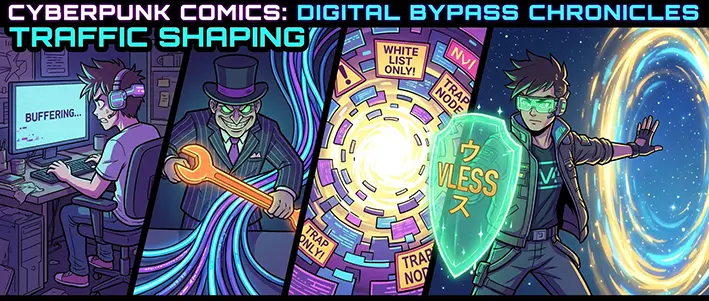
In the public discourse, it is still common to divide network incidents into two categories: "evil hackers breached a service" and "the regulator blocked an unwanted protocol again." This is a naive perspective. What is happening in network infrastructure right now—from new regulatory mandates on the forced disconnection of subscribers "upon suspicion of a cyber incident" to the mass implementation of national whitelists—is shaping a fundamentally different reality.
The era of classic IP and domain name blocking is over. It has been replaced by architectural traffic segregation, where the main threat to privacy lies not in packet interception, but in the attempt by monopolies to herd all data exchange into so-called "trusted reservations."
Let's analyze why this model is flawed at a physical level and why a personal tunnel today is a tool for network survival, not just a way to open a blocked page.
1. The Anatomy of "Silent Degradation": How Shaping Replaces Outright Bans
When a regulator or telecom operator needs to restrict unwanted traffic, they no longer post a warning banner stating "Access is restricted." That creates legal risks, causes public outcry, and immediately hits monitoring feeds.
The modern method is artificial algorithmic degradation.
Profiles with strict TCP Window limitations, artificial bufferbloat, and selective dropping of SYN/ACK packets upon the detection of characteristic entropy signatures are activated on border nodes (DPI). For the user, this looks like "bad connection quality":
- packets formally leave, but round-trip time (RTT) skyrockets from 20 ms to a catastrophic 2000–3000 ms;
- TCP sessions drop out due to timeouts;
- streaming video and secure WebSockets collapse, making the operation of interactive services impossible.
Meanwhile, the operator shrugs, citing "peak hours load" or "radio interference," even though a traceroute clearly shows that the internal local link is clean, and the artificial bottleneck was created precisely at the first border inspection gateway. This is quality censorship that is nearly impossible for an ordinary user to dispute.
2. The Whitelist Paradox: The Perfect Target for Targeted Attacks
The logic of operators and regulators seems flawless to them: "Let's allow access only to verified gateways and domestic services, and strangle all external, uncontrolled protocols."
In theory, this is presented as a fight against data leaks and botnets. In reality, it creates a colossal architectural vulnerability.
When the traffic of millions of users is forcibly driven into the narrow bottleneck of "authorized" perimeters:
- Data Concentration. Any government database or regional authentication gateway turns into a single point of failure. Whereas an attacker previously needed to attack distributed nodes, compromising a single valid gateway from the whitelist is now sufficient.
- Living off the Land Attacks. Recent large-scale credentials and customer database leaks have clearly demonstrated: attackers no longer break the perimeter head-on. They use compromised third-party accounts and authorized cloud instances whose traffic resides in the trusted zone.
A whitelist protects only against unqualified noise. It is completely blind to targeted attacks channeled through authorized paths.
3. Why Mass-Market Public VPNs No Longer Work
Out of habit, most users look for salvation in free or cheap mass-market VPNs. But in the modern realities of aggressive DPI, this is a dead-end branch.
- Address Pools on Display. Public subnets of commercial VPNs are known to traffic analysis systems long before you click "Connect." Their IP ranges are automatically flagged as high-risk and either go into a complete black hole or fall under background throttling.
- Signature Vulnerability. Standard protocols (even modern ones that are not obfuscated) are instantly detected by heuristic analyzers based on packet size, handshake structure, and the lack of simulated real TLS traffic.
- The Illusion of Isolation. By buying access to a shared server for a couple of dollars, you share a single egress gateway with hundreds of unknown neighbors. It only takes one of them to run a rogue script for the entire node to be promptly banned by backbone filters.
4. The Only Viable Model: Sovereign Infrastructure
Security and stability on the network are no longer a matter of downloading the "right program." It is a matter of owning your own point of presence.
To prevent data from leaking through leaky intermediary gateways and connections from dying under evening regulatory shaping, the network contour must be built on three principles:
- Transport Obfuscation (Stealth). Traffic must look like an ordinary, legitimate session to a major trusted web service (for example, standard TLS 1.3 with valid certificates). DPI systems must not find any hooks to classify the protocol.
- Dedicated Cloud Architecture. Hosting your own egress point on independent Tier-1 backbone resources (such as Google Cloud-level providers). This ensures that your address is not tainted by someone else's activity and that your channel is protected from volumetric junk floods directly at the global network level.
- Complete Control Over Customer Premises Equipment. Rejection of operator-issued "black boxes" and locked modems where modulation parameters and radio frequencies are hidden behind closed firmware. If you do not control your router and cannot see raw channel metrics, you do not control your security.
Summary
The network landscape has become rigid and pragmatic. Whitelists do not save against data leaks, operator filters choke connections under the guise of optimization, and mass-market security services lose ground under DPI pressure.
The only way to maintain independence, speed, and privacy is to stop relying on public crutches and build a personal, isolated network perimeter. You cannot fool network physics: control belongs exclusively to the one who holds the keys to their own gateway.