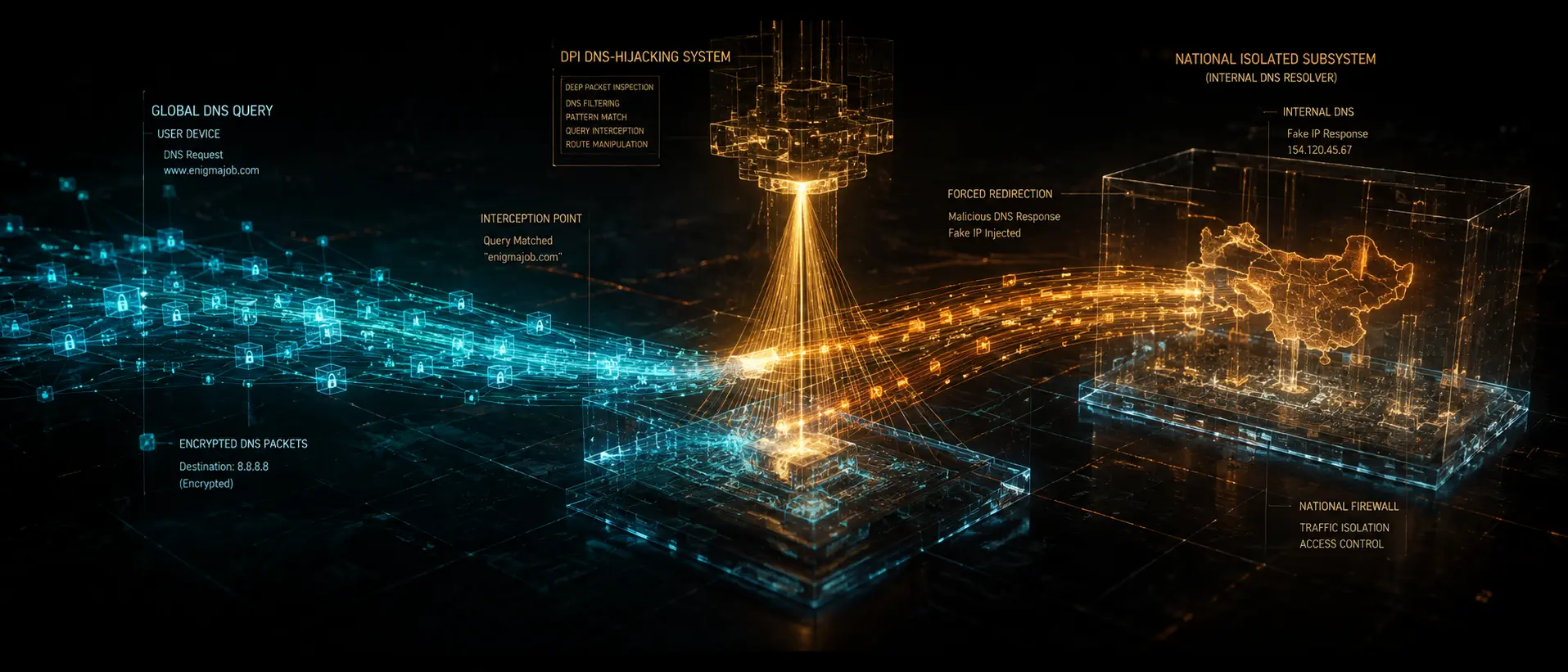
Yesterday's regulator leak and monitoring data confirmed that censorship is moving to its next phase: closing the two main "gray zones" that network engineers and proxy stack architects have relied on for years—transit masquerading under whitelist prefixes and resolution via public DNS resolvers (Google 8.8.8.8, Cloudflare 1.1.1.1).
Let's break down the technical internals of these mechanisms and why superficial software configuration no longer protects against resolution leaks and connection degradation.
**1. DNS-Hijacking Mechanics on TSPU: From Packet Dropping to Transparent Proxying**
Until recently, blocking public resolvers boiled down to filtering encrypted DNS-over-HTTPS (DoH) / DNS-over-TLS (DoT) by IP and SNI, along with targeted drops of UDP/TCP packets on port 53.
The current implementation works differently:
* TSPU on backbone channels intercepts outbound UDP packets destined for 8.8.8.8 and 1.1.1.1 on port 53.
* Instead of dropping the connection (RST/DROP), a **transparent redirect (Transparent Proxy / DNS Spoofing)** to national resolvers (NSDI / local ISP DNS) is performed at the hardware level.
* The client device receives a format-valid DNS response on behalf of 8.8.8.8, but with spoofed IP addresses (0.0.0.0, stub IPs, or local mirrors).
```
[Client: Request to 8.8.8.8:53] ──► [TSPU: Transparent UDP Intercept] ──► [NSDI Resolver]
│
[Client: "Clean" spoofed IP] ◄── [TSPU: Source IP Spoofing] ◄────────┘
```
To operating systems, this looks like a standard response: the OS sees no network errors, caches the fake A/AAAA record, and blocks access at the application layer without any timeouts.
**2. Severing Connectivity: Relocating Whitelists to Isolated ASes/Subnets**
The second part of the problem is address space segmentation. Historically, "whitelists" (banks, marketplaces, government services) shared Autonomous Systems (AS) and subnets with foreign CDNs and transit nodes. This allowed proxy modules to mask traffic as legitimate exchanges with trusted IPs.
Moving whitelists into dedicated isolated subnets (Clean Pipes / BGP Community Sharding) solves two tasks for the censor:
* **Compressing the analysis perimeter:** Traffic within isolated prefixes is completely exempted from deep L7 analysis, which unloads TSPU hardware capacities.
* **A black box for the rest of the network:** Any attempt to spin up a transit socket on an IP from the "white pool," if the destination is not physically located within an authorized data center, is cut off at the border BGP routing level.
**Architectural Response: How to Prevent DNS Degradation and Protect Traffic**
Under conditions of forced port 53 interception and subnet fragmentation, connection stability is ensured by strict discipline in the client and server stack:
* **Eliminating Cleartext DNS at the Network Interface Level:** A complete ban on sending unencrypted UDP/53 packets in the operating system. Any unencrypted DNS query outside the tunnel is guaranteed to be intercepted by TSPU.
* **Strict Resolution Encapsulation (Tunnel-Only DoH / DoT):** DNS lookups must occur strictly via encrypted sockets inside the tunnel itself to the server's internal resolver (e.g., local Unbound / CoreDNS on the VPS side).
* **Protection against DNS Leaks and WebRTC Leaks:** Forcibly binding network sockets to the virtual interface (TUN/TAP) and disabling parallel name resolution through physical ISP interfaces (Split-DNS).
* **Abandoning Static IP Whitelist Patterns:** Transitioning to dynamic transport protocols with full entropy randomization and temporal jitter, independent of trusted address ranges.
The filtering system is shifting from crude bans to seamless address space management. In this reality, infrastructure reliability depends not on an address list, but on the mathematical purity of traffic isolation.
#cybersecurity #DNS #TSPU #Blocking #Whitelists #DPI #NetworkSecurity #vpn-top-shop