Last time we dissected telephone spam, predictive robodialing, and how contact databases are sold through caller ID apps. Today, strictly following our alternating schedule of «everyday pain vs. engineering hardcore,» we move up to the backbone architecture level.
In telecomm corridors and analytical reports, the term «National Whitelist» (Default Deny / Whitelisting) is popping up with increasing frequency.
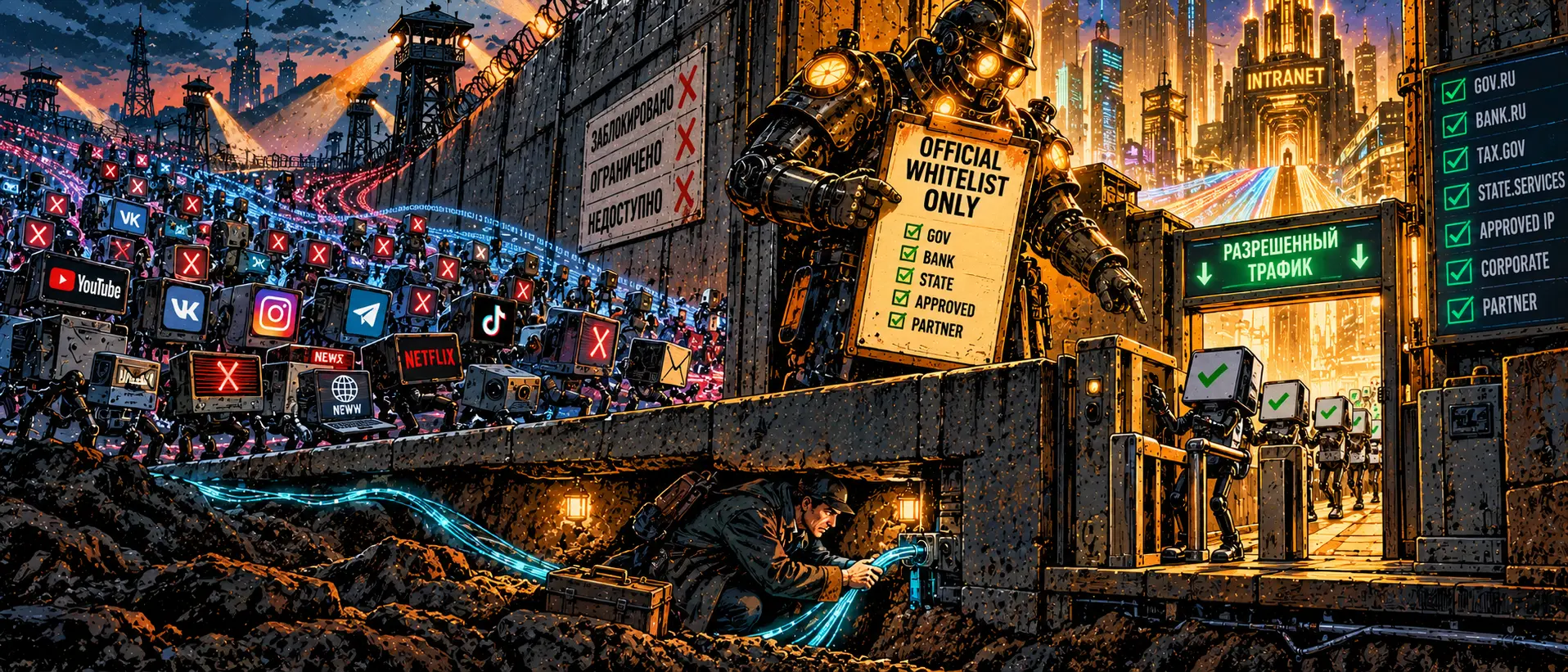
While censorship previously operated on a blacklisting principle (DPI hunting down forbidden domains, IPs, and protocol signatures while letting everything else pass), regulators are now testing the diametrically opposite approach: blocking all external space and leaving a green corridor exclusively for pre-verified resources.
For network engineers, DevOps specialists, and infrastructure architects, this is a fundamental paradigm shift. Let's break down the mechanics of this model without political slogans—at the level of routing, BGP, and cryptographic stacks.
Isolation Architecture: How Hardware Whitelisting Works
A country-scale «Default Deny» model isn't just a basic table of allowed websites in a firewall. The modern internet is far too dynamic to be locked down with a static list of URLs.
A backbone-level whitelist complex is implemented through three filtering echelons:
BGP filtering at external interconnects (Border Gateway Protocol). Tier-1/Tier-2 operator edge routers announce routes solely to trusted Autonomous Systems (ASNs) and verified Content Delivery Networks (CDNs). Any prefixes belonging to independent foreign hosters (Hetzner, DigitalOcean, OVH) simply fail to enter the routing tables or are assigned a zero-bandwidth priority.
SNI and ESNI/ECH validation on deep packet inspection (DPI) hardware (TSPU). A Client Hello packet is permitted only if the SNI field strictly matches a regular expression from the registry of socially significant resources or white B2B services. If the ECH (Encrypted Client Hello) extension encrypts the hostname, the session is automatically dropped via TCP RST, as the DPI cannot read the destination.
IP pool cross-checking with DNS responses (DNS-to-IP Binding). The DPI verifies whether the destination IP address actually belongs to a whitelisted domain. If you attempt to trick the system by supplying a legitimate marketplace domain in the SNI while sending the packet to your personal foreign server's IP address, the filter flags the address base mismatch and terminates the connection.
Systemic Collapse: Why Whitelists Destroy the Digital Economy
To bureaucrats, the whitelist model seems ideal: «we'll keep banks, public services, a couple of marketplaces, and a video hosting platform, and cut off the rest.»
However, modern software doesn't work that way:
The distributed dependency effect. A standard page on a modern online bank or user portal pulls resources from dozens of external sources: fonts, analytics scripts, frontend frameworks from public CDNs, and captcha validators. When strict whitelisting is enabled, interfaces shatter because no one adds minor technical hosts to the registry.
Paralysis of development and CI/CD. No modern service can be maintained without access to external code repositories (GitHub, GitLab, npm, PyPI, Docker Hub). Isolating the external perimeter instantly freezes software building and deployment processes within the country.
QUIC protocol (HTTP/3) fragmentation. Whitelists are notoriously reluctant to let UDP traffic through. As a result, mobile applications optimized for the QUIC protocol to run on unstable mobile networks face severe latency spikes due to constantly falling back to sluggish TCP.
Engineering Counter-Strike: Survival Methods in a Default Deny Paradigm
When blacklists give way to whitelists, classic bypass methods (simply renting a VPS and running a proxy) lose their effectiveness. Completely different principles must be baked into the architecture:
Inverse cloaking via white CDNs (Domain Fronting 2.0). Tunnel traffic is directed not to your server's IP address, but to the edge nodes of permitted transnational content delivery networks (provided they maintain a presence on the whitelist). Inside an approved TLS connection to a white domain, a WebSocket or gRPC stream is packed, which the CDN then forwards to the real backend.
Multi-tier relay through authorized B2B gateways. Building a chain of nodes where the first entry point is physically located inside the whitelist perimeter (e.g., a corporate server in a trusted domestic cloud with a dedicated channel), from which traffic heads out to the outside world via specialized tunnels with mutual mTLS authentication.
Transport over authorized application protocols. Using protocols that mimic approved data formats (e.g., encapsulating payloads into WebRTC video conferencing streams or simulating standard REST API requests to white services). To the DPI, such traffic looks like a legitimate session of an approved corporate messenger.
The era of free packet routing across the globe is gradually giving way to segmented digital enclaves. And the tighter the whitelist framework squeezes, the higher the demands placed on the flexibility of network solutions capable of finding narrow paths through a monolithic wall of network filters.