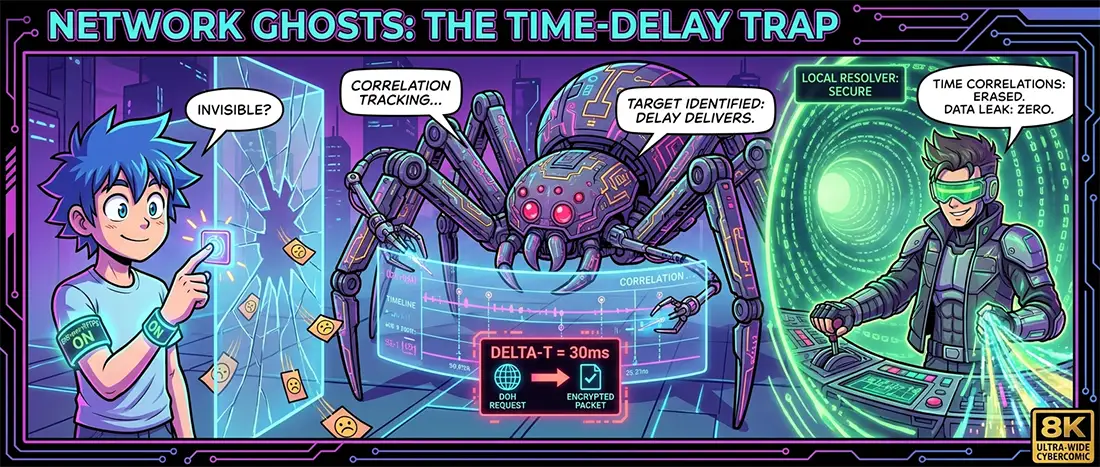
For a long time, the adoption of DNS request encryption (DoH and DoT) was touted by the industry as the definitive solution to user route interception. The logic seemed bulletproof: if the local telecom operator no longer sees raw UDP port 53, correlating outgoing traffic with a specific resource address becomes mathematically impossible.
However, practical analysis of recent blocks and data leaks over the past few days demonstrates the exact opposite: blind trust in DoH creates a false sense of stealth.
Deep Packet Inspection (DPI/TSPU) systems no longer need to crack the cryptographic envelope of a resolver request. Instead, they simply analyze temporal correlation and flow topology.
1. The Mechanics of Timing Correlation: DoH as a Session Start Marker
The main architectural weakness of encrypted DNS lies in its separation from the primary data transmission channel.
When a user attempts to open a node:
- The client establishes a TLS session to a public resolver (e.g., Cloudflare, Google, or Quad9) and requests an
A/AAAArecord. - A fraction of a second later (response time delta $\Delta t$, typically 15 to 60 ms), a new TCP/TLS connection is initiated from the same subscriber IP address to an unknown or suspicious external IP address.
For statistical analyzers on the operator gateway, this delay $\Delta t$ functions as a practically open signature. Even if SNI is masked and the DNS request is encrypted, correlating the traffic spike on the DoH resolver port with the outgoing SYN packet time to an external host allows the system to reconstruct access events with over 90% accuracy. You are essentially tipping off the DPI on the exact moment it needs to activate advanced heuristic modules at the border node.
2. The Collapse of the Centralized Resolver Concept
Using public DoH services gives rise to a second fundamental vulnerability — the concentration of metadata within regulatory blocklists:
- IP-based blocking of the resolvers themselves. The operator does not need to analyze every packet; it is enough to add the addresses of popular independent DNS providers to throttling lists. As a result, the subscriber device either falls back to the operator's standard open DNS (fallback vulnerability) or starts dropping packets during the name resolution phase.
- App-level telemetry leaks. Most activity profile leaks do not occur via cable interception, but through the correlation of open connection graphs. When millions of requests flow into a single pool, operator filters easily separate background system traffic from a specific user's targeted navigation.
3. Transport-Layer Metadata: Why Encrypted IP Still Reveals Too Much
Even when the hostname is completely hidden (via ECH — Encrypted Client Hello), the border gateway still sees:
- Destination Autonomous System Number (ASN). If traffic flows toward a hosting provider known for housing independent media or foreign proxies, this fact is logged instantly.
- Certificate size and structure. Server responses during the TLS Handshake are transmitted in packets of specific lengths. A fingerprint database of popular certificates makes it possible to identify a resource even without an open SNI field in the request header.
Attempting to protect yourself with isolated adjustments, such as enabling DoH in a browser without isolating the entire network contour, is like putting a deadbolt on a glass door.
4. Sustainable Name Resolution Architecture: The Practical Contour
To ensure address resolution does not trigger filtering systems, the infrastructure must adhere to the principles of strict control plane separation:
- A local recursive resolver inside the tunnel.
- DNS requests must never leave the boundaries of the personal encrypted channel. Name resolution must occur directly on the exit node, without querying third-party public hubs from your physical IP address. For the telecom operator, the session should appear as a continuous, monolithic data exchange with a single trusted address.
- Elimination of Fallback Leaks (DNS Leaks).
- The operating system's network stack must be rigidly configured to drop any requests to ports 53 (UDP/TCP) that bypass the primary tunnel. If the tunnel briefly dips, the network interface must block traffic (Kill Switch mechanism) rather than sending an unencrypted request to the operator's gateway.
- Dedicated private nodes without a public history.
- Using your own dedicated server eliminates identification via a pool of "compromised neighbors." When your DNS traffic is confined to an isolated instance, external filtering algorithms are deprived of the baseline data needed for statistical correlation.
Modern network security relies on eliminating correlation links. As long as individual elements of the network stack communicate with the outside world piecemeal, filtering systems will accurately calculate your actions. True privacy is achieved only when the entire volume of data, including service metadata and name queries, is packed into a single, unbroken, and homogeneous contour.