When people talk about cybersecurity, they usually imagine a dramatic scenario: attackers brute-forcing a cryptographic key, intercepting passwords, or finding a zero-day vulnerability in an encryption algorithm.
The reality of recent network conflicts and filtering is far more prosaic and ruthless: no one is trying to decrypt you.
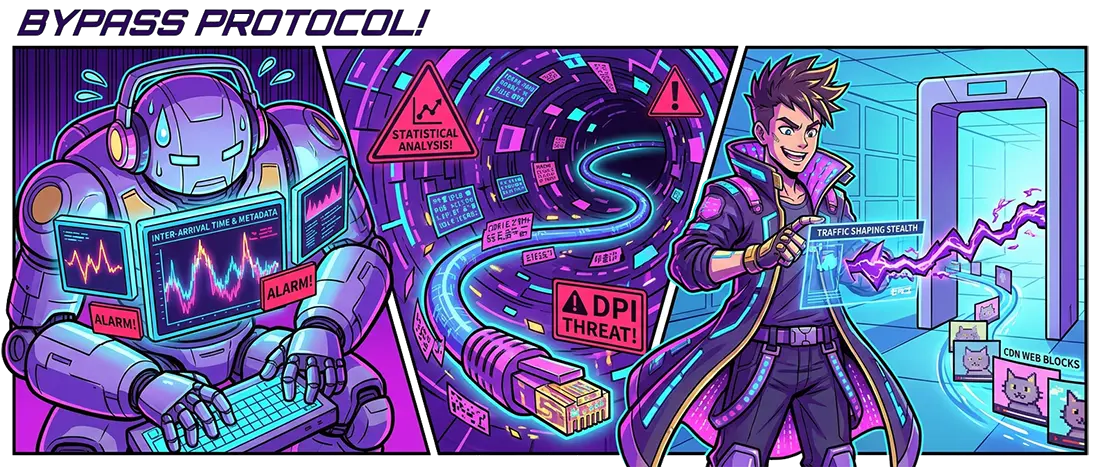
Modern carrier-grade DPI (Deep Packet Inspection) systems and traffic analysis tools literally do not care what is inside your encrypted packet—whether it is a messenger chat, a confidential report, or a developer session. The mathematical profile of your connection is all they need.
Welcome to the metadata era, where timing analysis and flow profiling have become the primary vector for compromise and blocking.
1. The Illusion of the "Impenetrable Tunnel": How Your Rhythm Betrays You
Suppose you use a reliable protocol and strong encryption like ChaCha20 or AES-256-GCM. The payload is turned into a pseudo-random sequence. However, fundamental characteristics remain completely exposed at the data link and network layers:
- Inter-arrival time. A real human scrolls a feed, reads text, or watches a stream with a very distinct pause dynamic. A bot, a tunnel, or a script behaves differently.
- Packet Size Distribution. A video stream generates heavy frames of fixed sizes, Voice over IP generates short packets at strict intervals of tens of milliseconds, and web browsing creates bursts of small requests followed by spikes of asset downloads.
- TCP ACK behavior pattern. The ratio of outgoing service packets to incoming ones exposes the architecture of the client-server interaction, even across three layers of obfuscation.
If a carrier-grade DPI system is trained on neural network classifiers, it determines in a fraction of a second that what lies before it is not just regular HTTPS traffic, but an encapsulated tunnel. From there, it uses regulatory shaping rather than outright blocking—packets are intentionally delayed at border transit points to simulate channel congestion, forcing the TCP stack to shrink its transmission window.
2. The Trap of Centralized Trusted Zones
Against the backdrop of regular news about database leaks and proposals to funnel infrastructure access into closed "national perimeters," the regulators' core engineering flaw becomes exposed: excessive centralization of trust.
When business, development, and user traffic are forcibly routed through a limited set of node hubs:
- Metadata is gathered into a single point of failure. An interceptor doesn't need to hack the servers of every individual service. It is enough to monitor tier-1 carrier backbone interconnects: connection graphs alone ("who, when, in what volume, and with what frequency accesses the gateway") can reconstruct the structure of a distributed team or data supply chain.
- Token and session leaks in "green zones." Inside so-called white lists, developers often neglect mutual node verification (mTLS), assuming that "everyone inside the perimeter is trusted." The result is massive compromises via a compromised border load balancer or a forgotten test node.
3. The Metamorphosis of Defense: From Masking to Biomimicry
If brute-force encryption attracts attention via anomalous entropy, and standard protocols are fingerprinted by header footprints, what should a viable security perimeter look like today?
- Traffic Shaping and Padding.
- A modern personal gateway must not only encrypt payloads, but also pad packets to standard web block sizes, as well as insert micro-delays and zero-weight dummy packets during pauses. Outwardly, the traffic must look monotonous and boring—just like regular static file transfers from a CDN.
- Correct TLS Fingerprints (JA4 / Client Hello).
- You cannot connect to the network with unique or outdated cryptographic signatures. Handshake parameters, the order of supported cipher suites, and SNI extensions must match the behavior of mainstream modern browsers on current engines down to the exact byte. Any deviation is an instant trigger for DPI heuristics.
- A Sovereign Egress Point on Independent Backbones.
- Using public VPN farms is compromised by design: their address pools and Autonomous Systems (ASNs) are known to all filters. The only resilient model is your own gateway on a dedicated cloud node with a clean reputation, where traffic is indistinguishable from routine requests to a cloud API or corporate SaaS service.
Conclusion
Security in the modern network is no longer a game of who can encrypt data the strongest, but rather of who can best hide the very fact that a private communication is taking place.
As operators and regulators refine algorithms for statistical connection profiling, salvation lies in abandoning cookie-cutter solutions. Owning your own infrastructure, fine-tuning hardware radio parameters, and blending your network footprint into the background web noise are the only ways to maintain a stable, free, and genuinely secure channel.