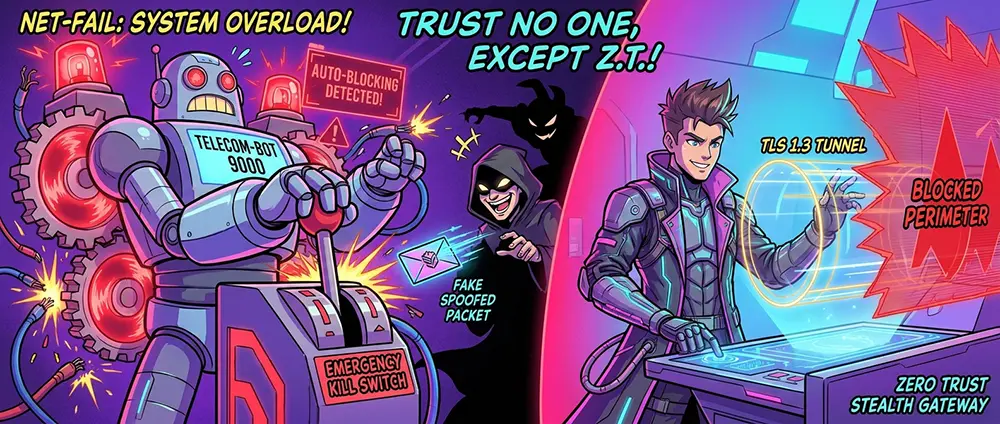
Tectonic shifts are occurring in the regulatory landscape: authorities are increasingly granting telecom operators the unilateral right to cut channels or completely isolate subscribers upon detecting a "cyber incident." This mechanism is packaged under the guise of security: if your node is suspected of generating parasitic traffic or participating in anomalies, the provider issues an ultimatum and shuts off the valve.
The paradox is that trying to cure systemic flaws with a forced kill switch does not solve the security problem. Instead, it generates a new class of vulnerabilities where the operators' own infrastructure becomes the primary weapon for attackers.
1. TSPU as a Tool for Third-Party DoS: Reflection Disconnection Attacks
When a regulator issues an order for operators to suspend services based on heuristic "threat" markers, it provides a ready-made attack vector for a skilled malicious actor.
Instead of spending terabits of distributed power on a classic DDoS, it becomes sufficient to provoke a border sensor:
- Spoofing and generating anomalous signatures. An attacker generates a stream of junk packets with a spoofed return IP address belonging to the victim, simulating C2 (Command & Control) beacons or malicious network activity.
- Automatic DPI reaction. The analyzer at the operator's gateway records an "incident." According to protocol, the system logs the address and starts a timer for performance degradation or complete disconnection.
- Result: the attacker spends pennies, while the operator manually and for free takes down the desired target resource or independent node.
Deep Packet Inspection systems, overloaded with rules to search for "undesirable" traffic, suffer from a high percentage of false positives. Turning DPI into an automatic trigger for sanctions transforms the provider into a tool for the extrajudicial elimination of third-party infrastructure.
2. The Illusion of Perimeter Security: Lessons from Recent Leaks
Recent incidents—ranging from the compromise of analytical cloud environments of major platforms to data leaks from centralized government registries—reiterate an engineering fact: perimeter defense is dead.
Organizations spend millions on negotiating whitelists, installing certified firewalls, and isolating networks. Yet data leaks not because an attacker breached the firewall from the external network, but because:
- Tokens and sessions are stolen at connection points. The breach occurs via trusted APIs, push-notification brokers, or third-party SaaS integrations that already possess legitimate access, bypassing any checks.
- Whitelists are blind to legitimate protocols. If an engineer's account or a Snowflake service key is compromised, the leak traffic flows through standard port 443 inside an authorized session. To the operator and their TSPU system, this is an entirely trusted, "clean" stream.
Attempts to isolate the network and herd users into walled reservations create a false sense of security while databases slip away through official holes in trusted gateways.
3. Why Mass VPNs Are Powerless Against Regulatory Shaping
Amidst this tightening of the screws, many continue to rely out of habit on public VPN clients. In modern realities, this is an architectural dead end:
- An easy target for regulatory blocks. The provider doesn't even need to prove a violation: standard tunneling headers inside operator monitoring are flagged as "unidentified anomalies," providing a legal pretext to push the channel into a degraded quarantine.
4. Criteria for a Sovereign Node: Survival Under Active Filtering
The only way to maintain predictable access and protect your data from operator arbitrariness is to eliminate dependence on centralized intermediaries:
- First-echelon individual infrastructure.
- Your personal gateway, deployed on an isolated instance in a neutral jurisdiction. A clean IP address with no parasitic history and zero proximity to junk traffic.
- Transport mimicry mimicking clean web traffic.
- The communication protocol must not emit non-standard entropy signatures. Traffic must strictly emulate standard browser behavior: valid TLS 1.3, realistic handshake fingerprints (JA4), and real domain names of trusted CDNs in the SNI.
- Zero Trust within your own perimeter.
- A complete rejection of the "trusted internal network" concept. Every service, backend, and microservice must require mutual cryptographic authentication (mTLS) and short-lived dynamic tokens, regardless of whether they are behind a VPN, on a whitelist, or on the open internet.
Summary
When regulators and monopolies pursue a course of automatically choking channels under the pretext of fighting threats, relying on public crutches becomes a fatal mistake.
Security is built neither on operator permissions nor on the height of regulatory fences. It rests on control over your own exit point, strict credential hygiene, and the ability to dissolve critical traffic within the general stream of the global network. Everything else is an illusion of control that shatters at the very first click of the operator's kill switch.