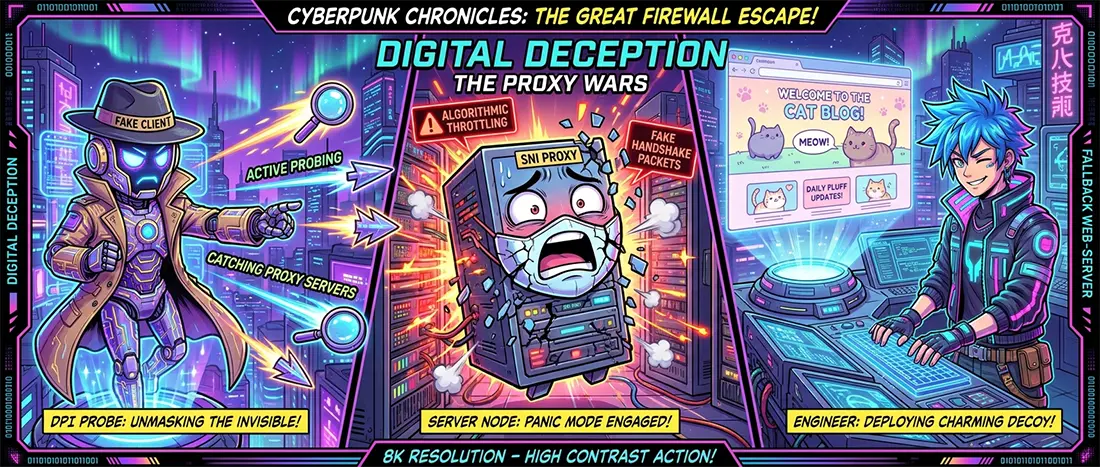
Analyzing recent filtering patterns and network tunnel failure trends reveals a tectonic shift in DPI (Deep Packet Inspection) tactics deployed by operators. For a long time, the confrontation between network censorship and privacy was built around passive analysis: the system monitored the traffic stream, calculated entropy, checked the SNI, and—if anything looked suspicious—quietly trimmed the TCP window or dropped the connection.
However, passive analysis generates too many false positives on legitimate corporate traffic. Consequently, deep packet inspection systems have moved to the next phase: Active Probing.
This is a game-changer. The filter no longer just observes from the sidelines; it actively intervenes, testing the resilience of your server by masquerading as a regular client.
1. How the Active Probing Mechanism Works
The active probing scheme is straightforward yet devastating for unprepared infrastructure:
- Trigger. A user initiates a secure session to their independent server. The traffic is encrypted, wrapped in TLS on the outside, and the SNI hostname points to a popular allowed resource.
- Edge DPI Detection. The filtering system intercepts the handshake. Even if the metadata looks plausible, the server's IP address does not belong to major global CDN lists (Cloudflare, Akamai, Google). The node is categorized as a "grey candidate."
- Operator-Initiated Fake Request. Within seconds (or sometimes concurrently), a specialized DPI scanning bot sends a series of synthetic requests to that same IP address and port:
- dispatches a malformed handshake packet;
- requests a random web path without valid headers;
- transfers specific byte sequences designed to trigger protocol errors.
- Verdict. If the remote server fails to behave like a fully fledged web server in response (e.g., instantly drops the connection with an RST, times out, or returns a non-standard TLS alert), the DPI makes a definitive conclusion: a proxy tunnel is hiding behind this port. The address is instantly sent to a black hole or subjected to hours of algorithmic throttling (Bufferbloat up to 3000 ms).
2. The Collapse of Naive Obfuscation
Most users setting up private gateways or using standard clients overlook this vector. They assume it is enough to wrap traffic in a trendy protocol disguised as a website, and the job is done.
However, the devil is in the behavior of the actual backend:
- The "Empty Mirror" Problem. If your proxy server simply masks itself as someone else's site via SNI proxying, but a direct bot request to the IP address fails to return a valid web response with a proper HTTP code (404, 403, or the homepage of a real service), the scanner instantly catches the mismatch.
- Fingerprint Mismatch. When a client presents a modern desktop browser fingerprint, but the server-side verification responds with a cipher stack typical of a raw Go library or Python script, heuristics flag an anomaly. The discrepancy between client and server cryptographic dialects is a primary marker of an artificial tunnel.
3. Defending Against Probing: The Architectural False-Facade Principle
Surviving under aggressive probing requires a private gateway to evolve from simple masking to full-scale infrastructure camouflage:
- Full-Fledged Fallback Web Server.
- A proper, production-ready web server (such as Nginx or Caddy) must run on the target server, serving a legitimate site with real HTML, CSS, and static assets. The proxy daemon must not expose a "naked port" to the outside world. Any unauthorized request from DPI scanners must be seamlessly redirected to the real website, returning a standard HTTP 200 with valid headers and a realistic response body.
- Pre-Handshake Authentication.
- If the client fails to transmit a valid cryptographic authenticator in the very first packet (a pre-shared secret or a specific signature within a permitted extension), the server must not show any signs of life as a proxy. To any external scanner, it must pretend to be a boring, ordinary blog or landing page.
- Out-of-Band Channel Monitoring.
- If a connection starts to degrade, it is critical to quickly identify the root cause: is it radio link attenuation on a local modem, a routine peak-hours provider slowdown, or targeted shaping of your IP following active probing? Having access to raw latency metrics for every route hop and clean radio signal parameters is the only guarantee that you are in control of the situation rather than left guessing.
Summary
The era when deploying a standard tunnel on a rented VPS was enough for stable connectivity is firmly in the past. Modern filters do not attempt to crack the encryption; instead, they actively provoke the infrastructure into exposing itself.
Today, the reliability of a personal perimeter relies not on the high-profile names of cryptographic algorithms, but on the engineering flawlessness of your false facade. A gateway is secure only when it looks, sounds, and responds to any third-party auditor like the most mundane, unremarkable server on the global web.