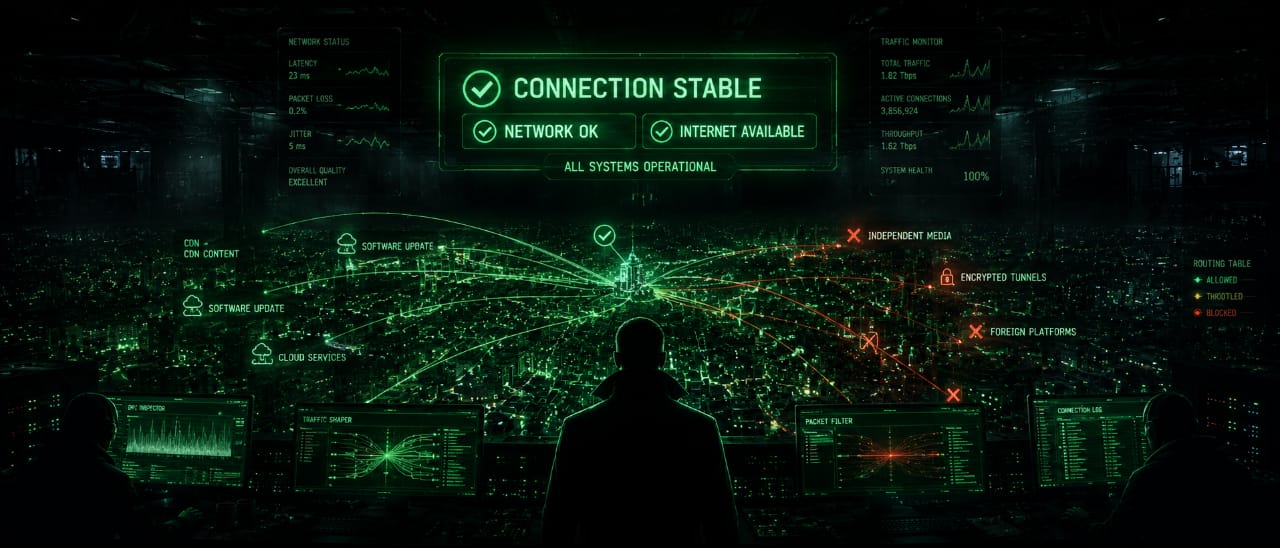
When another morning arrives, most users check network availability out of old habit: "Is the site opening? Is the page loading? That means everything works." But if you look under the hood of network traffic over the past day, it becomes obvious—the era of crude, demonstrative blocking with provider stub pages is officially being replaced by the era of "silent" degradation and selective isolation.
Modern TSPU (Technical Means of Countering Threats) complexes installed at backbone provider nodes no longer chop channels with an axe. They act like a precision scalpel, changing the very physics of how packets pass through.
Let's break down how covert traffic segregation is being implemented right now and why standard network availability tests no longer show the real picture.
The Throttling Method: A False Sense of Stability
Why block a resource completely, causing a wave of public discontent and a mass migration of users to circumvention tools, when you can make using it unbearable?
Technical analysis of recent filtering patterns shows that TSPUs are increasingly using artificial bandwidth restriction (shaping) and intentional packet loss:
Signature Analysis (Heuristics): DPI contours analyze not the destination IP address, but the structure of the connection itself. If the algorithm sees a pattern characteristic of streaming video or an encrypted tunnel, the speed in this specific direction is artificially lowered to a nominal 128 Kbps.
User "Fatigue" Effect: To the average person, the site isn't blocked—it's just "lagging" or taking a long time to open. The user blames their router, a bad data plan, or an overloaded server, closes the tab, and goes to "approved," fast local alternatives. The censorship goal is achieved without a single line in official registries.
TCP Response Spoofing and RST Packet Injection
Another deep analytical slice of recent days is the activation of covert Man-in-the-Middle attacks at the backbone level. When your device tries to establish a handshake with a remote server via the TLS protocol, the TSPU intercepts this request.
Instead of simply blocking the port, the provider's hardware generates and sends a fake packet with the RST (Reset) or FIN (Finish) flag to your device on behalf of the target site. Your browser is certain that the remote server itself dropped the connection due to an error or overload.
In the logs, this looks like an ordinary network failure (Connection Reset), although in reality, it was targeted filtering. Direct VPN protocols (WireGuard, OpenVPN) are destroyed in milliseconds in such an environment, as their headers look like an open book to DPI.
The Architecture of Invisible Resistance
In conditions where the System simulates network failures instead of explicit bans, classical diagnostic methods (like a standard ping or traceroute) become useless. Data and critical traffic protection must adapt to the rules of the "silent war" game.
Using Stealth Transports: The only way to break through a TSPU contour that simulates network degradation is to make your encrypted traffic technically indistinguishable from regular web page loading. Next-generation protocols (such as VLESS with Reality) use obfuscation techniques where the initial TLS handshake completely copies the parameters of an allowed, major Western or local resource from the "whitelist." To the DPI system, you are simply reading a legitimate website.
Dynamic Active Probing Mitigation: Modern censorship circumvention utilities are learning to recognize fake RST packets sent by the censor. If the application sees that the response to a request arrived abnormally fast (faster than the speed of light to the remote server physically allows), this packet is dropped as suspicious, and the connection is maintained.
Distributed Routing: Your traffic must be fragmented. Critically important corporate APIs, work scripts, and media streams should not be funneled through a single route. The network must dynamically balance between multiple independent proxy servers, changing ports and encryption parameters depending on the level of degradation recorded at the provider node.
The network will no longer work predictably. To preserve business processes and personal privacy, you must abandon the belief in a "stable internet" and build flexible, adaptive systems capable of recognizing covert traffic manipulation before it paralyzes your work.
#cybersecurity #TSPU #DPI #censorshipcircumvention #VLESS #Reality #trafficfiltering #vpn-top-shop