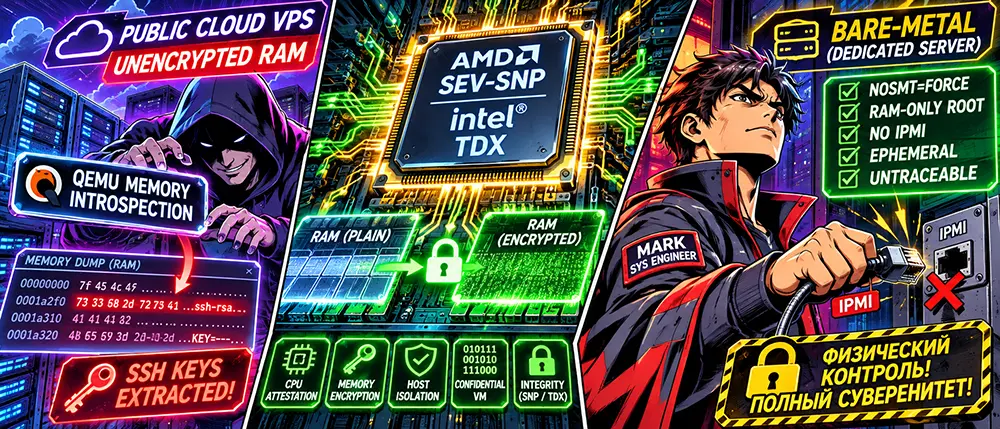
Imagine you have rented a safe deposit box in a central city depository. Thick concrete walls surround you, security guards check passes at the entrance, and the armored vault door is locked four times over. But there is a catch: your individual box inside is cobbled together from thin plywood, and the duty commandant's platform hangs right above the main hall. The commandant holds a master key to all internal latches, can peek through the gap between the boards at any moment to see what is sitting on your desk, and quietly slides out the back wall of the box on a whim—all while you remain confident that you control the only lock.
This is precisely what renting a virtual server (VPS/VDS) from public cloud providers looks like. An administrator might deploy resilient cryptographic chains and configure LUKS partition encryption, but they forget the primary axiom of the physical world: you are executing your code inside someone else's RAM space.
To the host system (the KVM, Xen, or VMware ESXi hypervisor), the guest operating system is nothing more than an ordinary isolated process. The moment the server decrypts a disk for operation, the closed master key drops directly into the RAM. Any data center engineer or third-party process with root privileges on the base node can extract these keys in a fraction of a second via a trivial RAM snapshot or by reading kernel descriptors.
Stop right there. If you sincerely believe that a disk password on a virtual machine in Hetzner, AWS, or DigitalOcean saves your private perimeter from seizure, close this tab. Continue admiring the green security certificates in your control panel.
But if you keep your hands on bare silicon, understand the physics of leaks through the L3 CPU cache, and want to build a perimeter that cannot be gutted via a memory dump—even with physical access to the rack by the hoster—descend into the hardware bunker.
The Architecture of Transparent Walls: How the Hypervisor Guts Guest Systems
The myth of virtualization security is built on a misunderstanding of kernel responsibility boundaries. Software isolation between virtual machines only works against low-level attacks from a neighboring VM, but it is utterly powerless against the superior management layer (Ring -1):
- Direct Address Space Dumping via Memory Introspection.
- In the Linux KVM architecture, a virtual machine is represented by the
qemu-system-x86_64process. All RAM of the guest OS is mapped into the virtual address space of this process on the host. A command like: - Bash
gdb --pid $(pgrep -f "guest_vm_name") -ex "dump memory /tmp/guest_ram.dump 0x0 0x7fffffff"
- unloads a raw image of the virtual server's memory to disk in a few seconds. Next, the
volatility3utility finds Linux kernel structures in the dump, pulling out WireGuard/Xray private keys, active SSH sessions, and database master passwords in plain text. - Hardware Leak Channels via CPU Microarchitecture (Cross-VM Side-Channel).
- Even if a provider swears they never look at client memory, virtual machines share the physical cores of the same processor. Simultaneous Multithreading (SMT) merges computing pipelines. Microarchitectural Data Sampling (MDS), L1TF (Foreshadow), and L3 cache manipulation (Flush+Reload) attacks allow malicious code from a neighboring cheap VM to reconstruct bytes of encryption keys passing through processor registers in real time.
- Hardware Backdoors in Service Controllers (IPMI / iDRAC / BMC).
- Renting bare-metal servers in budget data centers carries another threat: the Baseboard Management Controller (BMC). This is a separate, independent microcomputer on the motherboard running its own proprietary version of Linux. It has direct access to the PCIe bus and system memory via DMA (Direct Memory Access). If the IPMI port is exposed to the shared hosting network with a default password or is vulnerable to a buffer overflow, an external observer can read the contents of the server bypassing the operating system, even when the host power is turned off.
- A dedicated secure security coprocessor (AMD Secure Processor) is embedded inside the CPU.
- Every page of RAM for an isolated virtual machine is encrypted on the fly with a unique hardware AES-128 or AES-256 key directly within the memory controller.
- The hypervisor manages physical page allocation, but if the host attempts to read bytes from the guest's memory, the controller returns unreadable cryptographic noise. Any attempt by the host to spoof a memory page is detected via the Reverse Map Table (RMP) integrity check table, triggering an immediate emergency stop of the guest.
- Hardware Castration of IPMI/BMC at the Physical Level.
- The network cable from the dedicated BMC management port is physically unplugged. If remote console access is critically required, the interface is configured to work exclusively through an isolated, closed VLAN accessible only via a physical hardware key from a separate router with no gateway to the public internet:
- Plaintext
- Kernel Protection Against Inter-Process Attacks (GRUB Bootloader Parameters).
- On a bare-metal server, mechanisms for sharing computing pipelines are completely disabled. Kernel flags isolating processor threads are added to
/etc/default/grub: - Plaintext
- Ephemeral Operating Environment (RAM-Only Root with Auto-Destruction).
- The root file system is deployed exclusively in memory from an immutable encrypted image (initramfs). When power is cut or the physical link is lost, data vanishes without leaving a trace on solid-state drives:
- Bash
- Upon a sudden reboot, the one-time key from
/dev/urandomevaporates from the registers, turning the block device image into an unrecoverable array of entropy. - Network Isolation via Socket Stack Severing (Network Namespaces + BPF).
- Tunneling daemons and databases are isolated into independent network namespaces connected to the external interface solely through a strict eBPF/XDP filter, dropping any packets that fail signature verification at the zero clock cycle of network card reception:
- Bash
Technical Sovereignty: Hardware-Silicon-Level Isolation
Creating a truly independent perimeter requires moving away from software illusions and toward hardware-verified enclaves (Confidential Computing) and full control over physical iron.
1. Hardware Memory Encryption (AMD SEV-SNP and Intel TDX)
Modern server platforms support Secure Encrypted Virtualization with Secure Nested Paging (SEV-SNP):
2. Cryptographic Air-Gap and Elimination of DMA Vectors
The physical server must be stripped of unverified external management channels. The IOMMU (I/O Memory Management Unit) interface is activated in strict mode, blocking unauthorized access by any external controllers (network cards, USB hosts) to memory addresses containing kernel cryptographic keys.
Engineering Defense Protocol: Deploying an Autonomous Zero Trust Node
Assembling a sovereign server on your own physical hardware or an isolated dedicated server is built on the principle of eliminating any shared resources.
# Disabling the web interface and insecure protocols locally via ipmitool:
ipmitool lan set 1 access off
ipmitool raw 0x06 0x48 0x00 # Complete shutdown of the remote service port
GRUB_CMDLINE_LINUX="spectre_v2=on spec_store_bypass_disable=on l1tf=full,force mds=full,nosmt nosmt=force iommu=force amd_iommu=force_isolation slab_nomerge pti=on init_on_alloc=1 init_on_free=1"
The nosmt=force parameter disables Hyper-Threading virtual cores, eliminating the physical possibility of attacks via shared register caches. The init_on_alloc=1 and init_on_free=1 directives guarantee the zeroing of memory pages upon allocation and release, preventing the reading of residual dumps.
# Mounting a sensitive workspace into an encrypted ramdisk
modprobe brd rd_nr=1 rd_size=4194304 # Creating a 4GB ram0 block
cryptsetup open --type plain --key-file /dev/urandom /dev/ram0 secure_vault
mkfs.ext4 -m 0 /dev/mapper/secure_vault
mount /dev/mapper/secure_vault /opt/secure_workdir
# Complete block of routing between the management interface and the data perimeter
sysctl -w net.ipv4.ip_forward=0
sysctl -w net.ipv4.conf.all.send_redirects=0
sysctl -w net.ipv4.conf.default.send_redirects=0
Autonomy in the digital world cannot be bought via a monthly subscription to someone else's hosting with pretty load charts. As long as the processor executing your instructions obeys someone else's hypervisor code, the boundaries of your digital home are drawn in chalk on pavement. True sovereignty begins where every byte in RAM is encrypted by your own silicon, the network wire leads to an isolated physical port, and the key to your front door exists in a single copy held solely in your hands.