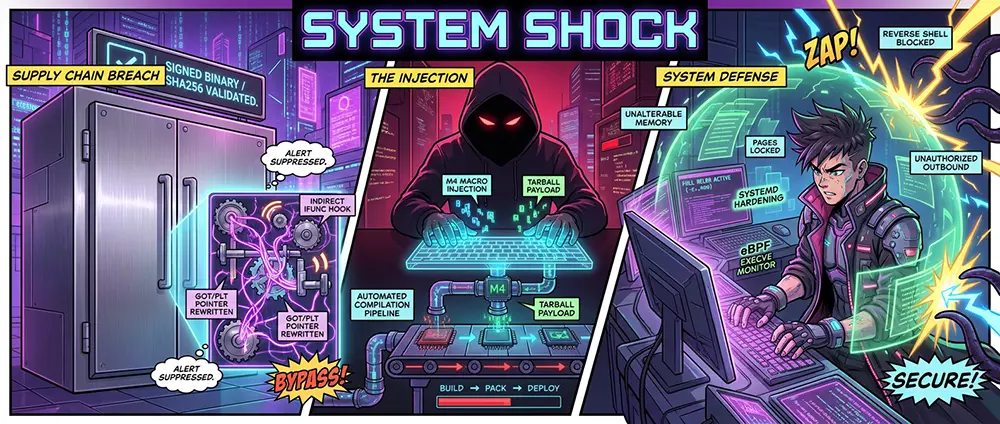
Imagine an upscale residential complex with 24/7 security, armored doors, and cameras on every floor. The residents are confident in their security: not a fly gets past the perimeter. But one day, the management company decides to replace the door hinges throughout the building. The contract is given to a quiet, longtime locksmith who has spent five years flawlessly lubricating locks. The locksmith takes a standard factory part and carves a microscopic groove inside the swivel mechanism. A regular key opens the lock just like before. The guard at the entrance sees the mechanism working as usual. But if you insert a special pick and turn it at a specific angle, the lock swings open without a click, and the alarm system considers it a routine opening.
This is precisely what a supply-chain attack looks like in server infrastructure. Administrators spend weeks configuring firewalls, isolating databases, and tuning NGINX configurations, but they forget a foundational axiom: a server consists of hundreds of third-party libraries. It is enough to introduce a hidden hook into a single low-level system component, and the entire cryptographic fence falls before the operating system has time to log the first suspicious packet.
Stop. If you believe that the apt update && apt upgrade command on a schedule automatically makes your system invulnerable — close this tab. Continue believing in the infallibility of official distribution mirrors.But if you have ever built software from source, tracked symbol hijacking via LD_PRELOAD, dug into ELF linker tables, and want to understand how compromising the build infrastructure bypasses digital signature verification — welcome to the engine room of system libraries.Architecture of Sabotage: Symbol Interception in GOT/PLT Tables
Breaching a system via a compromised component (a prime example being the backdoor injection via obfuscated m4 macros in build scripts, as seen in the high-profile liblzma/XZ case) is fundamentally different from classic web-interface attacks. An attacker does not need to look for a stack overflow bug in the NGINX or OpenSSH daemon itself. The task is solved at the dynamic library linking stage.
When a Linux kernel loads a binary file, the ld.so linker performs the binding of imported functions:
- Global Offset Table (GOT) and Procedure Linkage Table (PLT).
- The executable does not know the exact physical addresses of library functions in RAM until load time due to ASLR. Instead of a direct call, the code jumps to the
.pltsection, which reads a pointer from.got.plt. - Resolving Interception via the IFUNC (Indirect Functions) Mechanism.
- The GNU IFUNC extension allows library developers to dynamically select a function implementation at runtime (for example, choosing AVX-512 or SSE instructions depending on the CPU). Malicious code is embedded precisely into the IFUNC function constructor. At this stage, the
.gotmemory pages are still open for writing (PROT_WRITE). - Patching Pointers in the Daemon's Memory.
- The injected library intercepts the address of a critical authentication function (for example, the
RSA_public_decryptpublic key check inside the cryptographic subsystem). The legitimate function is replaced with the address of the backdoor microcode.
As a result, the daemon continues to appear in processes as an official, signed binary with correct sha256 checksums on disk. However, upon receiving an incoming connection with a specially crafted signature in the certificate field or header, the code transfers execution to the payload, bypassing standard PAM and logging mechanisms.
Shadow Commits and Binary Blindness
Classic code audits are powerless against multi-layered obfuscation in build pipelines:
- Release-Stage Injection.
- In the public GitHub repository, the code remains clean and passes all tests. Malicious injections are added only to the release tarball generated by the maintainer before submission to distribution package bases. Since developers rarely compare the hashes of every file in a tar archive with the git branch, binary artifacts are embedded into test files (for example, pseudo-corrupted archives for unpacking tests).
- Complex Decoding Chains in Configure Scripts.
- During execution, the build script parses a test binary file, extracts bytes via
sed,tr, andawkutilities, stitches the fragments into a single shell script, and injects the compiled.oobject file right before calling theldlinker. - Using AI Decompilers to Conceal Tracks.
- Modern vulnerability authors pass shellcode through optimizers that emulate the compilation style of standard GCC and Clang versions, rendering heuristic antivirus analysis of binaries nearly useless.
Engineering Defense Protocol: Strict Isolation and Runtime Auditing
Hoping that upstream developers will keep their repositories safe from account compromise is a fatal strategy. Infrastructure must operate on a Zero Trust assumption for any update.
- Enabling Full Linker Table Relocation (Full RELRO).
- All system services and custom daemons must be compiled with strict linking flags that make the GOT table read-only immediately after startup:
- Plaintext
CFLAGS="-O2 -fPIE -fstack-protector-strong -D_FORTIFY_SOURCE=2"
LDFLAGS="-Wl,-z,relro,-z,now -pie"
- The
-z,nowflag forces the dynamic linker to resolve all symbols before application launch and immediately switch GOT memory toread-onlymode, blocking function substitution in memory via IFUNC/GOT. - Isolating Network Daemons via Systemd Restrictions.
- Even if a library inside NGINX or sshd is compromised, it should not have the physical ability to spawn new shells or read the file system. Directives are added to
/etc/systemd/system/servicename.service.d/override.conf: - Ini, TOML
[Service]
ProtectSystem=strict
ProtectHome=yes
ProtectKernelTunables=yes
ProtectKernelModules=yes
ProtectControlGroups=yes
NoNewPrivileges=yes
RestrictAddressFamilies=AF_INET AF_INET6 AF_UNIX
MemoryDenyWriteExecute=yes
- Blocking Unauthorized Daemon Network Traffic at the Kernel Level.
- The NGINX web server or reverse proxy must not have permission to initiate outgoing connections anywhere except upstream sockets and trusted DNS resolvers. Limiting via
iptablesby local user cuts off attempts by a compromised process to drop a reverse shell: - Bash
# Deny outbound connections for the www-data user, except localhost and the trusted database port
iptables -A OUTPUT -m owner --uid-owner www-data -d 127.0.0.1 -j ACCEPT
iptables -A OUTPUT -m owner --uid-owner www-data -d 10.0.0.5 -p tcp --dport 5432 -j ACCEPT
iptables -A OUTPUT -m owner --uid-owner www-data -j DROP
- Version Pinning and Artifact Auditing via Reproducible Builds.
- Refusing automatic updates of critical packages on production servers without prior testing in an isolated staging environment. Using eBPF tools (such as
tetragonorfalco) to monitorexecvecalls inside system services. Alert signal: the web server process attempts to launch/bin/shor call a package manager utility.
System security cannot rely on the authority of third-party digital signatures. In the open ecosystem, the vector of compromise has shifted from direct perimeter breaches to quiet in-depth injection into the chain of trust. A server remains yours only as long as you control process privileges at the physical level and prevent foreign code from tampering with kernel memory.