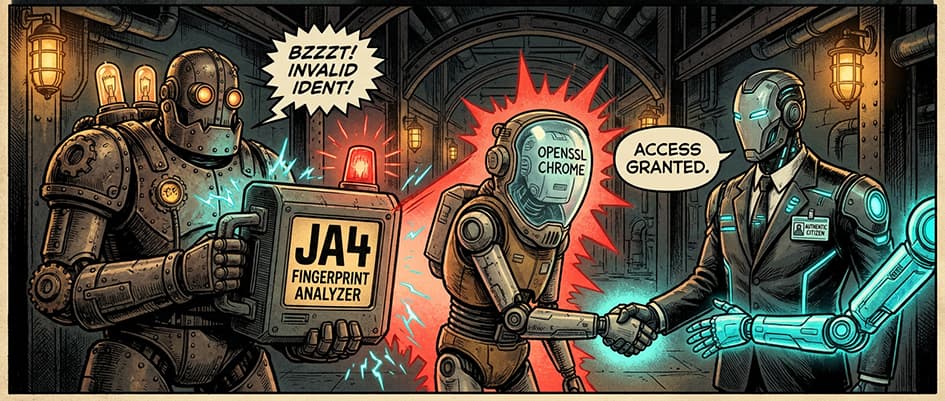
Last time, we mercilessly tore through corporate cybersecurity month theater and broke down why silly phishing tests don't actually stop real data leaks. Today, keeping strictly to our alternating schedule of real-world pain and engineering hardcore, we're diving back down to the level of bytes, cryptographic libraries, and network sniffers.
Let's talk about one of the subtlest and most ruthless traps in modern DPI: TLS fingerprinting and differences in cryptographic stack implementation on the client side.
Every other admin deploying a custom tunnel or proxy makes a classic rookie mistake: they take a standard OpenSSL-based client, wrap the traffic in TLS 1.3, slap it on port 443, and assume that to an external observer, they are completely indistinguishable from an ordinary user browsing a news feed in Google Chrome.
And then two days later, the channel starts crumbling: the connection drops right at the session establishment stage, speeds tank to zero, and the server gets flagged.
Where's the catch? The DPI didn't read the encrypted data. It simply compared your handshake fingerprint against a reference browser.
Under the TSPU Microscope: What Gives Away a Non-Standard Client
When a browser opens a secure website, it sends a Client Hello packet. This packet doesn't contain encrypted data yet—the client and server are just agreeing on the rules of the game. But those few hundred open bytes contain the complete pedigree of your software:
- Cipher Suites Order. The Google Chrome browser (powered by BoringSSL) offers ciphers in a strictly defined sequence optimized for the hardware acceleration of modern processors (such as ChaCha20-Poly1305 and AES-128-GCM). The OpenSSL library or the curl system stack builds this list completely differently. The filtering system calculates the JA3/JA4 hash in fractions of a microsecond. Doesn't match the legitimate browser database? Suspicion flag.
Extensions Set and Geometry (TLS Extensions). A real Chrome browser transmits a bunch of specific parameters: supported_groups, key_share, alpn (with a hardcoded list of h2, http/1.1 protocols), as well as Grease pseudo-random markers (Generate Random Extensions And Sustain Extensibility). Standard command-line utilities either don't support these extensions or pack them in a different order.
- Grease Values. Google Chrome intentionally inserts reserved garbage values (e.g.,
0x0a0aor0x1a1a) into the cipher and extension lists to verify that servers won't crash from unknown data. If yourClient Hellopacket claims a Chrome User-Agent, but lacks Grease bytes inside—for a DPI heuristic analyzer, that's a 100% fake.
The Architectural Dead End of Standard OpenSSL
Trying to mask a network tunnel using standard system libraries is a pointless endeavor:
- Strict Statics. OpenSSL wasn't designed to mimic other programs. Its fingerprint is stable, predictable, and instantly recognized by any signature analysis equipment.
- Application-Layer Mismatch. You can pass a
User-Agent: Mozilla/5.0...string in the HTTP header, but if the cryptographic handshake a layer lower screams "I'm a Python script using the urllib3 library," the TSPU backbone classifier instantly flags a discrepancy between OSI L4 and L7 layers. - TLS Version Patterns. Attempts to forcibly disable older protocol versions without properly configuring extensions often create a unique mathematical footprint (a JA4 hash) shared by one in a million devices. For anomaly analysis systems, this is an ideal target.
An Engineering Counter-Strike: Building Flawless Masking with uTLS
To make a private node session physically indistinguishable from a live human clicking a link in a browser, the handshake stack must be emulated at the source code level:
- Implementing the uTLS Library. Modern bypass protocol clients (Xray, Sing-box, Mihomo) have abandoned system SSL libraries in favor of a modified
uTLSfork (written in Go). This library allows clients to reproduce theClient Hellostructure of any target application down to the exact byte—right down to a specific Chrome build on Windows or Safari on iOS. - Dynamic Grease and Padding Emulation. A real browser stack pads the size of the initial handshake packet with a special Padding extension to hide the actual data length. Enabling the
chrome_autopreset in the client configuration ensures valid Grease values are generated along with the correct frame length. - ALPN (Application-Layer Protocol Negotiation) Synchronization. The client must negotiate the application-layer protocol strictly in accordance with the emulated browser's behavior. If you are masking as web traffic,
h2(HTTP/2) must take priority in ALPN, and the Flow Control Window size must precisely copy Chromium engine parameters.
In the era of deep statistical analysis, victory doesn't go to the one who encrypts the channel the strongest, but to the one whose handshake doesn't differ by a single bit from millions of ordinary users simply opening their morning news.